The Divine Stage

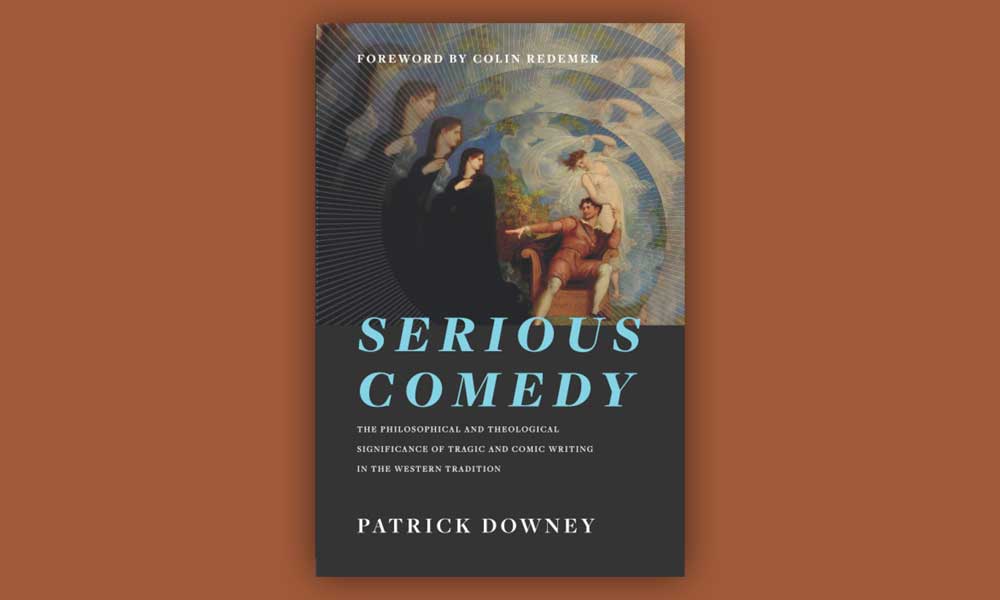
Serious Comedy: The Philosophical and Theological Significance of Tragic and Comic Writing in the Western Tradition by Patrick Downey

Davenant Press, 2022

(470 pages, $37.95, paperback)

Whereas most ancient civilizations produced some kind of national epic and expressed themselves in various forms of poetry, the ancient Greeks alone—and among them, the Athenians alone—gave birth to the democratic genre of tragedy. Performed once a year during a sacred festival to Dionysius, the fifth-century-BC tragedies of Aeschylus, Sophocles, and Euripides engaged their citizen-audiences in themes and issues that were at once political, philosophical, theological, ethical, and aesthetic.

About a century later, Aristotle, casting his eye back on the tragedies of the Golden Age of Athens, set himself the task of assessing the source of their power. In Poetics, he carefully enumerates the elements of a successful tragic plot and characters, climaxing with his influential theory about the pleasure unique to tragedy. To witness communally the dramatic power of, say, the Oedipus of Sophocles, he argues, is to experience a catharsis of one’s emotions of pity and fear.

Catharsis, a Greek word which is nearly always transliterated rather than translated into English, connotes both a purgation and a purification of pity and fear. Critics for the last 2,400 years have debated what exactly Aristotle meant by catharsis and what part pity and fear play in it. In Serious Comedy: The Philosophical and Theological Significance of Tragic and Comic Writing in the Western Tradition, Patrick Downey offers his own original and complex, if somewhat idiosyncratic and stilted, take on the nature of catharsis and the vital role it plays in the maintenance of democracy.

Downey, a professor in the Philosophy Department at St. Mary’s College of California, borrows key insights from the work of such diverse thinkers as Nietzsche, Leo Strauss, René Girard, Northrop Frye, and Paul Ricoeur. The result is an ambitious, interdisciplinary tour de force that offers some unexpected and challenging insights but sometimes paints with too broad a brush and often borders on incoherence. In what follows, I will attempt to piece together a mostly linear argument that highlights some of his more provocative interpretations of pre-Christian, Christian, and post-Christian literature.

An Inverse Insight

Downey begins by taking a straightforward view of pity and fear as emotions we feel when we encounter an incident that threatens our desire for a happy life free from the sudden catastrophe (Greek for “downturn”) that is dramatized on the tragic stage. In feeling pity for what befalls the hero, we are drawn toward him, while in feeling fear that the same thing might happen to us, we are pulled away.

Downey then asks the relevant questions: “Why should the tragic poet want to imitate or ‘re-present’ what is not at all pleasant in its initial presentation? If fear and pity are emotions that flow from the frustration of our desire for happiness, why should we want to experience them again?” (21). His preliminary answer is sound both aesthetically and psychologically:

Tragic catharsis is no more and no less than the presentation of mimetic images that cause us initially to fear and take pity, and yet finally cause us to lose, purge, or cast out those unpleasant and painful emotions because of the very pleasure we experience in seeing them as imitated rather than directly experienced. (22)


Louis Markos , Professor in English and Scholar in Residence at Houston Baptist University, holds the Robert H. Ray Chair in Humanities. His 19 books include Lewis Agonistes; Restoring Beauty: The Good, the True, and the Beautiful in the Writings of C. S. Lewis; On the Shoulders of Hobbits: The Road to Virtue with Tolkien and Lewis; and From A to Z to Narnia with C. S. Lewis.

A Journal of Mere Christianity—Delivered to Your Door

  • Essays on theology, culture, and the Church
  • Contributors from across the Christian traditions

Subscribe (Print + Online)

Six print issues (one year) of Touchstone, plus full online access and PDF downloads for only $39.95.

Subscribe (Online Only)

Get a one-year full-access subscription to the Touchstone online archives for only $19.95.


bulk subscriptions

Order Touchstone subscriptions in bulk and save $10 per sub! Each subscription includes 6 issues of Touchstone plus full online access to touchstonemag.com—including archives, videos, and pdf downloads of recent issues for only $29.95 each! Great for churches or study groups.

Transactions will be processed on a secure server.


more from the online archives
30.3—May/June 2017

Three Trojan Horses

Insider Attempts to Disorient the Orthodox by Alexander F. C. Webster

20.8—October 2007

Aliens in Zion

on Why I Can’t Be Just Another Earthman by Louis Markos

24.6—Nov/Dec 2011

Statutes of Liberty

on the Tyranny of Modern Freedom versus the Freedom of Jesus by Gillis J. Harp

calling all readers

Please Donate

"There are magazines worth reading but few worth saving . . . Touchstone is just such a magazine."
—Alice von Hildebrand

"Here we do not concede one square millimeter of territory to falsehood, folly, contemporary sentimentality, or fashion. We speak the truth, and let God be our judge. . . . Touchstone is the one committedly Christian conservative journal."
—Anthony Esolen, Touchstone senior editor

Support Touchstone

00