




Clergy Exposé
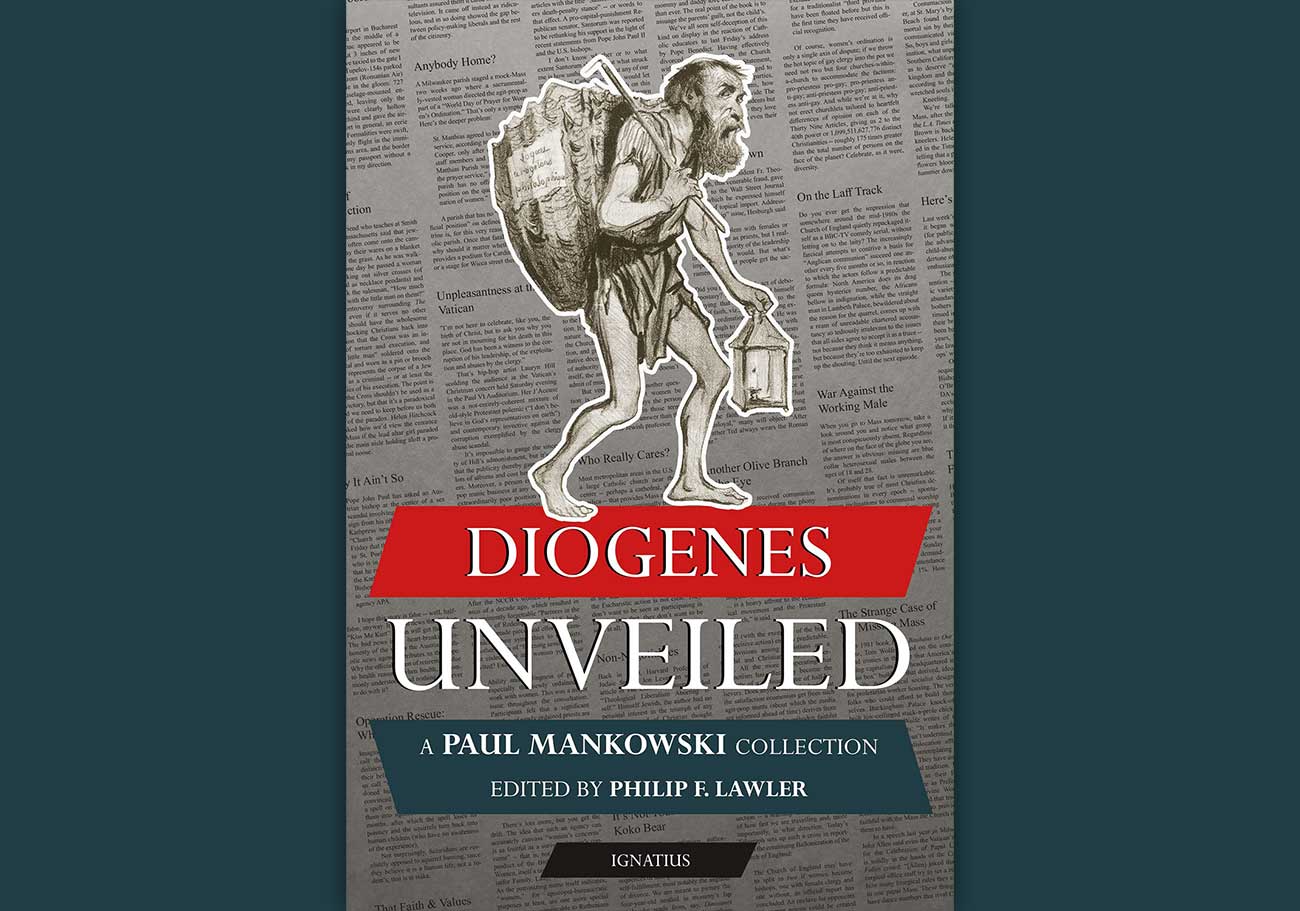
Diogenes Unveiled: A Paul Mankowski Collection edited by Philip F. Lawler
Father Paul Mankowski, S.J., died of a massive heart attack on September 3, 2020. He was not an old man. I know of no one in the world who has replaced him, or who could replace him. Many Catholic priests, a few of them Jesuits, are as faithful as Father Mankowski was, but I doubt that anyone has his combination of far-ranging and careful scholarship, his wide human experience outside of university halls, his deep sympathy with human beings of all classes, and his sharp pen and ready wit.
For many years, his order forbade him to publish articles on the Church under his own name, and he obeyed. Obedience is the arm-twist whereby the disobedient and the double-dealing deal with priests who are wiser and better than they are. Nevertheless, Mankowski did write under the moniker “Diogenes,” and his blog essays have been collected and edited by his friend and compatriot, Philip Lawler, in Diogenes Unveiled.
What Journalists Used to Be
Why “Diogenes”? The illustration on the book’s cover reminds us. Diogenes was that ancient Greek philosopher who, it was said, wandered about the world in rags, carrying a lantern, because he said he was searching for a single honest man. The parallel with Father Mankowski is precise and painful. For many of the essays have to do with the sex scandal that plagued the Church, and the venal, craven, self-serving, callous, and contemptible way her prelates dealt with it.
He was what journalists at their best used to be. He grabs hold of a clue and will not let it go; and the scholar in him was trained to hear what words say and what—more often when we are listening to politicians, whether they wear a clerical collar or not—words do not say, or unsay, attempting to mislead, to muffle, or to bury the truth.
The results are often shrewdly ironic, always invigorating. Take, for example, the time when Cardinal Roger Mahony of Los Angeles was accused of perjury. This was a man who, as Mankowski reports, could not “remember the two abuser priests he advised to leave the country,” or police reports he had received about one of the worst of the criminals. “We can go through hundreds of pages of testimony by [Cardinal Bernard] Law and Mahony without coming on a single instance where either their memory or their forgetfulness works to their disadvantage,” says Mankowski, and then adds, pointedly, “their personal disadvantage.” But perjury? Oh, never that. Mankowski cites Mahony’s spokesman, who says that “Cardinal Mahony has always insisted and always will insist that honesty always prevails when giving testimony under oath,” and that to ask any question about it is “insulting and unprofessional.”
“And unprofessional,” writes Mankowski, hanging them with their own rope. “Right.”
But what really separates Mankowski from a thousand other intelligent critics is his ability to enter the shabby souls of the priests involved. It is not enough for him to show that Mahony was lying. Mahony, he says, could not possibly believe in eternal damnation. For that is the substance of the oath in court. “If I am lying,” the oath compels you to say, “may God damn me.” Nor can you weasel out of it by the confessional, since the penitent must undo the harm by telling the truth. But, as many of the essays show, the people in the pews are often more likely than the priest at the altar to believe what the Church teaches. Indeed, some such priests pride themselves on giving pleasant scandal, undermining the faith of the people. Here is a short and pithy post, in toto:
I don’t get it. Father prances up the aisle surrounded by song, incense, and banners; spins, dips, counterspins, pirouettes into the sanctuary; holds the Book of the Gospels aloft in a rapture of exultation.
And then in his homily explains that the events recounted never really happened.
Anthony Esolen is Distinguished Professor of Humanities at Thales College and the author of over 30 books, including Real Music: A Guide to the Timeless Hymns of the Church (Tan, with a CD), Out of the Ashes: Rebuilding American Culture (Regnery), and The Hundredfold: Songs for the Lord (Ignatius). He has also translated Dante’s Divine Comedy (Random House) and, with his wife Debra, publishes the web magazine Word and Song (anthonyesolen.substack.com). He is a senior editor of Touchstone.
A Journal of Mere Christianity—Delivered to Your Door
- Essays on theology, culture, and the Church
- Contributors from across the Christian traditions

Six print issues (one year) of Touchstone, plus full online access and PDF downloads for only $39.95.

Get a one-year full-access subscription to the Touchstone online archives for only $19.95.
bulk subscriptions
Order Touchstone subscriptions in bulk and save $10 per sub! Each subscription includes 6 issues of Touchstone plus full online access to touchstonemag.com—including archives, videos, and pdf downloads of recent issues for only $29.95 each! Great for churches or study groups.
Transactions will be processed on a secure server.
more on Biography from the online archives
more from the online archives

31.1—January/February 2018
on Taking the Measure of the Deserving & the Undeserving Poor by Martin Bordelon

28.1—January/February 2015
on State Impositions & Church Acquiescence by Stephen Baskerville

17.6—July/August 2004
Old Science Confronts a Formidable Challenge in the Scientific ID Movement by Jay W. Richards
calling all readers
Please Donate
"There are magazines worth reading but few worth saving . . . Touchstone is just such a magazine."
—Alice von Hildebrand
"Here we do not concede one square millimeter of territory to falsehood, folly, contemporary sentimentality, or fashion. We speak the truth, and let God be our judge. . . . Touchstone is the one committedly Christian conservative journal."
—Anthony Esolen, Touchstone senior editor
