


Searching for Hope
A Tale Told in Music
by Calvin Stapert
In “Dover Beach” Matthew Arnold likened the recession of Christianity in the Western world to the “dull, melancholy roar” of the receding tide. By the time he wrote the poem (1867), the recession had long since been underway, and the eighteenth-century Enlightenment had given it increased momentum.
The Enlightenment was an optimistic movement that fostered the belief that man could achieve a better world solely with human resources—knowledge, science, and reason. An important product and producer of Enlightenment optimism was the 35-volume Encyclopédie (1751–1780). As Jacques Barzun pointed out in From Dawn to Decadence, “encyclopedia” means “the circle of teachings,” a fitting emblem for an age confident “that the new knowledge, the fullness of knowledge, was in its grasp and was a means of emancipation.” Samuel Taylor Coleridge called it a time when “hope sprang forth like a full-born Deity,” but that hope was dashed in the violent end of the French Revolution. The oppressed had become the oppressors. As Herman Melville put it in his preface to Billy Budd, “The Revolution itself had become a wrong doer, one more oppressive than the kings.”
Despair ensued. In The Revolt of Islam,Percy Bysshe Shelley called the years following the Revolution an “age of despair,” an age that had lost its hope for a world of liberty, equality, and fraternity, the watchwords of the Revolution. In his poem “Ozymandias,” he used the fallen statue of a mighty ruler to symbolize the futility of relying on human might. The poem ends with Ozymandias saying, “Look on my works, ye Mighty, and despair!”
But hope dies hard. As Emily Dickinson wrote, “‘Hope’ is the thing with feathers / That perches in the soul.” It even sings “in the Gale” and “on the strangest Sea.” Even so, when hope is based solely on human resources, the monster of despair will rear its ugly head sooner or later. Thomas Hardy’s “darkling thrush,” like Dickinson’s “thing with feathers,” sings despite the gloom and cold of winter. But Hardy saw nothing “written on terrestrial things / Afar or nigh aground” to account for the “blessed Hope” he heard in the bird’s “happy good-night air.”
Here I tell stories of the search for hope after Christian hope in Jesus had been jettisoned. I tell of post-Enlightenment searches for reasons to hope as they are reflected in major works of music from the early nineteenth century to the early twentieth.
Hope in a Great Hero: Beethoven, Symphony No. 3
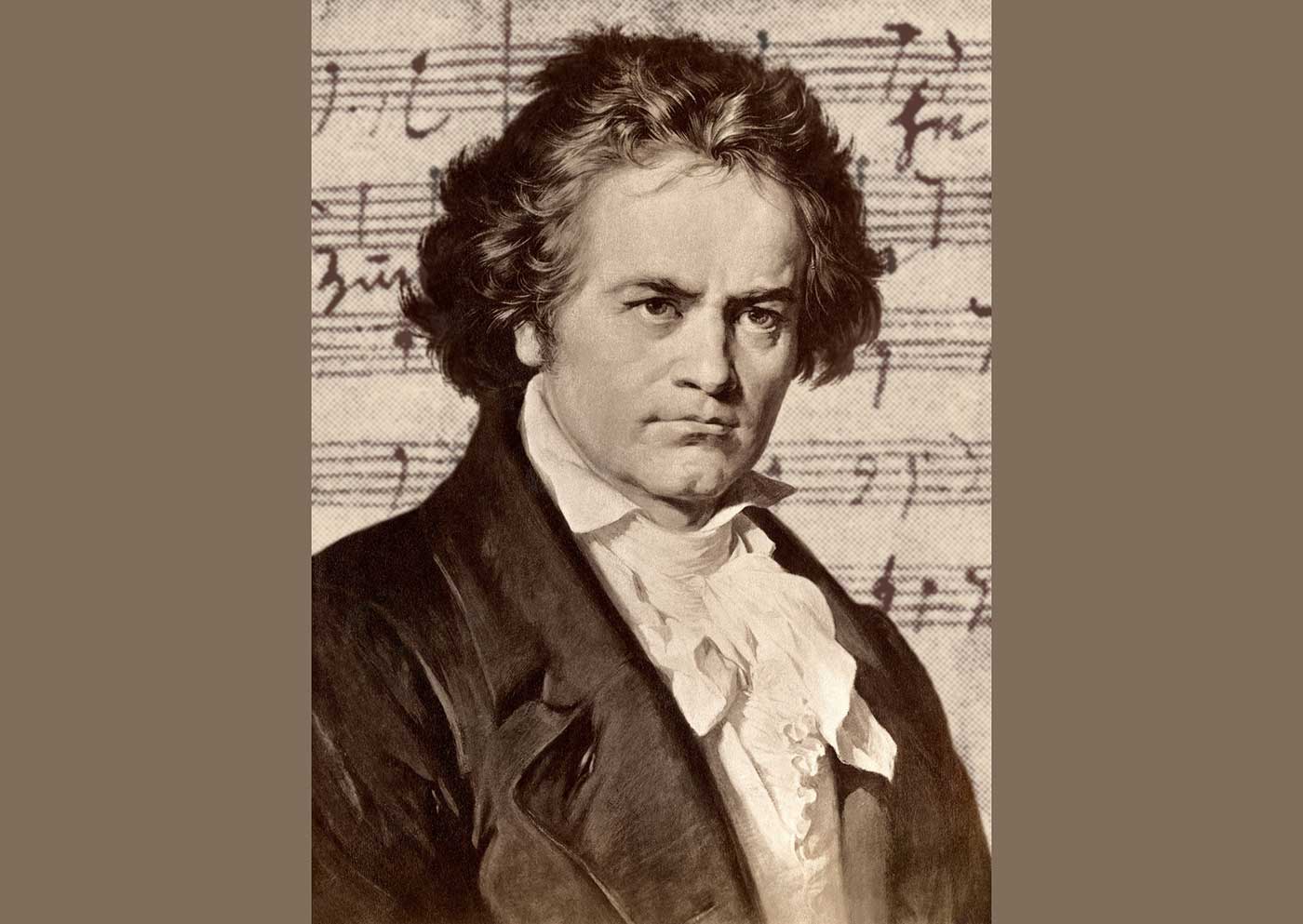
In the early decades of the nineteenth century, the decades following the French Revolution, two composers dominated the musical scene. A history of music published in 1835 called those decades “The Age of Beethoven and Rossini.” I would add Franz Schubert to that duo. His short life ended in 1828, just one year after Beethoven died and one year before Rossini wrote his last opera. Each of the three composers represents a different response to the discouragement that followed the violent end of the Revolution. Beethoven hoped against hope, Rossini “whistled past the graveyard,” and Schubert simply gave up and withdrew.
When Beethoven hymned “All men will be brothers” in his Ninth Symphony, it was not his first work to express Enlightenment hope. Musicologist Martin Geck writes that all of Beethoven’s symphonies “are a reflection of their composer’s claim to recreate the world using the resources of art.” Even if that is overstated, there can be little doubt that many of Beethoven’s works express the Enlightenment hope that light and freedom will overcome darkness and oppression. A generation after Beethoven, one commentator memorably described the Fifth Symphony as moving “through night to light, through struggle to victory”—an apt description of several other works as well.
In his Third Symphony, “Eroica,” Beethoven celebrated a hero he had hoped would fight valiantly for freedom from tyranny. The story behind the composition is well known. A friend of the composer, Ferdinand Ries, tells us that in writing this symphony Beethoven was thinking of Napoleon. At a gathering of friends, Ries saw the score lying on a table with “Bonaparte” inscribed at the top. When he told Beethoven that Napoleon had declared himself emperor, Beethoven “broke into a rage and exclaimed, ‘He will tread under foot all the rights of man!’” Although there are questions about Ries’s story, its basic thrust is confirmed by an autograph title page which reads, “Grand Symphony entitled Bonaparte.” But Beethoven scratched out “Bonaparte” so vehemently that he tore a hole in the paper. When the symphony was published, it was renamed Sinfonia eroica, and it bore the inscription, “composed to celebrate the memory of a great man.”
The first movement is perhaps the greatest artistic expression of optimistic Enlightenment hope for a better world achieved by heroic human effort. From the beginning the music establishes a pattern of struggle and triumph. Just ten notes in, a stable theme in Eb major is upset by a “wrong” C#. But within a few measures the conflict is resolved. What happens in small at the outset happens in large during the rest of the movement. Ever-mounting struggles eventually conclude in victory.
Calvin Stapert is Professor of Music Emeritus at Calvin College (now university). He holds a Ph.D. in musicology from the University of Chicago and has published five books, the latest being Playing Before the Lord: The Life and Work of Joseph Haydn (Eerdmans, 2014). He and his wife live in Grand Rapids, Michigan, and are members of the Church of the Servant (Christian Reformed). They have five children and thirteen grandchildren.
A Journal of Mere Christianity—Delivered to Your Door
- Essays on theology, culture, and the Church
- Contributors from across the Christian traditions
Six print issues (one year) of Touchstone, plus full online access and PDF downloads for only $39.95.

Get a one-year full-access subscription to the Touchstone online archives for only $19.95.
bulk subscriptions
Order Touchstone subscriptions in bulk and save $10 per sub! Each subscription includes 6 issues of Touchstone plus full online access to touchstonemag.com—including archives, videos, and pdf downloads of recent issues for only $29.95 each! Great for churches or study groups.
Transactions will be processed on a secure server.
more on Music from the online archives

33.3—May/June 2020
Bach's Cantata BWV 106, Gottes Zeit ist die allerbesteZeit (God's time is the very best time) by Ken Myers
more from the online archives

30.6—Nov/Dec 2017
Christ, Individualism & the Meaning of Cultural Diversity by Anthony Esolen

31.4—July/August 2018
on the Brevity & Theology of Her Recorded Words by Judith Anderson

32.6—November/December 2019
An Open Letter to Christian Readers of Jordan Peterson & Roger Scruton by James Bryson
calling all readers
Please Donate
"There are magazines worth reading but few worth saving . . . Touchstone is just such a magazine."
—Alice von Hildebrand
"Here we do not concede one square millimeter of territory to falsehood, folly, contemporary sentimentality, or fashion. We speak the truth, and let God be our judge. . . . Touchstone is the one committedly Christian conservative journal."
—Anthony Esolen, Touchstone senior editor