





Gifts for a Baby King
At the time of his birth, the Light of the world was acknowledged by only a handful of worshipers: a bedazzled congregation of shepherds and two pious souls, long watching and waiting for him in the temple.
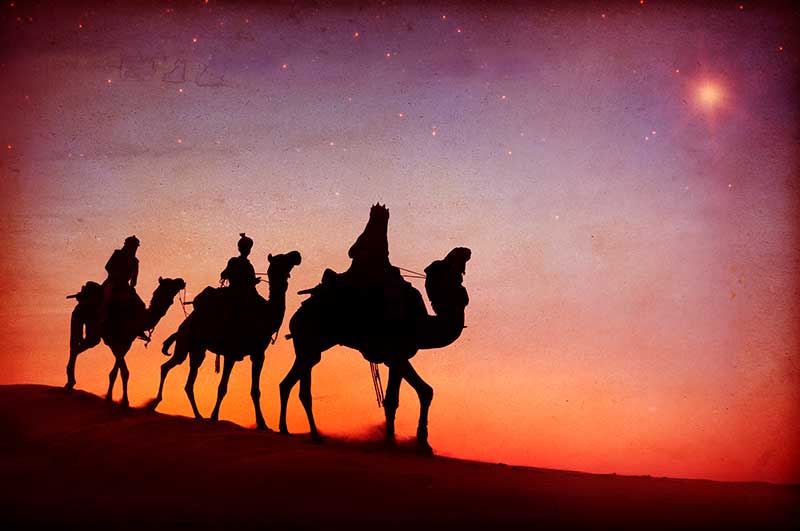
A bit later, coming “from the East,” the first Gentile worshipers of Christ arrived, fulfilling Isaiah’s prophecy that the Redeemer of Israel would be a light for the nations. These astrologers had seen a light in the sky that testified to the advent of the Light of the world. An eager expedition ensued, with the intention of paying homage to a new King. Their arrival in Judea is the first empirical evidence of the universal and global significance of a very particular and local event.
Since about the fourth century, in the Western church, the Feast of the Epiphany has commemorated the testimony implicit in the journey of the Magi, and a great deal of music has emerged from that attention. In Western churches, Epiphany has also included a celebration of Christ’s baptism and the first miracle at the wedding at Cana as well as the visit of the Magi. (In Eastern churches, Epiphany focuses on the baptism as the shining forth of God’s Trinitarian presence, as the Son assents to his humanity, the Father announces his pleasure at the Son, and the Spirit descends in the form of a symbol of peace.)
THIS ARTICLE ONLY AVAILABLE TO SUBSCRIBERS.
FOR QUICK ACCESS:
Ken Myers is the host and producer of the Mars Hill Audio Journal. Formerly an arts editor with National Public Radio, he also serves as music director at All Saints Anglican Church in Ivy, Virginia. He is a contributing editor for Touchstone.
A Journal of Mere Christianity—Delivered to Your Door
- Essays on theology, culture, and the Church
- Contributors from across the Christian traditions

Six print issues (one year) of Touchstone, plus full online access and PDF downloads for only $39.95.

Get a one-year full-access subscription to the Touchstone online archives for only $19.95.
bulk subscriptions
Order Touchstone subscriptions in bulk and save $10 per sub! Each subscription includes 6 issues of Touchstone plus full online access to touchstonemag.com—including archives, videos, and pdf downloads of recent issues for only $29.95 each! Great for churches or study groups.
Transactions will be processed on a secure server.
more on music from the online archives

33.3—May/June 2020
Bach's Cantata BWV 106, Gottes Zeit ist die allerbesteZeit (God's time is the very best time) by Ken Myers
more from the online archives

31.5—September/October 2018
The Rise of the Gnostic Liberal State After Christianity by Andrew Latham
31.6—November/December 2018
on Futility & the Open Door to Deliverance by Patrick Henry Reardon

18.3—April 2005
on Being a Free Narnian & the Joy of Subordination by Donald T. Williams
calling all readers
Please Donate
"There are magazines worth reading but few worth saving . . . Touchstone is just such a magazine."
—Alice von Hildebrand
"Here we do not concede one square millimeter of territory to falsehood, folly, contemporary sentimentality, or fashion. We speak the truth, and let God be our judge. . . . Touchstone is the one committedly Christian conservative journal."
—Anthony Esolen, Touchstone senior editor
