




How Do I Use Thee?
Every so often I get a letter from someone I don’t know, who would like me to give him a syllabus of things he might read to familiarize himself with English poetry. As often as not, the person writing to me has been an English major in college or something of the like.
What’s just as disappointing to me is to find that among those Christians who read a lot of books, very few of them know the slightest thing about sacred poetry in their own language. Perhaps we might lay the initial blame at the feet of modern poets, whose pursuit of obscurity and confusion—at first, as in T. S. Eliot, meant to reflect the confusion of a civilization in ruins—has declared, as with the howl of a beast or the garble of an academic, that poetry is not for ordinary people, who expect sentences to mean things, with clear subjects and verbs.
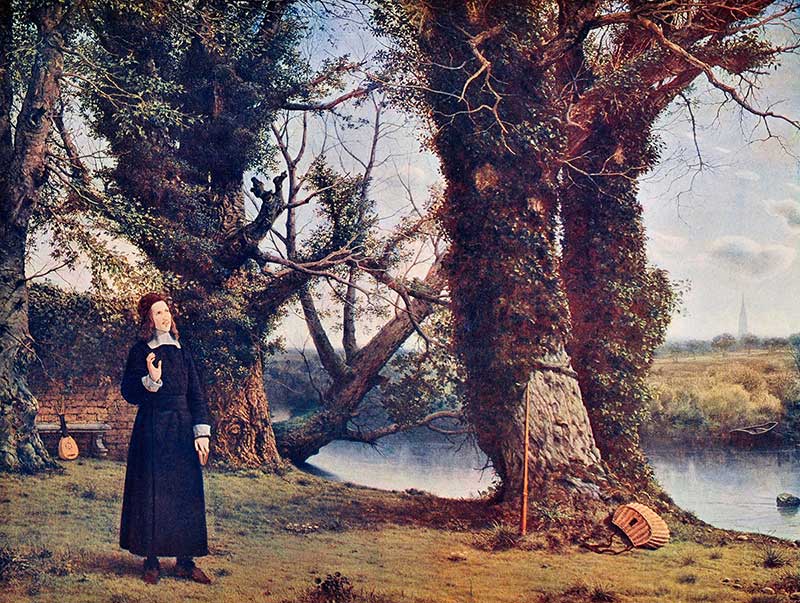
But eventually we must take care for our own heritage, especially as nobody else will do it. And that should be no onerous task; rather, a delight, the delight of unsuspected riches and recovery. So then, if you are a Christian and a reader—as you doubtless are, because otherwise you would not be reading these words—you should get for yourself, right away, a copy of the collected poems of George Herbert (1593-1633), the young courtier and member of Parliament who left the high life to become an Anglican priest in a poor and far-flung parish, dying of consumption before he turned forty. Such wealth, in so small a place! It may take you a couple of months to read The Brothers Karamazov. It will take you a few minutes to read one of Herbert’s poems, and the poem may remain with you all your life long.
How We Treat All Friends but One
Here, for example, is a poem called “Unkindness.” The word means what we mean by it, but it retains also an old sense that what is unkind is against Kind, that is, against Nature. For it is natural in us to treat our friends well, especially when we have reaped benefits from them. So the speaker in the poem does, with one most incomprehensible exception:
Lord, make me coy and tender to offend:
In friendship, first I think, if that agree,
Which I intend,
Unto my friend’s intent and end.
I would not use a friend, as I use Thee.
Has he not laid his finger on the open sore of our selfishness and ingratitude? We do what we like, and either we conveniently neglect to consider whether it accords with the will of our Lord, or we are satisfied if we can say at least that it is not in discord with it. We put ourselves first, and not our friend. How long would mere human friendship last in that condition?
The second stanza takes us into society, and how we treat the friend when others who are hostile to him are near:
If any touch my friend, or his good name,
It is my honor and my love to free
His blasted fame
From the least spot or thought of blame.
I could not use a friend, as I use Thee.
Do we stand up for the Lord? Not just from the safe distance of the internet, but face to face with someone who scoffs at him or, more frequently, at the often raffish and unpresentable people who worship him—when the form of the worship is not to our taste? Rather, how often do we win favor from the scoffers, by ensuring that we are not like the people we despise?
What about our earthly goods? It is easy, Herbert suggests, to be generous with the friend:
Anthony Esolen is Distinguished Professor of Humanities at Thales College and the author of over 30 books, including Real Music: A Guide to the Timeless Hymns of the Church (Tan, with a CD), Out of the Ashes: Rebuilding American Culture (Regnery), and The Hundredfold: Songs for the Lord (Ignatius). He has also translated Dante’s Divine Comedy (Random House) and, with his wife Debra, publishes the web magazine Word and Song (anthonyesolen.substack.com). He is a senior editor of Touchstone.
A Journal of Mere Christianity—Delivered to Your Door
- Essays on theology, culture, and the Church
- Contributors from across the Christian traditions
Subscribe (Print + Online) 
Six print issues (one year) of Touchstone, plus full online access and PDF downloads for only $39.95.
Subscribe (Online Only) 
Get a one-year full-access subscription to the Touchstone online archives for only $19.95.
bulk subscriptions
Order Touchstone subscriptions in bulk and save $10 per sub! Each subscription includes 6 issues of Touchstone plus full online access to touchstonemag.com—including archives, videos, and pdf downloads of recent issues for only $29.95 each! Great for churches or study groups.
Transactions will be processed on a secure server.
more on poetry from the online archives
37.5—Sept/Oct 2024
A Battle Plan for Peace While Growing Old by Anthony Esolen
more from the online archives
29.3—May/June 2016
A Deathbed Reflection on Catholic Social Teaching & Our Future Prospects by Karl D. Stephan


31.2—March/April 2018
The Transmission of Christianity Is Not a New Task by Nathanael Devlin
calling all readers
Please Donate
"There are magazines worth reading but few worth saving . . . Touchstone is just such a magazine."
—Alice von Hildebrand"Here we do not concede one square millimeter of territory to falsehood, folly, contemporary sentimentality, or fashion. We speak the truth, and let God be our judge. . . . Touchstone is the one committedly Christian conservative journal."
Support Touchstone
—Anthony Esolen, Touchstone senior editor
