




Mandelbrot Set
The Cascading Beauty of Fractals in C. S. Lewis, Scripture & Art
A classic four-frame Peanuts comic strip from 1960 begins with a panel showing the character Lucy van Pelt looking off to the side and saying, "That's really kind of disillusioning." In the second frame, Charlie Brown walks up to her and asks, "What's the matter?" In the third frame, as Lucy and Charlie both look at something off-screen, Lucy replies, "Snoopy isn't as smart as I thought he was." In the final panel, Snoopy, in the foreground, is looking down with pursed lips at a book lying open on the floor. In the background, Lucy says to Charlie Brown, "He moves his lips when he reads!"
The wry disconnect between Lucy's notion of intelligence and reading ability, given Snoopy's canine status, is palpable. She seems to discern only one level of awareness. But I would suggest that this sort of disconnect is wide-ranging in real life, and ironically even can be found among scientists and mathematicians, whose goal, almost by definition, is to "step back" in order to see multiple levels from "outside" the confines of a particular level. All of us can at times be as seemingly clueless and unaware of different levels as Lucy is in the comic strip.
Another Lucy, one of the four Pevensie children and a primary character in several of C. S. Lewis's Narnian books, expresses, in contrast, actual recognition of levels in a different context. In a scene near the end of the final book, The Last Battle, the protagonists are thrust, seemingly to their death, into a small stable in Narnia, only to discover a whole world within. Lord Digory then observes, "Its inside is bigger than its outside," and Lucy replies, "Yes, in our world too, a stable once had something inside it that was bigger than our whole world."
Lucy Pevensie's prescient recognition of levels of awareness about the situation she and her friends were thrust into is also palpable—in the opposite direction from Lucy van Pelt's. That single line was enough to be—with prodding by the Holy Spirit, certainly—one of the primary factors in my own dark-night conversion to Christianity during my college years. It was something that my courses as a college mathematics major somehow hadn't led me to notice before.
Three Primary Qualities
I once saw a charming container sitting on top of a business office desk. It was shaped like a giant, silver-foil-wrapped Hershey's chocolate Kiss. The pointy tip of the container formed the lid. Removing the lid revealed the container to be a candy dish filled, as one might guess, with little silver-foil-wrapped Hershey's chocolate Kisses. The first thought of my inner mathematician child upon seeing the contents was, "Huh—a two-level fractal!" In lighthearted fashion, I immediately imagined the chocolate Kisses to be conscious chocolate beings clothed in tin-foil hats, completely unaware that they were the lower part of a two-level chocolate Kiss fractal (whether the inner mathematician child recognized itself as the lower part of a two-level fractal of personalities with me is another question).
The word fractal, coined by Benoit Mandelbrot in 1975 for shapes described as self-similar, originally had a technical and complex mathematical definition, and there was a precise method for determining the "fractional dimension" of "self-similar" shapes. But the meaning and understanding of the term was later expanded to include a variety of artistic and visual images, along with an aesthetic, that portray a broader sense of self-similarity in general. (Mandelbrot himself eventually described the term simply as "a shape made of parts similar to the whole in some way.")
I have often described fractals as objects that exhibit three primary qualities—complexity, variety, and structure (or composition)—each and all of which are embedded at different levels of magnification. In theoretical mathematical models, such as the Mandelbrot Set, the levels of complexity can literally reach infinitely deep within the set, but there are myriad physical examples whose multiple levels of similarity are finite.
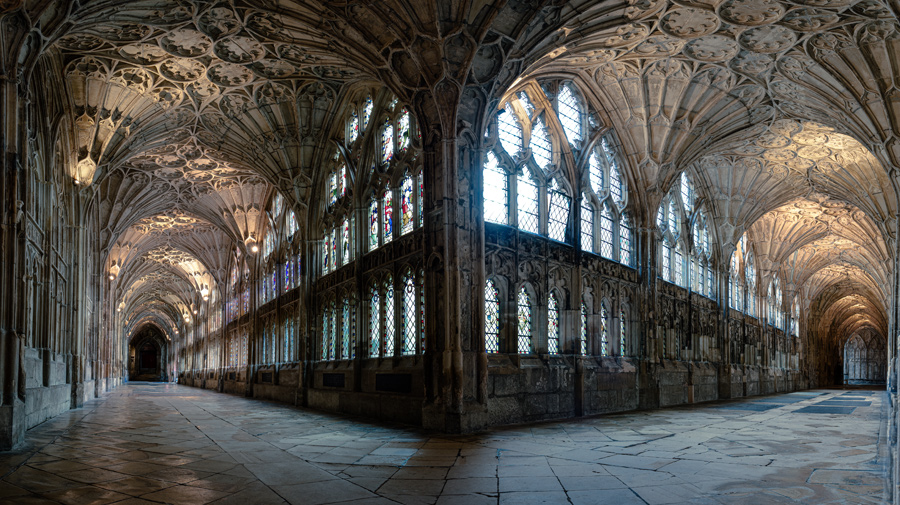
Three of my favorite concrete examples, in different branches of art, display a satisfyingly fractal nature several layers deep: the complex architectural designs of arches-within-arches-within-arches in a medieval cathedral; the variety and invention of musical themes-within-themes-within-themes of a Beethoven symphony (the Seventh, followed closely by the Fifth, are my favorite musical examples of this fractal quality); and the composition and structure seen in virtually any portion, tiny or large, of Jan van Eyck's painting The Arnolfini Wedding. In fact, I have suggested that the degree to which "great art" is great is largely (but not exclusively) dependent on how "deep" the levels of this fractal quality go.
A Larger Notion of Fractalness
Stanley E. Anderson holds a degree in mathematics and has worked in data analysis, IT, and quality assurance in the aerospace industry. He and his wife are converts from Anglicanism to the Catholic Church.
A Journal of Mere Christianity—Delivered to Your Door
- Essays on theology, culture, and the Church
- Contributors from across the Christian traditions

Six print issues (one year) of Touchstone, plus full online access and PDF downloads for only $39.95.

Get a one-year full-access subscription to the Touchstone online archives for only $19.95.
bulk subscriptions
Order Touchstone subscriptions in bulk and save $10 per sub! Each subscription includes 6 issues of Touchstone plus full online access to touchstonemag.com—including archives, videos, and pdf downloads of recent issues for only $29.95 each! Great for churches or study groups.
Transactions will be processed on a secure server.
more on C. S. Lewis from the online archives

19.6—July/August 2006
The Three-Fold Cord of Imagination, Reason & Will in C. S. Lewis by Michael Ward
33.2—March/April 2020
Lewis, Chesterton, et al. Against the Frauds, Experts & Revisionists by Vigen Guroian

more from the online archives

31.2—March/April 2018
The Transmission of Christianity Is Not a New Task by Nathanael Devlin
calling all readers
Please Donate
"There are magazines worth reading but few worth saving . . . Touchstone is just such a magazine."
—Alice von Hildebrand
"Here we do not concede one square millimeter of territory to falsehood, folly, contemporary sentimentality, or fashion. We speak the truth, and let God be our judge. . . . Touchstone is the one committedly Christian conservative journal."
—Anthony Esolen, Touchstone senior editor
