




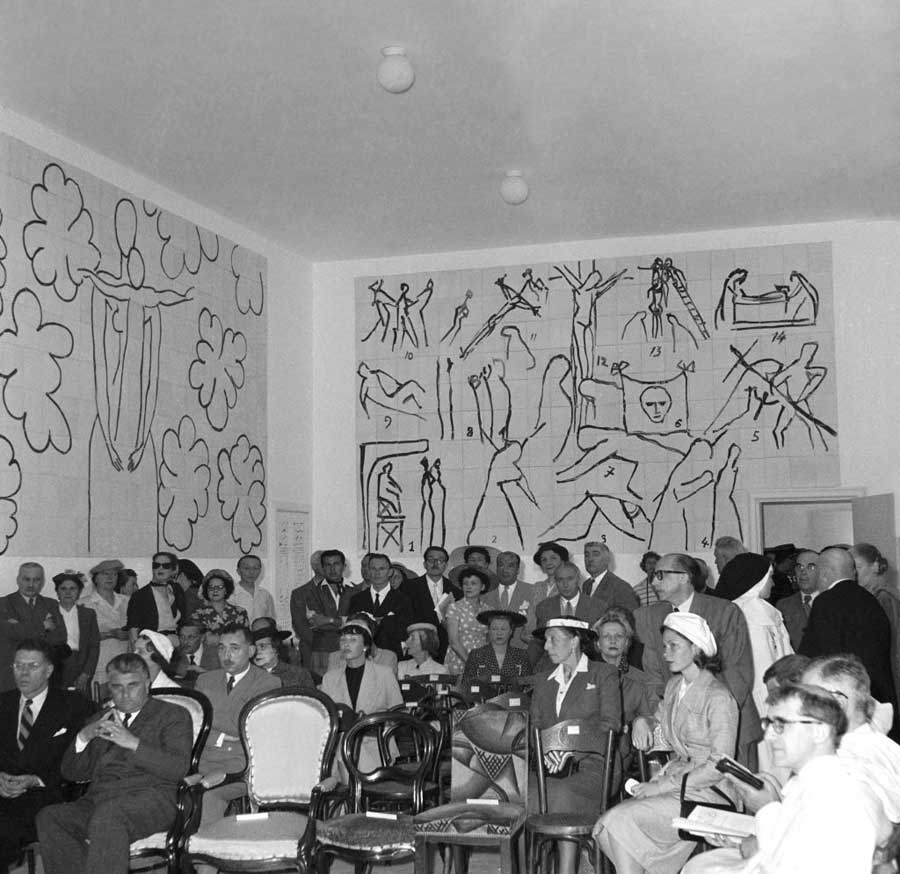
Henri Matisse's Chapel of the Rosary, Part 2
by Mary Elizabeth Podles
Matisse next turned his hand to the Ave mural, an image of the Madonna, to whom the rosary is addressed. He tried out images from the Litany of Loreto, which is generally recited after the rosary and evokes the Virgin in lyrical terms ("Mystical rose, Tower of David, Tower of ivory, House of gold, Ark of the covenant, Gate of heaven, Morning star"). One drawing, illustrating the phrase "Vessel of honor," makes a curious vase shape of Mary's dress; Matisse abandoned that design as unsuccessful. In the end, he settles upon "Queen assumed into heaven," at first surrounded by roses, but in the final version by clouds.
Matisse was deeply impressed by his first plane ride, and it has been suggested that these clouds are a memory of that flight. Within the clouds, Mary presents the infant Jesus to us like a baby standing proudly for the first time, but also in the pose of the Crucifixion, so that the mystery of the Incarnation also includes that of the Passion. Yet it is a visionary and eternal image, like that of St. Dominic, levitating without ground lines or perspective.
THIS ARTICLE ONLY AVAILABLE TO SUBSCRIBERS.
FOR QUICK ACCESS:
Mary Elizabeth Podles is the retired curator of Renaissance and Baroque art at the Walters Art Museum in Baltimore, Maryland. She is the author of A Thousand Words: Reflections on Art and Christianity (St. James Press, 2023). She and her husband Leon, a Touchstone senior editor, have six children and live in Baltimore, Maryland. She is a contributing editor for Touchstone.
A Journal of Mere Christianity—Delivered to Your Door
- Essays on theology, culture, and the Church
- Contributors from across the Christian traditions

Six print issues (one year) of Touchstone, plus full online access and PDF downloads for only $39.95.

Get a one-year full-access subscription to the Touchstone online archives for only $19.95.
bulk subscriptions
Order Touchstone subscriptions in bulk and save $10 per sub! Each subscription includes 6 issues of Touchstone plus full online access to touchstonemag.com—including archives, videos, and pdf downloads of recent issues for only $29.95 each! Great for churches or study groups.
Transactions will be processed on a secure server.
more from the online archives
25.3—May/Jun 2012
Calls for Freedom, Democracy & Secularism End Up with None of the Above by Hunter Baker
calling all readers
Please Donate
"There are magazines worth reading but few worth saving . . . Touchstone is just such a magazine."
—Alice von Hildebrand
"Here we do not concede one square millimeter of territory to falsehood, folly, contemporary sentimentality, or fashion. We speak the truth, and let God be our judge. . . . Touchstone is the one committedly Christian conservative journal."
—Anthony Esolen, Touchstone senior editor
