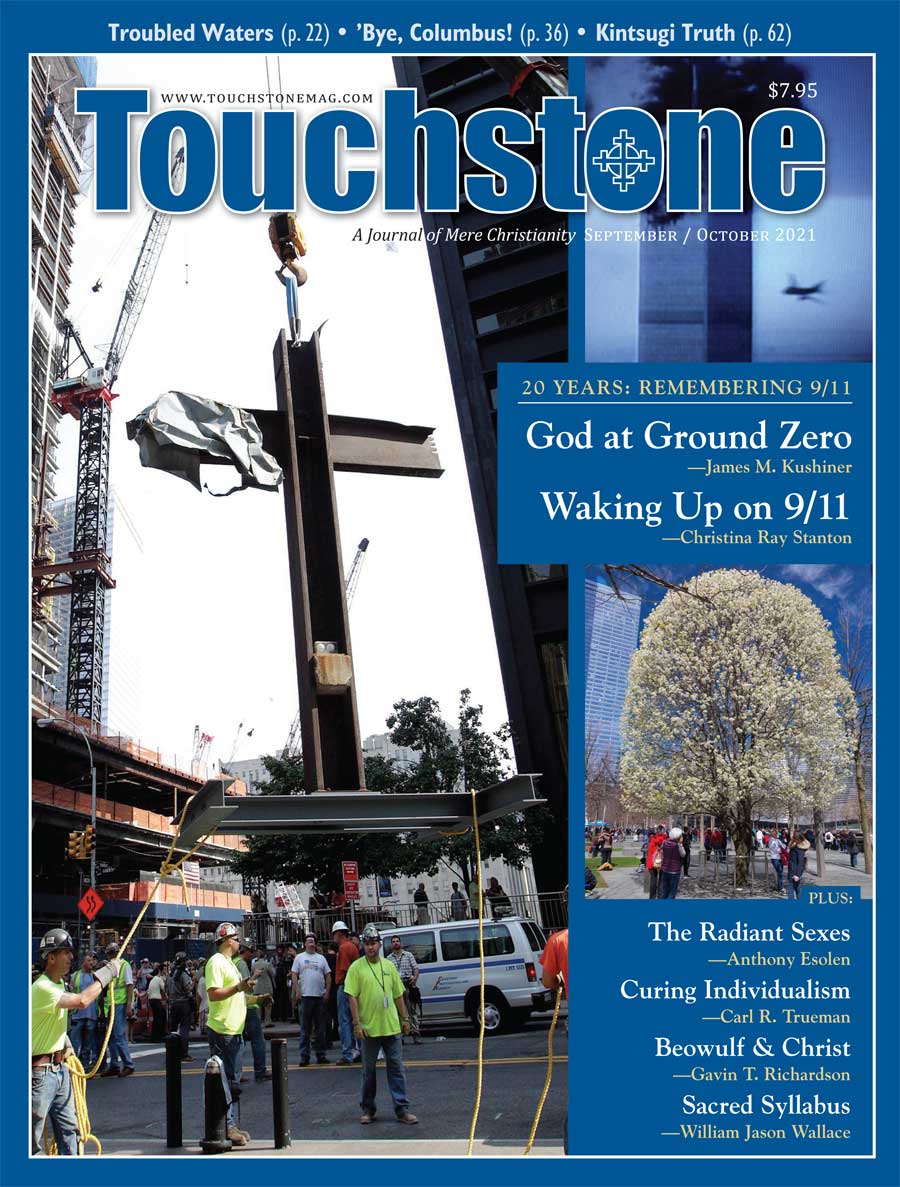
Sacred Syllabus by William Jason Wallace

Sacred Syllabus

The Case for Authentic Christian Higher Education

In the third decade of the twenty-first century a host of questions surround the future of Christian higher education. The questions are not new, but the implications of the answers are different in important ways. Both the cost and the purpose of higher education have changed. By and large, the older philosophical functions of university life have permanently yielded to pragmatism, and the cost is exorbitant. Christian higher education competes in a difficult marketplace, and the concomitant problem of Christian identity is attenuated in that market.

Just so, answers are needed. What are the benefits of Christian higher education, given other available options? Is the transmission of knowledge in a Christian university different from that in non-sectarian universities? What is the distinctive or added value in attending a Christian college or university?

Easy answers to these questions are elusive, but reckoning with them is necessary to make sense of how the idea of Christianity comports with the idea of modern higher education. One option, albeit an unpopular one, is for those who work in Christian higher education to concede that Christianity and modern assumptions about academic freedom and human freedom are simply not compatible, and that this incompatibility is the necessary boundary that gives Christian higher education its distinct purpose.

Without this boundary, as scholars such as Mark Noll, George Marsden, Mark Schwehn, and James Schall have shown, Christian higher education becomes untenable. If academic freedom translates into interminable speculation about human nature, the natural order, and God, then it is a freedom in conflict with Christianity. Moreover, if Christian higher education prioritizes its purpose around pragmatic utility, it will lose both its constituency and its raison d'etre.

Christians confess their faith within boundaries of inherited authority. The Apostle Paul indicates as much when he uses the language of bondage and freedom to explain the meaning of human experience and Christian identity. His language is of possession, of insider and outsider, of a status of transformed being, of one reality replaced by another. According to the apostle, a Christian's eternal condition changes through spiritual appropriation of the gospel, or justification, and also in terms of final and ultimate reality, the eschatological.

Christians are not self-possessed or self-determined. Their confession of faith begins with the life, work, death, and Resurrection of Christ, and is confirmed by the apostolic witness to his life, work, death, and Resurrection. The facts and miracles of Christ are the testimony the first Christians confessed as true. The ancient Church continued this testimony by organizing and clarifying these facts and miracles into summary statements, or creeds. This is what confessions do; they organize and clarify what is already present in Scripture and the apostolic witness. They are statements of belief. Nowhere do they abrogate mystery, feelings, emotions, or experiences. But neither do they allow them complete freedom. Without facts demarcated and governed by Scripture and confession, Christianity is without content, and so, too, is Christian education.

Christian claims about human nature and human need do not change if one argues that Christianity is not a univocal faith, that it has multiple manifestations and multiple meanings, or that it is simply a product of a particular time and place and in need of new expression to remain relevant. Arguments such as these are old, with advocates in the ancient world, the European Enlightenment, the American modernist controversies of the late nineteenth and early twentieth centuries, and, more recently, in "post-evangelical" appeals to "ambiguity" or "messiness" as balm for the scars of an unmerciful fundamentalism. Such arguments have either rejected confessional Christianity in favor of new idioms for the historical faith, or they have given up on Christianity altogether.

New idioms, however, that replace scriptural and apostolic witness with the metaphorical, the aesthetic, the existential, and the ineffable arguably change the content of Christianity such that it becomes unrecognizable on any pattern of orthodoxy. When this happens, the new idioms and expressions may be quite creative and even elegant, they may find adherents who prove likable and moral, but as a matter of belief, they are no longer Christian. Something else has been wrought.

Authority & Boundaries

The something else is the great rift that resulted in an irreparable shift in how many in Christian higher education understand authority. For those suspicious of the historical reliability of the testimony of Scripture, as well as of basic doctrines emerging from Scripture, to which the Catholic Church, the Eastern Orthodox Church, and, historically at least, a large majority of Protestant churches are agreed, Christianity may be morally useful, but it is not authoritative. Because it is no longer authoritative, reason and experience are freed from the normative claims of the Bible and the Church. Once "liberated," the intellect may criticize with the impunity of methodological doubt.

This approach to Christianity, and to knowledge in general, permanently changed Christian higher education. In yielding to the modern transformation of knowledge and authority, and to the accompanying reduction of confession to ethics, Christian colleges and universities have either met their Waterloo in outright defeat, met their Saigon in chaotic retreat, or, worst of all, met their version of Vichy in claiming a defiant faithfulness while cooperating with anti-Christian forces when tempted with relevance or respectability.


A Journal of Mere Christianity—Delivered to Your Door

  • Essays on theology, culture, and the Church
  • Contributors from across the Christian traditions

Subscribe (Print + Online)

Six print issues (one year) of Touchstone, plus full online access and PDF downloads for only $39.95.

Subscribe (Online Only)

Get a one-year full-access subscription to the Touchstone online archives for only $19.95.


bulk subscriptions

Order Touchstone subscriptions in bulk and save $10 per sub! Each subscription includes 6 issues of Touchstone plus full online access to touchstonemag.com—including archives, videos, and pdf downloads of recent issues for only $29.95 each! Great for churches or study groups.

Transactions will be processed on a secure server.


more on education from the online archives
18.6—Nov/Dec 2005

Lesson Plan

on Fifteen Principles of Christian Parenting by Paige Patterson

24.5—Sept/Oct 2011

Pupils Delighted

on Wondering or Wandering Through College Education by Anthony Esolen

27.2—March/April 2014

Poetry Above Compulsion

Higher Education Should Advance the Glorious Liberty of the Sons of God by Anthony Esolen


more from the online archives

33.1—January/February 2020

Do You Know Your Child’s Doctor?

The Politicization of Pediatrics in America by Alexander F. C. Webster

16.5—June 2003

The Truth About Men & Church

on the Importance of Fathers to Churchgoing by Robbie Low

22.6—July/August 2009

Samurai Bioethics

on a Noble Defense Doomed by Darwinian Materialism by John G. West

calling all readers

Please Donate

"There are magazines worth reading but few worth saving . . . Touchstone is just such a magazine."
—Alice von Hildebrand

"Here we do not concede one square millimeter of territory to falsehood, folly, contemporary sentimentality, or fashion. We speak the truth, and let God be our judge. . . . Touchstone is the one committedly Christian conservative journal."
—Anthony Esolen, Touchstone senior editor

Support Touchstone

00