Troubling the Waters by Korey D. Maas

Troubling the Waters

The subtleties of sacramental theology rarely make headlines, even in the Christian press. It was therefore something of an anomaly when, in late August of last year, local, national, and even international outlets hurriedly published articles attempting to explain the intricacies of sacramental "form," "matter," "intention," and "validity." The immediate impetus for this sudden and surprising interest was (as a Detroit Free Press headline announced) the revelation that a "Catholic priest finds his baptism was invalid."

That priest was Father Matthew Hood, who'd had good reason to believe he'd been baptized thirty years earlier. Indeed, in April of last year he'd actually watched a video of the ceremony. Though he noticed then that the deacon administering the rite had said, "We baptize you" instead of the more familiar "I baptize you," local superiors assured him that he could presume his baptism was valid.

But less than four months later—and with no obvious connection to his own case—the Vatican officially declared that such baptisms were not in fact valid. It suggested that any use of the plural pronoun arose from "debatable pastoral motives," and that the intention "to express the participation of the family and of those present" might obscure the confession that "when a man baptizes it is really Christ Himself who baptizes." Because the baptizing minister acts as the "sign-presence" of Christ, it was explained, he may not instead "declare that he is acting on behalf of the parents, godparents, relatives or friends."

Ripple Effect

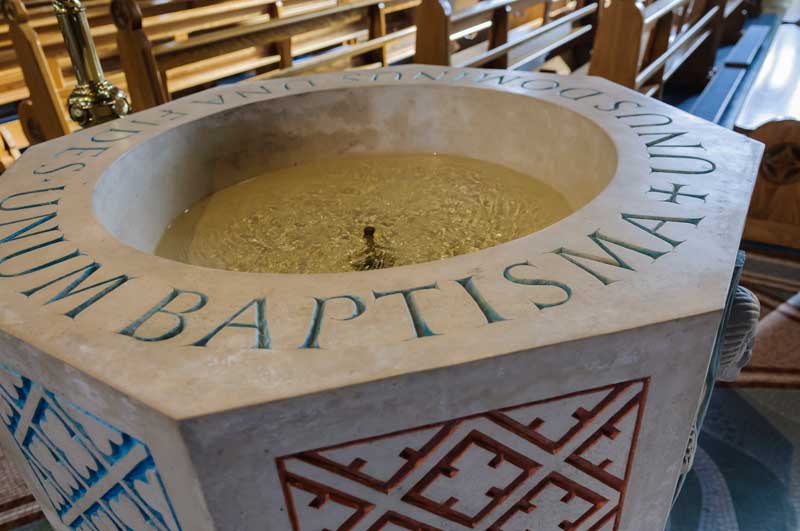
Despite the Catholic particulars of Father Hood's case, the fundamental question it raises—What are the necessary criteria by which a "true" baptism is recognized?—is hardly an exclusive concern of the Catholic Church. Despite some disagreement about what those criteria might be (and even more vehement disagreement about the actual nature and effects of baptism), the various Christian traditions fully agree that there are criteria. And though they may not invoke the technical vocabulary of form and matter, all clearly operate with the concepts conveyed by such terms. Regardless of your affiliation, for example, if you were "baptized" at the beach, but with the sand found there rather than the water, you're going to want to speak with your pastor. And even if water was applied, but in the name of Thor, Odin, and Loki, you'll definitely want to talk to your minister.

Though clearly (or at least hopefully) absurd, such examples illustrate what all Christian communities implicitly understand: both the "material" element and the verbal "formula" of a baptism matter. Whatever intractable differences exist between Baptists, Methodists, Lutherans, and others, each would surely conclude that the hypothetical instances above could not be deemed Christian baptisms.

That being the case, though, the specifically Catholic context of Father Hood's case did entail further implications. Because Catholicism understands baptism to be a prerequisite for reception of the church's other sacraments, the invalidity of his baptism in 1990 meant that his 2017 ordination to the priesthood was also deemed invalid. So too, therefore, were many of the sacraments he had himself administered in two parishes over the next three years. This ripple effect, then, more fully explains the anomalous press coverage, as Catholic media especially attempted to alert readers to the possibility that certain sacraments they'd received might have been invalid, to clarify when and why this might be the case, and to explain what steps should be taken by concerned individuals.

Claims & Clarifications

Such attempts to clarify the doctrine, practice, and implications of holy baptism were, of course, entirely laudable. Unfortunately, however, many of those same attempts might actually, if unwittingly, have introduced further confusion. Because use of the plural "we" was deemed to have rendered Father Hood's initial baptism invalid, a number of commentators concluded that the proper form requires the use of the singular "I." Readers were regularly informed that the "correct formula" includes the words, "I baptize you."
Some authors more emphatically spoke of "the required 'I baptize you'" and suggested that the rite "requires pure water and the proper form—the word 'I.'" Archbishop Allen Vigneron of Detroit, whose August 23rd "Letter to the Faithful" first brought Father Hood's situation into public view, likewise referred to "the proper words (formula)" being "I baptize," and explained that "ministers must allow Jesus to speak through them and say, 'I baptize you'" (emphases in original). In an essay explaining "Why the Words of Baptism Matter," Father Hood himself expressed the same, writing that the Vatican's Congregation for the Doctrine of the Faith (CDF) had clarified that the form of a valid baptism "must be 'I baptize you'."

Despite the good intentions guiding such claims, they remain problematic in a number of respects. Most immediately, they do not accurately represent the CDF's Responsum, the document that formally confirmed the invalidity of Father Hood's baptism. More significantly, any assertion that the word "I" is essential to the baptismal formula is, in fact, mistaken. Finally, if it were actually the case that valid baptisms did require use of the singular pronoun, the ramifications would be devastating not only for the church catholic, but for the Catholic Church herself.

Though the CDF Responsum clarified that Rome does not recognize the validity of baptisms conferred with the plural pronoun, it did not go on explicitly to state that the singular pronoun is a necessary component of the baptismal formula. To be sure, the appended doctrinal note's regular use of the definite article in references to "the form," "the sacramental formula," and "the formula handed down by Tradition" might incline one to infer that there is indeed (in the words of the early twentieth-century Catholic Encyclopedia) a "sole valid form of baptism," and that it must therefore be that with which most are familiar, that which includes the word "I."

If the CDF had intended to confirm the necessity of the singular pronoun, however, it certainly could have done more than leave readers to infer as much; it could have made this point explicit. That it refrained from doing so is almost certainly not accidental; indeed, the best explanation for its not having done so is that the Congregation recognized that it is simply not true. Indeed, even the Catholic Encyclopedia's blunt assertion that "the requisite and sole valid form of baptism is: 'I baptize thee'" is immediately qualified with a parenthetical "or 'This person is baptized.'"

Absurd Conclusion

This is not mere pedantry. "This person is baptized . . ." or "N. is baptized . . ." has been the common baptismal formula of the Eastern Orthodox Church since at least the fifth century. Any assertion of a "required 'I baptize you'" would thus implicitly deny the validity of nearly all Eastern baptisms, past and present. The implications of such a conclusion would vastly and obviously overshadow those of Father Hood's own invalid baptism. Allowing that baptism is "the door which gives access to the other sacraments," virtually no Eastern ordinations could be recognized as valid; nor, therefore, could the vast majority of Orthodox Eucharistic celebrations.


Korey D. Maas is an associate professor of history at Hillsdale College in Hillsdale, Michigan.

A Journal of Mere Christianity—Delivered to Your Door

  • Essays on theology, culture, and the Church
  • Contributors from across the Christian traditions

Subscribe (Print + Online)

Six print issues (one year) of Touchstone, plus full online access and PDF downloads for only $39.95.

Subscribe (Online Only)

Get a one-year full-access subscription to the Touchstone online archives for only $19.95.


bulk subscriptions

Order Touchstone subscriptions in bulk and save $10 per sub! Each subscription includes 6 issues of Touchstone plus full online access to touchstonemag.com—including archives, videos, and pdf downloads of recent issues for only $29.95 each! Great for churches or study groups.

Transactions will be processed on a secure server.


more on Christianity from the online archives
30.2—March/April 2017

The Cross of Least Resistance

Our Path to Holiness Runs Straight Through Calvary by Robin Phillips

32.4—July/August 2019

A Case of Win-Win

on Probability, Death & the Existence of God by Graeme Hunter

33.3—May/June 2020

Deliberation, Inc.

Human & Divine Societies Require Careful Thought & Discourse by Anthony Esolen


more from the online archives

5.3—Summer 1992

The Bible Tells Me So

Everything You Need to Know About Morality & the Bible by David Mills

18.8—October 2005

Vanishing Sea of Faith

European Islam & the Doubtful Future of Christian Europe by William Murchison

19.10—December 2006

God Rest Ye Merry

by Wilfred M. McClay

calling all readers

Please Donate

"There are magazines worth reading but few worth saving . . . Touchstone is just such a magazine."
—Alice von Hildebrand

"Here we do not concede one square millimeter of territory to falsehood, folly, contemporary sentimentality, or fashion. We speak the truth, and let God be our judge. . . . Touchstone is the one committedly Christian conservative journal."
—Anthony Esolen, Touchstone senior editor

Support Touchstone

00