




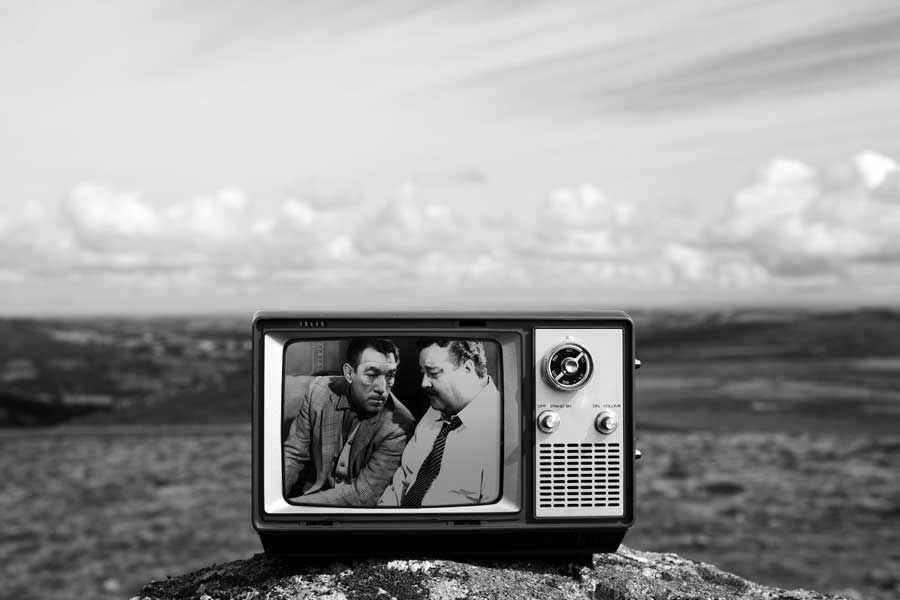
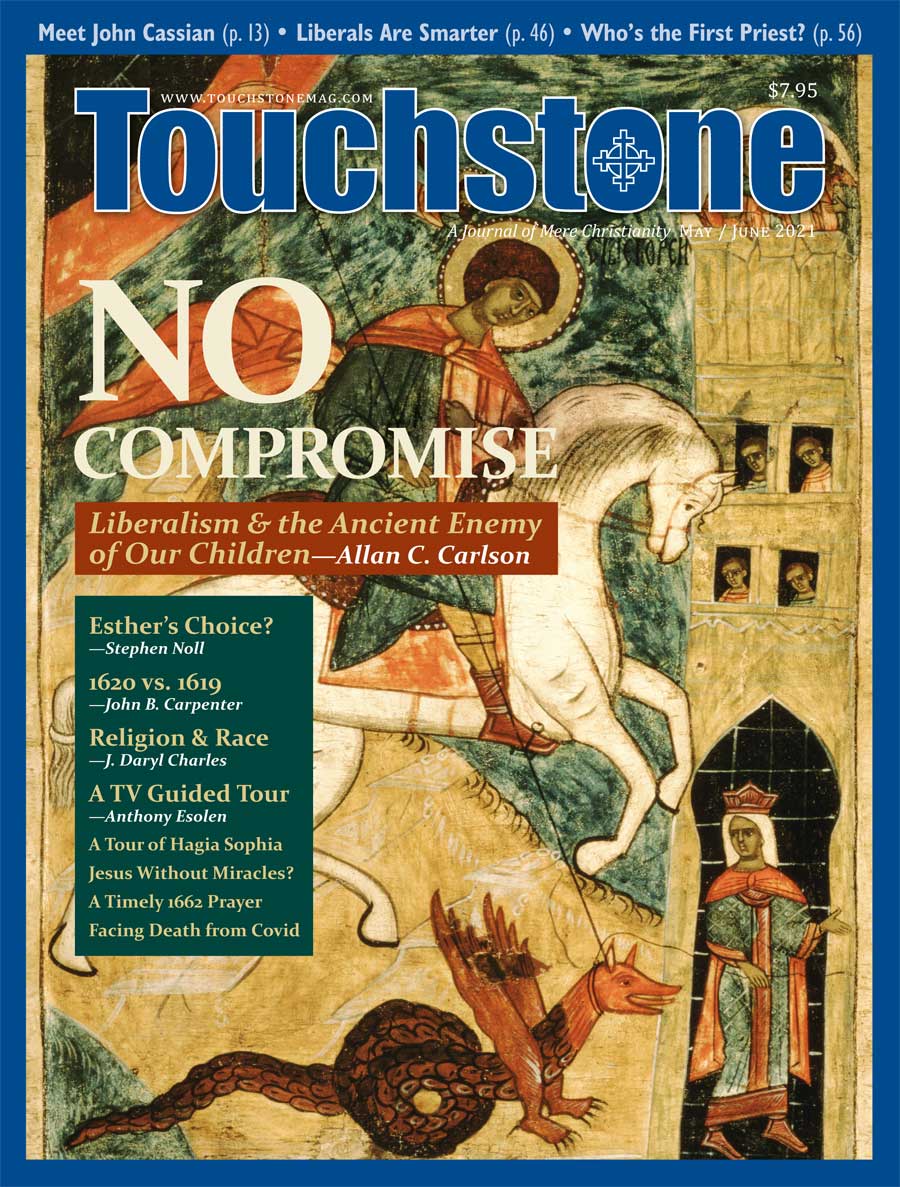
What Television Shows
An Ancient TV Guide Suggests a Program for Today's Choices
by Anthony Esolen
The next time someone asks me what I do for a living, I think I will reply, "I am an archaeologist," because I study human habits long forgotten, and try to bring them to the attention of my readers, so that together we may stretch our imaginations and see what life might have been like for people less blessed with ignorance and distraction than we are now.
To that end, my wife dug up a fossil for me and put it in my Christmas stocking. It is the May 11–17, 1957 issue of TV Guide. The listings are for seven channels in New York City (ABC, CBS, NBC, DuMont, and three independent channels) and two in western Connecticut (one ABC, the other offering a combination of shows from ABC, CBS, and DuMont). Most people in the country would not have had so many choices. These were not boutique channels, tailored for a specific audience. They had to capture a large enough share of the general audience to stay in business.
Several things leapt to my attention, which I will describe in ascending order of significance. Each of them marks its provenance as an alien culture, almost an alternate universe.
Variety in Life
The first thing is that ordinary people did a lot of things. They were the last generation who had grown up without television. In their world, people largely made their own entertainment. To spend time outdoors did not mean that you walked along town-designated trails in the woods close to home. There were no such. It did not mean a week skiing in Colorado. Most people did not have the money for that, even if they had the inclination, and farmers—there were millions of farmers still—could not leave their animals untended. It meant that you lived among other people: outdoors meant being with others, doing things.
We see as much in the amateur shows, and, incidentally, in plenty of other places. Every weekday at 5:00 p.m., WOR-9 in New York ran Teenage Bandstand, featuring teenagers from one regional high school after another, and the Guide names them: William Howard Taft H.S., the Bronx; Elmont H.S., Long Island; and so forth. The host was Ted Steele, a ferociously active young impresario, bandleader, recording executive, and sometime Pennsylvania farmer and raiser of Guernseys. Steele himself had been a boy prodigy, enrolling at the New England Conservatory of Music when he was seven. Teenage Bandstand was mostly a music show, but not exclusively: on Monday, May 13, students from the High School of Fashion Industries, in the Bronx, came to show off the graduation dresses they had designed and made.
Assuming that summer was for reruns, Steele must have visited about 150 high schools each year, all from the greater metropolitan area. There is no reason to suppose that Long Island was less social in this regard than the panhandle of West Virginia or the hills of the Ozarks.
There were amateur hours, too, with the old meaning of the word in force: people who did things because they loved them. The Ed Sullivan Show, for example: "Tonight Ed presents anotherAll-Navy talent program, chosen from Navy personnel from all over the country" (Sunday, May 12, 8:00 p.m., CBS). Some of the acts are solo singers, but we have also a ventriloquist, an accordion duo, two quartets, a guitarist, a marimba duo, a pantomime, a composer, and a vocal-instrumental duo novelty act.
Not to be outdone by CBS, ABC had the Ted Mack Amateur Hour at 9:00 p.m., the successor to the long-running radio show, the Major Bowes Amateur Hour. "Tonight Ted salutes Dayton, Ohio," says the Guide, suggesting that the show could someday set up shop near your own town. The guests on this night included a woman pop singer, a vocal quartet from Upper Darby, Pennsylvania, a man-woman vocal duo from Lansdowne, Pennsylvania, a soldier baritone from Fort Dix, New Jersey, a choral group of student nurses from Saint Peter's hospital in Albany, New York, and a pianist from Passaic, New Jersey. "Ted's special guest tonight," says the Guide, "is Frederick H. Boland, Ireland's ambassador to the United Nations." What Boland did for the show, I cannot tell, but his wife was a painter of note, and his daughter a poet.
Vibrant Social Life
Anthony Esolen is Distinguished Professor of Humanities at Thales College and the author of over 30 books, including Real Music: A Guide to the Timeless Hymns of the Church (Tan, with a CD), Out of the Ashes: Rebuilding American Culture (Regnery), and The Hundredfold: Songs for the Lord (Ignatius). He has also translated Dante’s Divine Comedy (Random House) and, with his wife Debra, publishes the web magazine Word and Song (anthonyesolen.substack.com). He is a senior editor of Touchstone.
A Journal of Mere Christianity—Delivered to Your Door
- Essays on theology, culture, and the Church
- Contributors from across the Christian traditions

Six print issues (one year) of Touchstone, plus full online access and PDF downloads for only $39.95.

Get a one-year full-access subscription to the Touchstone online archives for only $19.95.
bulk subscriptions
Order Touchstone subscriptions in bulk and save $10 per sub! Each subscription includes 6 issues of Touchstone plus full online access to touchstonemag.com—including archives, videos, and pdf downloads of recent issues for only $29.95 each! Great for churches or study groups.
Transactions will be processed on a secure server.
more from the online archives
17.4—May 2004
The Unhappy & Abusive Marriage of Liberalism & Modernism by James Hitchcock
26.1—Jan/Feb 2013
on Abortion as a Matter of National Welfare by W. Ross Blackburn
14.1—January/February 2001
The Christian Heart of Fatherhood
The Place of Marriage, Authority & Service in the Recovery of Fatherhood by John M. Haas
calling all readers
Please Donate
"There are magazines worth reading but few worth saving . . . Touchstone is just such a magazine."
—Alice von Hildebrand
"Here we do not concede one square millimeter of territory to falsehood, folly, contemporary sentimentality, or fashion. We speak the truth, and let God be our judge. . . . Touchstone is the one committedly Christian conservative journal."
—Anthony Esolen, Touchstone senior editor
