John Paul II at 100 by J. Daryl Charles

Feature

John Paul II at 100

A Protestant Appreciation of His Teaching

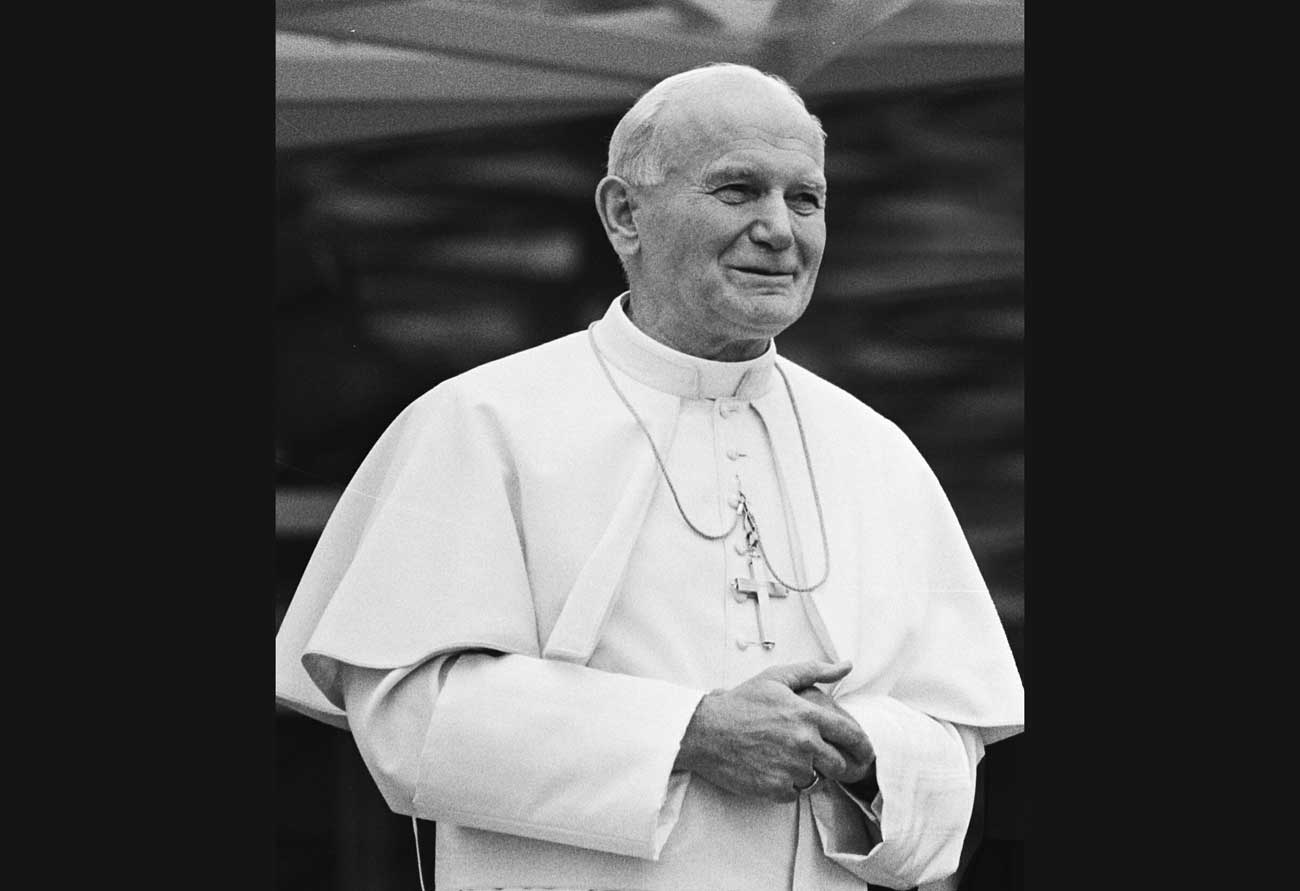
It is fitting in this year, which marks the 100th anniversary of his birth, that Karol Wojtyla—Pope John Paul II—be the focus of gratitude and meditation in many corners of the Christian Church. More than any pontiff in recent memory, John Paul offered a penetrating and faithfully Christian critique of contemporary culture, and he did so on a continual basis. His pen, like his mind, was extremely active.

Trained as a theologian with a philosophical bent and gifted with remarkable clarity of thought, this pope (1978–2005) published every several years either a major encyclical or an apostolic letter that addressed both the current cultural climate and the Church's need to confront that climate in ways faithful and discerning yet creative and compassionate. Whether reflecting on the redemptive value of suffering (Salvifici doloris, 1984), the dignity of work and the worker (Laborem exercens, 1981, and Centesimus annus, 1991), the character of truth (Veritatis splendor, 1993), the imperative of Christian unity (Ut unum sint, 1995), the emerging "culture of death" (Evangelium vitae, 1995), or the symbiotic relationship between faith and reason (Fides et ratio, 1998), John Paul addressed matters of faith and society in a manner that was timeless yet timely.

Not insignificantly, it was during his pontificate that the Catholic Church for the first time, in an official way, proclaimed Martin Luther as "our brother in Christ." To mark the 500th anniversary of Luther's birth on November 10, 1483, the pope sent a letter to Johannes Cardinal Willebrands, archbishop of Utrecht in the Netherlands and president of the Secretariat for Christian Unity, with a view to reassessing the Catholic Church's attitude toward Luther. Six years later, John Paul publicly acknowledged to Lutheran bishops that Rome's excommunication of Luther in the year 1521 (via the papal bull Exsurge Domine) had "expired" with the reformer's death and hence should not serve as an obstacle to dialogue between Catholics and Protestants. Such dialogue served as an acknowledgment that some of Luther's teachings on reform and renewal had long been accepted by the Catholic Church. Hence, the time was ripe for a reassessment.

These events were occurring at the same time that Lutherans themselves were participating in ecumenical dialogue concerning justification (see, e.g., Justification by Faith: Lutherans and Catholics in Dialogue VII, Augsburg, 1985). And it was also at about this time, in 1985, that John Paul convoked "an extraordinary assembly of the Synod of Bishops" on the occasion of the twentieth anniversary of the close of the Second Vatican Council. The purpose of this assembly was to "celebrate the graces and spiritual fruits" of Vatican II, to "study its teaching," and to "promote knowledge and application of it." The results of this "celebration" and "study" would be the publication of the Catechism of the Catholic Church, overseen by Joseph Cardinal Ratzinger (who would succeed John Paul as Pope Benedict XVI).

The sheer significance of only the second catechism of the Catholic Church since the mid-sixteenth century was enormous. Any Protestant who, as I did, seriously read Part One of the Catechism ("The Profession of Faith") found it impressive. The largest part of the Catechism, Part One consists of a systematic theological exposition of the creedal elements of the historic Christian faith. Most striking at the time, at least for me, was how "evangelical" the language of faith and grace appeared as employed by the Catechism (nos. 153–175).

Three Particularly Valuable Writings

Such "evangelical" formulation was an accurate mirror of John Paul's own theological framework. The pontiff's ability to contextualize the historic Christian tradition in philosophically astute and culturally sensitive ways was unparalleled among his predecessors. While all of his writings have been instrumental in my own thinking as an orthodox Protestant and while I have used most of his writings in my university theology classes through the years, three at the time were—and remain—particularly valuable.

These three are likely to have received less publicity than, say, Veritatis splendor and Evangelium vitae (EV). However, they address elements of faith and culture that are frequently neglected by the Christian community. One, an apostolic letter, was relatively short and demonstrated unusual pastoral care in its treatment of the problem of suffering (Salvifici doloris). One was eminently practical, addressing the dignity of work and the workplace (Centesimus annus). And one was dense, theoretical, and philosophically rich (Fides et ratio). A few appreciative reflections on each of these are in order.

I. Salvifici doloris (1984)

In this remarkable letter, John Paul displays a noteworthy measure of pastoral sensitivity and cultural discernment. Among our contemporaries, human suffering is viewed as meaningless and, hence, to be avoided at all costs. This attitude can be seen in the willingness of Western societies to embrace suicide, including physician-assisted suicide, and euthanasia in unprecedented ways. (To these categories we might add abortion and, to a lesser extent, infanticide.) Why do these inhumanities, at both the individual and the collective levels, receive such popular support? If we seek a baseline motivation, it would seem that they are perceived as necessary to end present or prevent future suffering. Each, therefore, becomes a "compassionate choice," especially as it applies to end-of-life matters (broadly construed). In our day, the drive to eliminate suffering from the human experience very frequently stands behind the use of the language of "compassion."


J. Daryl Charles is the Acton Institute Affiliated Scholar in Theology & Ethics. He is the author or editor of twenty books, including Retrieving the Natural Law (2008), Natural Law and Religious Freedom (2018), and, most recently, Just War and Christian Traditions (forthcoming). He is also co-editor of Abraham Kuyper, Common Grace: God's Gifts for a Fallen World, Volume 3 (2020). He is a contributing editor to Touchstone.

A Journal of Mere Christianity—Delivered to Your Door

  • Essays on theology, culture, and the Church
  • Contributors from across the Christian traditions

Subscribe (Print + Online)

Six print issues (one year) of Touchstone, plus full online access and PDF downloads for only $39.95.

Subscribe (Online Only)

Get a one-year full-access subscription to the Touchstone online archives for only $19.95.


bulk subscriptions

Order Touchstone subscriptions in bulk and save $10 per sub! Each subscription includes 6 issues of Touchstone plus full online access to touchstonemag.com—including archives, videos, and pdf downloads of recent issues for only $29.95 each! Great for churches or study groups.

Transactions will be processed on a secure server.


more on Catholic from the online archives
32.6—November/December 2019

Reformation Redux?

on Taking Heed of the Parallels Between the Crises of Yesterday & Today by Korey D. Maas

27.5—Sept/Oct 2014

The Hundred Years' War

The Culture of Death's Campaign Against the Catholic Church by Brantly Millegan
31.6—November/December 2018

Enduring Sacrilege

The Slow Vindication of Leon Podles by S. M. Hutchens


more from the online archives

22.8—November/December 2009

The Origin of Aesthetics

Looking for Beauty & Justice 150 Years After Darwin’s Classic by Charles Taliaferro

28.5—Sept/Oct 2015

Cambodia's Anti-Exodus

Remembering Angka & the Idolatry of the Khmer Rouge 40 Years Later by Les Sillars

18.8—October 2005

Vanishing Sea of Faith

European Islam & the Doubtful Future of Christian Europe by William Murchison

calling all readers

Please Donate

"There are magazines worth reading but few worth saving . . . Touchstone is just such a magazine."
—Alice von Hildebrand

"Here we do not concede one square millimeter of territory to falsehood, folly, contemporary sentimentality, or fashion. We speak the truth, and let God be our judge. . . . Touchstone is the one committedly Christian conservative journal."
—Anthony Esolen, Touchstone senior editor

Support Touchstone

00