




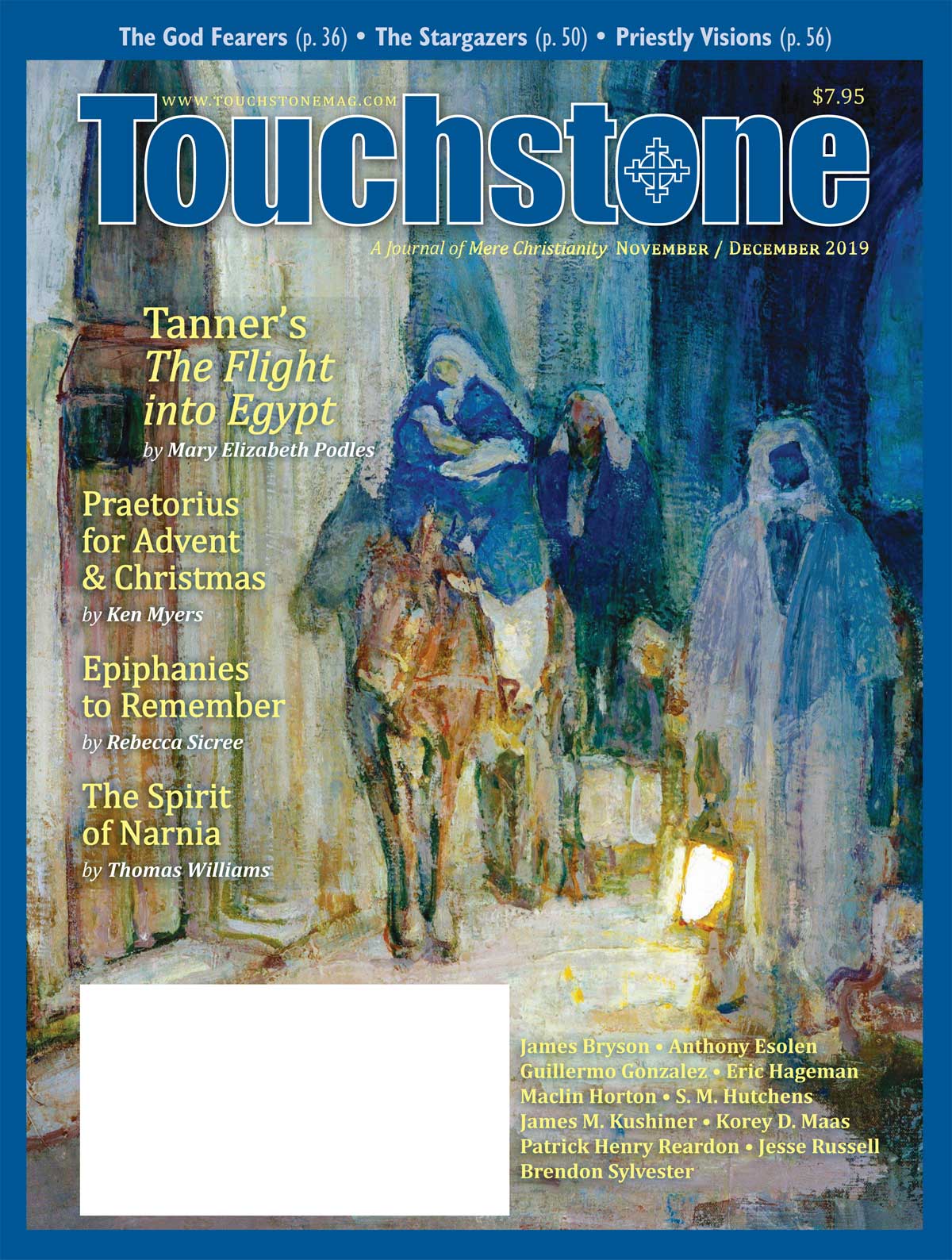
View
Snapdragon & Swordplay
Rebecca Sicree on Christian Imagination & Epiphanies to Remember
I bought my daughter a guillotine for Christmas.
For the record, the guillotine was a magician's arm-guillotine, not a Frenchman's chop-off-your-head--guillotine. Ours even came with a fake arm. Maria had wanted one, not because she was a Robespierre in training, but because she didn't have a lovely assistant to saw in half, just a reluctant ten-year-old brother.
"After Maria's arm was cut off," Helena remembered, "it reached out of the bag and tried to choke John. It was very funny. It was almost as good as the punch bowl filled with punch that she pulled out of her handkerchief."
The Play's the Thing
Maria and John's magic show was the warm-up act before Christmas in Camelot, the mummers' play our kids and their friends from our parish performed at our Twelfth Night party that January. Unlike traditional mummers' plays, ours was sandwiched between a potluck dinner and a swing dance in our nice and warm parish hall, not performed by costumed mummers traipsing door to door in the mid-winter cold like overgrown and over-late trick-or-treaters.
We also did not use the traditional plot. Usually, in a real mummers' play, the characters of Saint George and the Turkish Knight duel to the death in a series of sword fights—only to rise and fight again, like Vikings in Valhalla, cured by the wonder-working Doctor. Commentary is provided by Father Christmas. Mummers' plays vary from place to place, so sometimes Saint George has more than one opponent. These can include the Dragon, of course, or the King of Egypt or Hector or Alexander the Great or other heroes or villains.
Or Oliver Cromwell.
A Broken Tradition
Cromwell was the leader of the Puritans during the English Civil War. When they seized power, the Puritan Parliament not only closed all the theaters in England but also banned the celebration of Christmas. Although these bans were lifted in 1660, after Cromwell died and the monarchy was restored, no record exists of any mummers' plays being performed until a hundred years later. No one knows whether these plays were a revival of a lost folk art form or the development of a new tradition derived from older types of Christmas dramas, such as the medieval mystery plays put on by trade guilds.
When a broken tradition is revived, it might come back in a different form, so that Father Christmas from the old Christmas masques ends up in a miracle play about Saint George performed on Twelfth Night. Mummers' plays saw their heyday in Victorian England, then began dying out in the twentieth century. Today's mummers rarely perform their plays door to door: London mummers, for example, perform on outdoor stages, while Philadelphia ones march in a New Year's parade instead.
Rebecca Sicree writes from Boalsburg, Pennsylvania. She and her family attend Our Lady of Victory Catholic Church in nearby State College. She and her husband Andrew have ten children, six of whom are now adults.
A Journal of Mere Christianity—Delivered to Your Door
- Essays on theology, culture, and the Church
- Contributors from across the Christian traditions

Six print issues (one year) of Touchstone, plus full online access and PDF downloads for only $39.95.

Get a one-year full-access subscription to the Touchstone online archives for only $19.95.
bulk subscriptions
Order Touchstone subscriptions in bulk and save $10 per sub! Each subscription includes 6 issues of Touchstone plus full online access to touchstonemag.com—including archives, videos, and pdf downloads of recent issues for only $29.95 each! Great for churches or study groups.
Transactions will be processed on a secure server.
more from the online archives

19.8—October 2006
on the Good Father’s Quiet Desperation by Russell D. Moore
31.6—November/December 2018
The Slow Vindication of Leon Podles by S. M. Hutchens
32.6—November/December 2019
An Open Letter to Christian Readers of Jordan Peterson & Roger Scruton by James Bryson
calling all readers
Please Donate
"There are magazines worth reading but few worth saving . . . Touchstone is just such a magazine."
—Alice von Hildebrand
"Here we do not concede one square millimeter of territory to falsehood, folly, contemporary sentimentality, or fashion. We speak the truth, and let God be our judge. . . . Touchstone is the one committedly Christian conservative journal."
—Anthony Esolen, Touchstone senior editor
