




Feature
Poet of Heaven & Earth
His Thoughts Are Not Our Thoughts, Nor His Words
by David Lyle Jeffrey
My God, my God, thou art a direct God, may I not say a literal God, a God that would be understood literally and according to the plain sense of all that thou sayest? But thou art also (Lord, I intend it to thy glory, and let no profane misinterpreter abuse it to thy diminution), thou art a figurative, a metaphorical God too. . . ." So John Donne, poet and poetical preacher par excellence, addresses God in one of his intimate (yet published) Devotions. He does not mean in any way that "God" is a metaphor for something else; as is abundantly clear throughout his writings, for Donne the reality of God is the most utterly real thing in the universe. Rather, he is noticing something about God—the way God expresses himself in many parts of Scripture.
What he notices is that God often speaks in poetic language. This insight affects the way Donne prays. Does his prayerful address to God as supreme poet contain a theological or literary insight we, too, might usefully ponder? I think so.
Artist & Architect
The effort to find expressible words to communicate the inexpressible glory of the immortal, invisible God, an evident emphasis of the human authors of the Bible from the Burning Bush through both Testaments, has continued in the Christian tradition. In the Bible itself, despite explicit divine warnings against idolatrous comparisons (e.g., Is. 40:25; 46:5), approved poetic analogies for God abound (God is a Rock, a Fortress, a Consuming Fire). All of them say something, even though such insights, as they gather, must by definition be partial. Yet they deepen understanding.
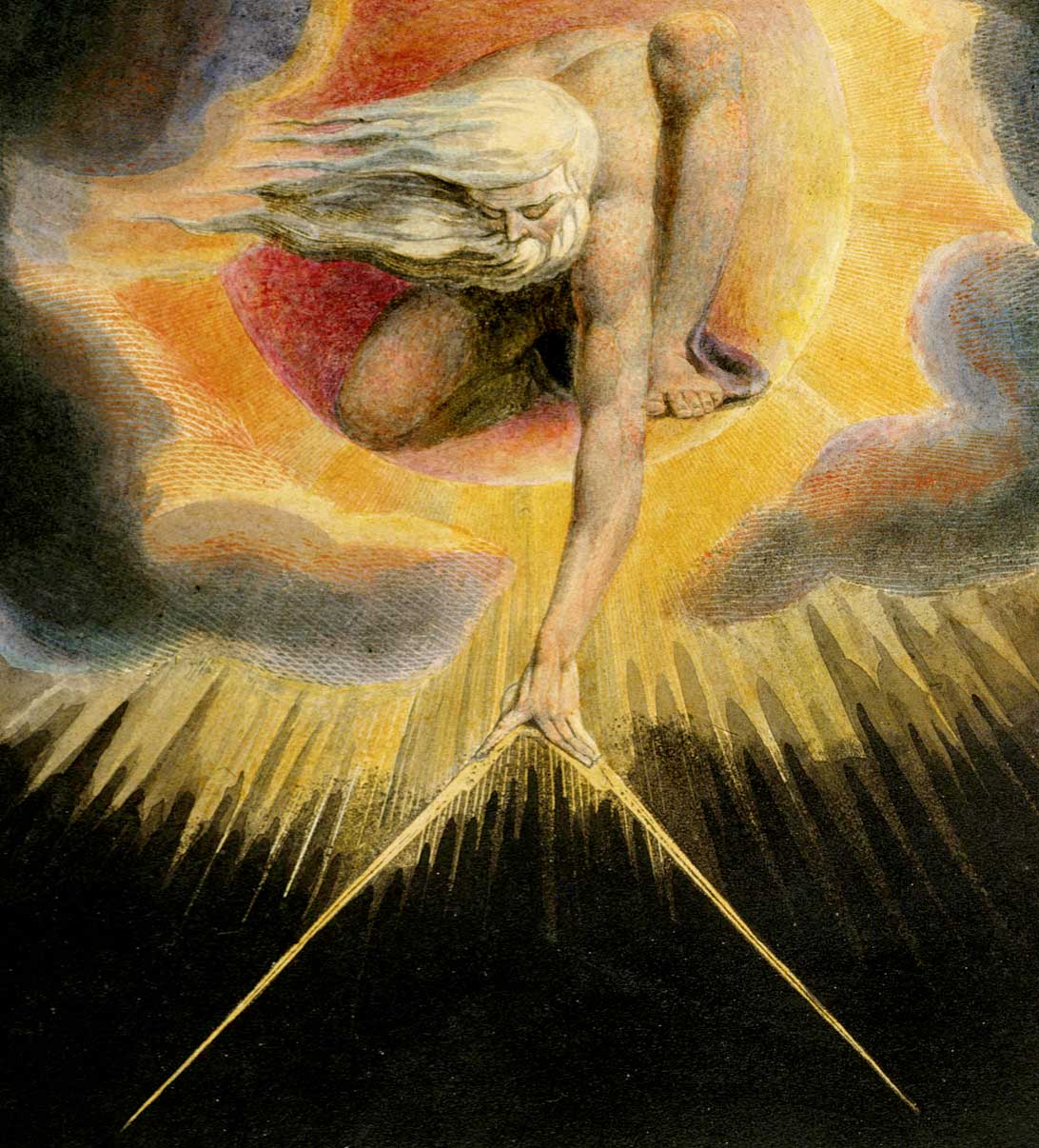
When such biblical metaphors are tumbled in the imaginations of later commentators, typically the invisible, omnipotent God is still envisioned poetically through figurative language. For example, in the Christian tradition, imaginative pictorial representations of God as the architect of the universe, such as William Blake's "Ancient of Days," draw not only upon the first chapters of Genesis, as we would expect, but also upon related phrasing in the New Testament. In Hebrews, Abraham, still in the wilderness and not knowing where he is going, is said to have "looked forward to the city that has foundations, whose architect [Gk. technítes;Lat. artifex] and builder [Gk. demiourgos;Lat. conditor] is God" (11:10). This New Testament metaphor interprets Genesis, but it also looks forward to the end of salvation history, when all human flesh will see that God is alpha and omega,the first and the last (Rev. 1:11; 22:13).
The biblical writers speak here of God as Creator in terms of a human analogy; it is highly doubtful that any of them thought of God as drawing up blueprints and executing a building plan as we would, but they do envision God as the original Artist (the Greek word for his "making" is poesis). God brings the world into being, and yet also, as the apostle puts it, "upholds all things by the word of his power" (Heb. 1:3); the architect image, like all metaphors, breaks down when pushed too far and needs to be supplemented, yet in Scripture it is regarded as useful for getting our imaginations in gear. Accordingly, this "artist" or "architect" image is far from being the only kind of biblical assistance we are given to imagine what God is like.
Speaker of Poetry
A second kind of biblical metaphor for God speaks not just to his omnipotence and omnipresence but, more intimately, to his personal nature; in other texts he may present himself as a lover, a bridegroom, a father. What Donne has noticed is that of this latter kind of self-disclosure, one figura in particular seems to provide an important register of meaning for our understanding of God in Scripture: God speaks poetry. As with a human lover, or bridegroom, or father, how he speaks, not just what he says, tells us much about who he is.
When people less familiar with the Bible think of the "voice of God," they often think of it in terms of "thou shalt not" and similar moral imperatives. When we look more closely at the full canon of Scripture, however, we soon encounter a God who speaks fulsomely and more frequently in poetry, yet not in such a way as to mask the radical truth he utters. In the writings of the prophets, these divine poetic eruptions are so evident when the text is read aloud that modern editors can readily insert quotation marks around the speeches of God, even when these utterances are not clearly indicated by a prose transition such as, for example, "Thus saith the Lord" (Is. 50:1).
If one is reading an English translation, this qualitative distinction in expression is most clearly apparent in the King James, or Authorized, Version (which I quote here, though set visually so that its poetry becomes more apparent). For example, words ascribed to Isaiah himself are sometimes followed by an antiphon, or response, of the Lord, which is often both an answer to the prophet and an amplification.
Here is a luminous instance: After he has praised the Lord as "exalted," the prophet Isaiah notes despairingly the contrary, desolate condition of his people because of their sin: "The highways lie waste, the wayfaring man ceaseth" (33:8).
The answering voice of God then (beginning at 34:16 are several divine interjections) takes up the prophet's lament and turns it into an extended poem about divine restoration:
David Lyle Jeffrey is Distinguished Professor Emeritus of Literature and the Humanities at Baylor University and Resident Distinguished Professor of Baylor Institute for Studies in Religion.
A Journal of Mere Christianity—Delivered to Your Door
- Essays on theology, culture, and the Church
- Contributors from across the Christian traditions
Subscribe (Print + Online) 
Six print issues (one year) of Touchstone, plus full online access and PDF downloads for only $39.95.
Subscribe (Online Only) 
Get a one-year full-access subscription to the Touchstone online archives for only $19.95.
bulk subscriptions
Order Touchstone subscriptions in bulk and save $10 per sub! Each subscription includes 6 issues of Touchstone plus full online access to touchstonemag.com—including archives, videos, and pdf downloads of recent issues for only $29.95 each! Great for churches or study groups.
Transactions will be processed on a secure server.
more on poetry from the online archives
37.5—Sept/Oct 2024
A Battle Plan for Peace While Growing Old by Anthony Esolen
more from the online archives
32.3—May/June 2019
on the Implications of Changing the Pater Noster by John M. McCarthy
32.6—November/December 2019
on Taking Heed of the Parallels Between the Crises of Yesterday & Today by Korey D. Maas
calling all readers
Please Donate
"There are magazines worth reading but few worth saving . . . Touchstone is just such a magazine."
—Alice von Hildebrand"Here we do not concede one square millimeter of territory to falsehood, folly, contemporary sentimentality, or fashion. We speak the truth, and let God be our judge. . . . Touchstone is the one committedly Christian conservative journal."
Support Touchstone
—Anthony Esolen, Touchstone senior editor
