




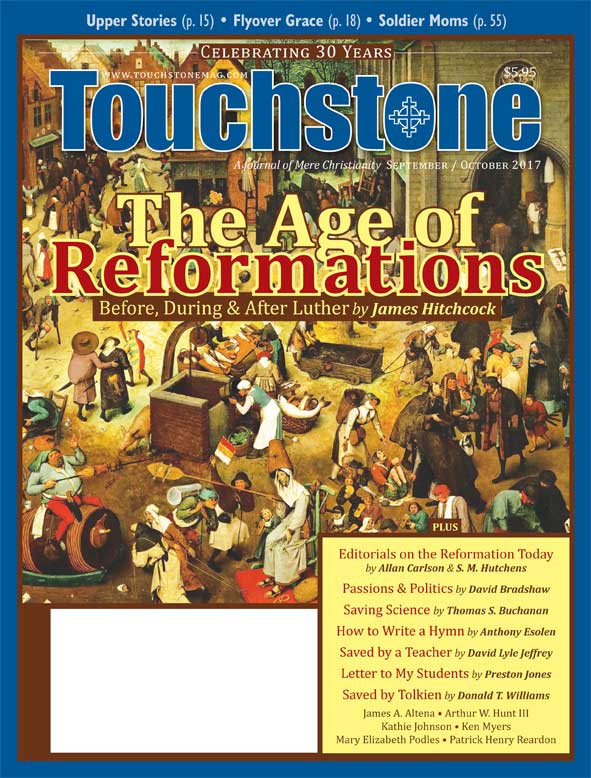
Editorial
Allied Soldiers
Reformations & Touchstone Diplomacy by S. M. Hutchens
Some years ago I was in Geneva on Reformation Sunday and took the opportunity to attend services at the Cathédrale Saint-Pierre, the adopted home church of John Calvin, and one of the focal points of the Reformation. The sermon was neatly crafted and celebrated what the occasion called for, not by criticizing anything distinctly Roman, but by making the Reformation a major event in the ongoing work of overthrowing regressive ideas and attitudes that is ever at the true heart of Christianity.
It was my impression that the Genevois, having at present greater spiritual affinity with their native son Rousseau than with the cross-grained reformer from Noyon, have made the best of the Reformation by yoking them together in the struggle for liberation from the forces of reaction and repression. I left that imposing sanctuary—after a performance of some doubtlessly regressive medieval polyphony by an excellent ensemble from the local Salvation Army—thinking of the finger-wagging admonition I had received back in Chicago by an official of the United Presbyterian Church USA. He had told me without blushing that Presbyterians who still held to the Westminster Confession were untrue to their tradition because Ecclesia Reformata semper reformanda, which in this context has a number of interesting possible translations, such as, "The Reformed Church has no form," or perhaps, "You can't step into the same Reformed Church twice." My buddies among the confessional Presbyterians, though, say that it ain't so.
Mere Christianity
At Touchstone we have no interest in such amoebic reformations except to warn people off them and their dysenteric results. But surely here, at the five-hundredth anniversary of Protestantism, we are obliged to say something significant about it—for it is a very large thing, at least sub specie temporis, that cannot justly be ignored. If we turn to the analogy provided by C. S. Lewis's essay from which this journal's subtitle is derived, we find him comparing the faith, and by implication the Church in its present state, to a house that has common areas of shared, fundamental belief ("mere Christianity") and walled-off rooms—the various churches—in which the practical business of the house is carried out.
In this analogy, the Reformation would stand as a major partition forming a Protestant Room in which only Protestants can be accommodated comfortably. A Catholic who ventures in may be placed close to the fire, to be sure, but he also risks being placed in it. While this and the house's other rooms can be clearly seen and commented upon as important historical phenomena affecting the life of the Church, the celebration (or deprecation) of the Protestant wall is business proper to the rooms, not to the common area in which Touchstone has tried to establish itself.
Many Catholics, and doubtless Orthodox as well, logically take the very idea of mere Christianity to be a rather self-serving -Protestant notion, a more accurate analogy being that of a great manor in which Protestant churches are not "rooms" at all but encampments somewhere out on the grounds, such as we find in the declaration Dominus Iesus (2000). Thus, the outlying encampments celebrate the Reformation while the True House deprecates it. Lewis's analogy now weakens considerably—"mere Christianity" being replaced with something like "us and what's left of Christianity out there"—but still holds, at least enough for Catholics and Orthodox to work and confess with Protestants in matters of doctrine and ethics in a very broad field of agreement—if we can keep our tempers until the Lord straightens out who needs it, as he did others who understood neither the Scriptures nor the power of God.
Under a Flag of Truce
This temper-keeping is a very important thing, for the Touchstone ethos has no respect for the double-minded or for people who will settle for compromise instead of truth, so it tends to be constituted (miraculously) of people who are close to the centers of their own faith traditions, as Lewis said we would be. We are soldiers, not diplomats, and this doesn't change under a flag of truce where we are not fighting each other, but common enemies.
For many of us, the Reformation—and other church divisions—are battlegrounds in which we are still invested. Concentrating on them tends to draw out the original problems, problems for which we doubt there are ecumenical solutions, and which serve as distractions from the business we believe we are to be about. There is no lack of writing this year on the Reformation, but it is probably best to go elsewhere if one is looking for deep coverage, much less for opinion on whether or not it was a good thing.
S. M. Hutchens is a senior editor and longtime writer for Touchstone.
A Journal of Mere Christianity—Delivered to Your Door
- Essays on theology, culture, and the Church
- Contributors from across the Christian traditions

Six print issues (one year) of Touchstone, plus full online access and PDF downloads for only $39.95.

Get a one-year full-access subscription to the Touchstone online archives for only $19.95.
bulk subscriptions
Order Touchstone subscriptions in bulk and save $10 per sub! Each subscription includes 6 issues of Touchstone plus full online access to touchstonemag.com—including archives, videos, and pdf downloads of recent issues for only $29.95 each! Great for churches or study groups.
Transactions will be processed on a secure server.
more on mere christianity from the online archives
more from the online archives
35.2—Mar/Apr 2022
on Fatigued Christians Deciding to Engage the Culture by Keith Lowery

31.6—November/December 2018
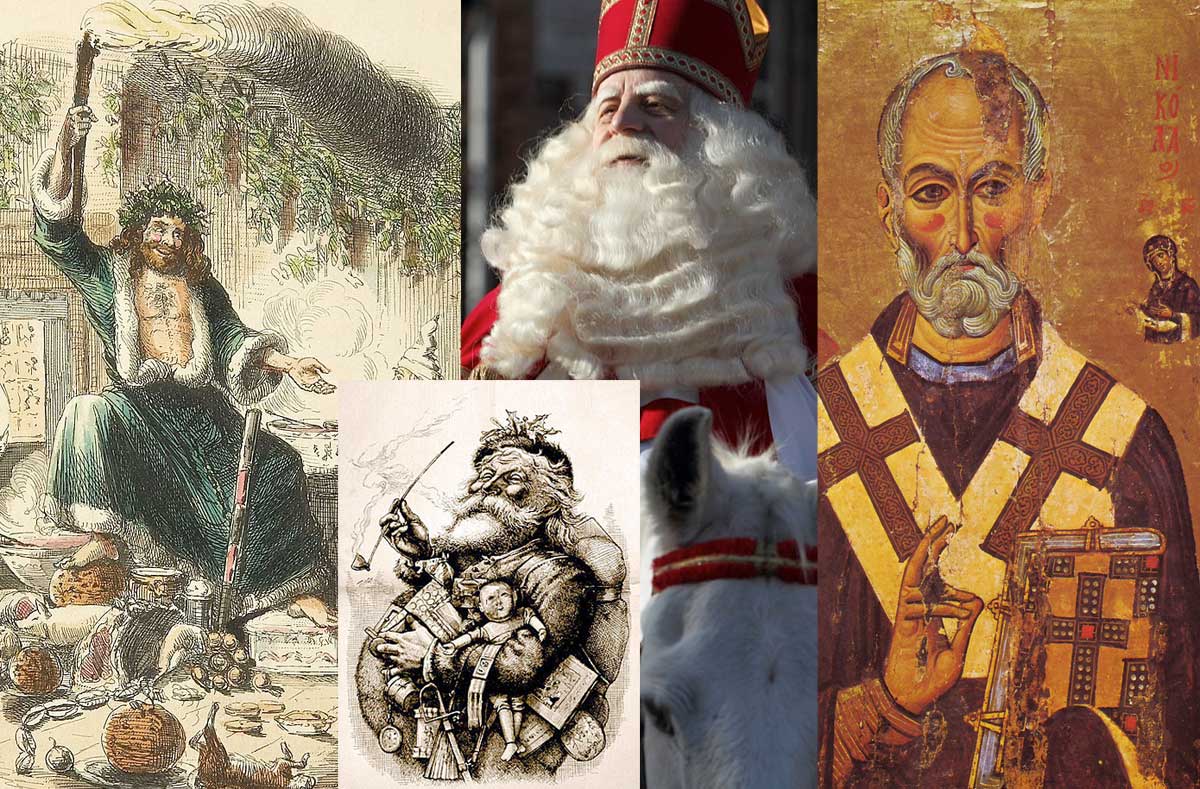
on Childhood Encounters with a Christmas Icon by Rebecca Sicree
calling all readers
Please Donate
"There are magazines worth reading but few worth saving . . . Touchstone is just such a magazine."
—Alice von Hildebrand
"Here we do not concede one square millimeter of territory to falsehood, folly, contemporary sentimentality, or fashion. We speak the truth, and let God be our judge. . . . Touchstone is the one committedly Christian conservative journal."
—Anthony Esolen, Touchstone senior editor
