




Illuminations
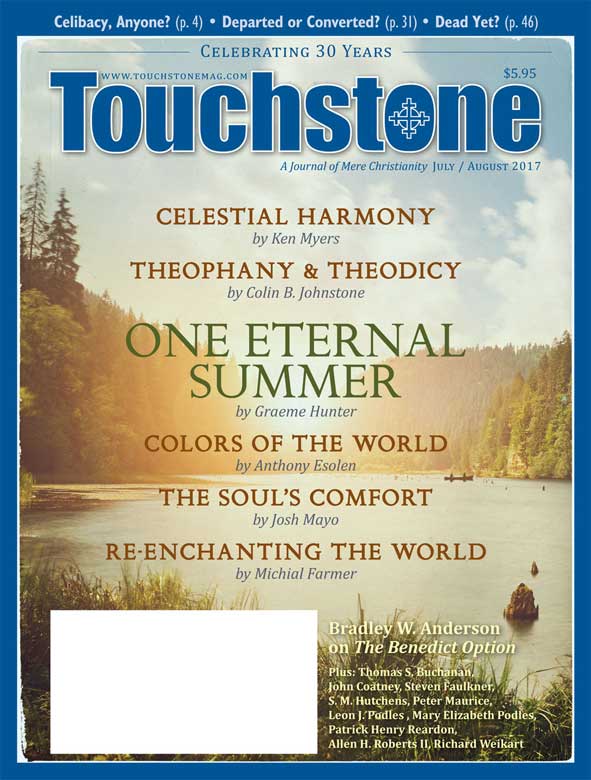
All the Colors of the World
by Anthony Esolen
I am not the first to note with dismay that the rainbow, once the radiant and quiet pledge of God that he would never again deluge the world to wash away the filth of man, is now raised as the banner of New Sodom, bubbling up from the bituminous sands of the Dead Sea. Such as it is, the banner is an advertising ploy, bright and garish and belligerent, like much of the bad art of our time, ignorant of history, tradition, culture, and the bewildering shades of the human experience. It is not for barbarians. It is not innocent enough for the barbarian. It is for the mad and decadent and blind.
The response to bad post-Christian symbolism is not bad symbolism of our own. In the battle before us, the Lord has given us a gift of inestimable value. Our opponents, though clever, have no taste, know nothing of the West's heritage of art and poetry, and, being ill-read, are not used to considering the depths of man's despair and joy in his encounters with the divine. Let us not squander the gift. Let us not meet stupidity with stupidity. Let us learn from the masters.
Cowper's Trials
The poet William Cowper (1731–1800) knew, as did his collaborator, the former slave-driver John Newton (1725–1807), the dark mines of the human soul. For much of his life, Cowper suffered periods of intense depression. When he was a young man, he broke under the stress of making a career for himself in the English government, and attempted three times to take his own life. He had to be put away in a house for the insane, run by the devout poet and physician Nathaniel Cotton.
After he recovered, he took up residence in the home of an Anglican clergyman, Morley Unwin, where he met Newton, who encouraged him to take up poetry again and to put his considerable lyrical talents to the crafting of hymns for congregations of ordinary Christian farmers and workingmen—not odes for collegians to study, but ballads to be remembered and cherished and sung on a Sunday.
Newton had plenty of talent that way himself, and so he and Cowper began to compile works for what would be published eventually as the Olney Hymnbook. These were texts alone, to be sung to whatever melody well-known to the people would fit the meter. Meanwhile, Cowper fell into madness again, this time occasioned by his dreadful fears that he had been predestined to damnation. It took him a year to recover; the widow of the Reverend Unwin cared for him until the Lord restored him to health and hope.
The Hymn
It was after this second period of spiritual darkness that Cowper wrote the hymn "Sometimes a Light Surprises," which our worthy pastor chose for the offertory this Easter. It is not specifically an Easter hymn, but rather a meditation on the lights and shades of the Christian's life, in the warmth of Easter. Here is the first stanza:
Sometimes a light surprises
The Christian while he sings;
It is the Lord who rises
With healing in his wings;
When comforts are declining,
He grants the soul again
A season of clear shining,
To cheer it after rain.
Not one line of it is political. There is not a single pious slogan. There is nothing of the breathless, forced cheer of the contemporary Praise 'n' Worship salesman, whose only colors are strawberry pink and lemon yellow. Cowper writes about what he knows. You are singing to the Lord, and you are not cheerful, until and unless the light from the Lord takes you by surprise, granting you a calm and clear day after the time of gloom.
Anthony Esolen is Distinguished Professor of Humanities at Thales College and the author of over 30 books, including Real Music: A Guide to the Timeless Hymns of the Church (Tan, with a CD), Out of the Ashes: Rebuilding American Culture (Regnery), and The Hundredfold: Songs for the Lord (Ignatius). He has also translated Dante’s Divine Comedy (Random House) and, with his wife Debra, publishes the web magazine Word and Song (anthonyesolen.substack.com). He is a senior editor of Touchstone.
A Journal of Mere Christianity—Delivered to Your Door
- Essays on theology, culture, and the Church
- Contributors from across the Christian traditions

Six print issues (one year) of Touchstone, plus full online access and PDF downloads for only $39.95.

Get a one-year full-access subscription to the Touchstone online archives for only $19.95.
bulk subscriptions
Order Touchstone subscriptions in bulk and save $10 per sub! Each subscription includes 6 issues of Touchstone plus full online access to touchstonemag.com—including archives, videos, and pdf downloads of recent issues for only $29.95 each! Great for churches or study groups.
Transactions will be processed on a secure server.
more from the online archives

26.5—Sept/Oct 2013
The Perils of Pragmatism in Christian Attitudes Toward the Liberal Arts by Robin Phillips

24.4—July/August 2011
The Cultural Marxists’ Strategic Assault on Religion, Life & Family by Patrick F. Fagan

calling all readers
Please Donate
"There are magazines worth reading but few worth saving . . . Touchstone is just such a magazine."
—Alice von Hildebrand
"Here we do not concede one square millimeter of territory to falsehood, folly, contemporary sentimentality, or fashion. We speak the truth, and let God be our judge. . . . Touchstone is the one committedly Christian conservative journal."
—Anthony Esolen, Touchstone senior editor
