





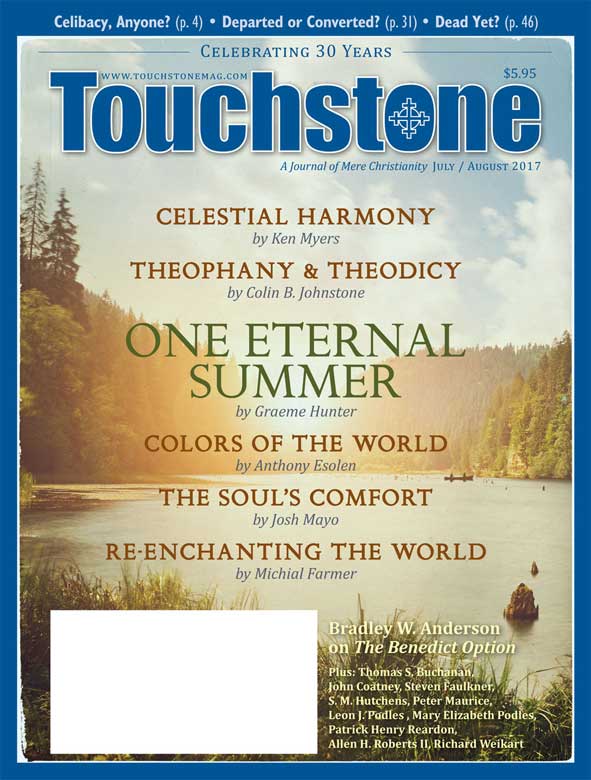
From Heavenly Harmony
The Harmony of Celestial Revelations
by Ken Myers
In 1146, the abbess of a small Cistercian convent in the Rhineland sent a letter to the abbot of a large and influential Cistercian monastery in Ville-sous-la-Ferté in northeastern France. The nun was both comforted and disquieted by a series of visions she had experienced, visions that conveyed to her a deep theological understanding of the Scriptures, which she was laboring to set down in writing. But she did not want to be presumptuous in transmitting this knowledge to others. As she was only an unlearned nun, was her assumption of the role of teacher an expression of unseemly pride?
The poetic disposition of this humble mother superior must have made an impression on the letter's wise and worthy recipient. As her appeal for counsel intensified, she implored him "by the sacred sound through which all creation resounds" and "by the Word from which all the world was created, by the height of the Father who through the sweet power of green vigor sent the Word to the Virgin's womb where it took on flesh like the honey in the honeycomb."
THIS ARTICLE ONLY AVAILABLE TO SUBSCRIBERS.
FOR QUICK ACCESS:
Ken Myers is the host and producer of the Mars Hill Audio Journal. Formerly an arts editor with National Public Radio, he also serves as music director at All Saints Anglican Church in Ivy, Virginia. He is a contributing editor for Touchstone.
A Journal of Mere Christianity—Delivered to Your Door
- Essays on theology, culture, and the Church
- Contributors from across the Christian traditions

Six print issues (one year) of Touchstone, plus full online access and PDF downloads for only $39.95.

Get a one-year full-access subscription to the Touchstone online archives for only $19.95.
bulk subscriptions
Order Touchstone subscriptions in bulk and save $10 per sub! Each subscription includes 6 issues of Touchstone plus full online access to touchstonemag.com—including archives, videos, and pdf downloads of recent issues for only $29.95 each! Great for churches or study groups.
Transactions will be processed on a secure server.
more from the online archives
33.3—May/June 2020
Bach's Cantata BWV 106, Gottes Zeit ist die allerbesteZeit (God's time is the very best time) by Ken Myers
20.4—May 2007
A Short & Surprising History of Protestantism & Contraception by Allan C. Carlson
calling all readers
Please Donate
"There are magazines worth reading but few worth saving . . . Touchstone is just such a magazine."
—Alice von Hildebrand
"Here we do not concede one square millimeter of territory to falsehood, folly, contemporary sentimentality, or fashion. We speak the truth, and let God be our judge. . . . Touchstone is the one committedly Christian conservative journal."
—Anthony Esolen, Touchstone senior editor
