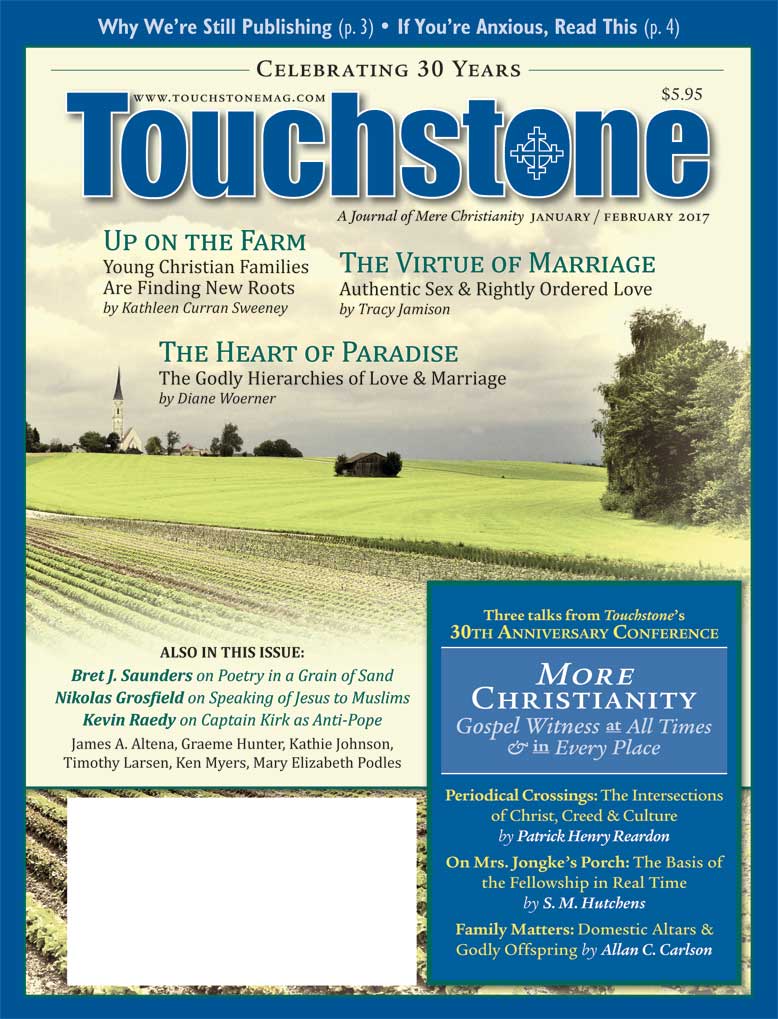
The World in a Grain of Sand by Bret J. Saunders

View

The World in a Grain of Sand

Bret J. Saunders on the Importance of Poetry in Christian Education & Life

In a time of down-to-earth economic and political concerns, hardly anything seems less worthwhile than poetry. Poetry is the business of introspective twenty-somethings living in their parents' basements; or perhaps it is mostly the business of snobby academics and obscure journals. Poetry seems purposely vague and narcissistic. Why would any sane person squander as much time as poets do on a single image, verse, or line—sometimes even a single word? Perhaps poets, especially modern ones, are in fact not sane; or maybe they write poetry because they can't do anything (else). And specifically "Christian" objections are not hard to come by. "Shouldn't you spend more time on God's word," someone might say, "instead of Robert Frost's and your own?" Fair question. What about spiritual pursuits of deeper value, like witnessing or going on a mission trip?

What follows is a defense of poetry and its place in Christian education and life.

First, what are we talking about? By "poetry" I mean "concentrated excess of speech," as Peter Leithart puts it. I mean language that is intentionally rhythmic and imagistic. Language in which the poet takes meanings, melts them down in the crucible of his imagination, and recasts them in an image or sequence of images. A poem bulges; but it also forges. According to Shakespeare, a poem gives ideas, worldviews, or character types "a local habitation and a name." William Blake once rhymed that poetry makes you "see a World in a Grain of Sand / And a Heaven in a Wild Flower / Hold Infinity in the palm of your hand /And Eternity in an hour."

All this sounds nice, but what good is poetry?

Let us get something out of the way first: we will never agree about the worth or role of poetry in education and life if we don't agree on the goals of education and life. What is education for? Education is different from job training. Education is for making you the kind of person who will pursue the true, the good, and the beautiful regardless of how you "make a living" and how much you make. Education is the shaping of the -imagination and the filling of the heart. If you agree with that, you might also desire a broader role for poetry in shaping and filling our lives—even beyond "school." We are always being educated.

Now to specifics.

Training in Description

Poetry trains us in the skill of vivid, concise description, as opposed to clichéd emoting. You probably have encountered one of those (usually young) people whose eulogistic vocabulary consists mostly of "awesome" and a few synonyms ("rad," "sick," "chill"). When you ask them to report on an overwhelming experience—the trip to Mexico, the hike, the rafting adventure, the ethnic cuisine—the experience proves too "awesome" for (any other) words. Such a speaker is, in the words of C. S. Lewis, "far more eager to praise and dispraise than to describe and define." Such a person's vocabulary is ill-equipped to handle the profundities he or she experienced. If everything's "awesome," then nothing's awesome.

Two consequences follow from this. The first is that relationships lack the depth and energy of shared experience. Lewis wrote, "Lovers are normally face to face, absorbed in each other; [whereas] friends [are] side by side, absorbed in a common interest." Of course it is speech that unites friends in a common interest when one is not present. "Oh my," someone says, "let me tell you how it went down." But the more such descriptions wither into clichés and sheer emoting, the more "awesome" they become, the less a mutual appreciation can bind friends together. This lack of words is especially damaging to long-distance relationships and ones in which the individuals inhabit very different worlds (e.g., a grandparent and a college student).

At this point you might want to suggest that photo-sharing on social media makes up for the poverty of language. Why labor to find the right words when friends can see for themselves? First of all, none but perhaps the most expensive cameras can capture the actual sensations of the experience the way that speech can. Second, cameras are generic, machine eyes. If I show you a photo of a mountain I met as I emerged from the forest on a backwoods adventure, that doesn't tell you how I saw it. The photo doesn't tell you how the color and shape and size of the mountain shocked my expectations at first sight. It doesn't tell you what I thought that color was ("magenta . . . no, pumpkin orange in the sunset . . . no, it was like that rusty '68 T-Bird of yours before your dad restored it . . .") or what that shape reminded me of.


A Journal of Mere Christianity—Delivered to Your Door

  • Essays on theology, culture, and the Church
  • Contributors from across the Christian traditions

Subscribe (Print + Online)

Six print issues (one year) of Touchstone, plus full online access and PDF downloads for only $39.95.

Subscribe (Online Only)

Get a one-year full-access subscription to the Touchstone online archives for only $19.95.


bulk subscriptions

Order Touchstone subscriptions in bulk and save $10 per sub! Each subscription includes 6 issues of Touchstone plus full online access to touchstonemag.com—including archives, videos, and pdf downloads of recent issues for only $29.95 each! Great for churches or study groups.

Transactions will be processed on a secure server.


more on poetry from the online archives

37.5—Sept/Oct 2024

Young Folly & Elder Hope

A Battle Plan for Peace While Growing Old by Anthony Esolen


more from the online archives
16.4—May 2003

Common Sense

Chesterton & the Aristotelian Tradition by Patrick Henry Reardon

33.2—March/April 2020

How It Happens

Easy Descent on an Unguarded Road by S. M. Hutchens

35.6—Nov/Dec 2022

To Is or Not To Is

on E-Prime by J. Douglas Johnson

calling all readers

Please Donate

"There are magazines worth reading but few worth saving . . . Touchstone is just such a magazine."
—Alice von Hildebrand

"Here we do not concede one square millimeter of territory to falsehood, folly, contemporary sentimentality, or fashion. We speak the truth, and let God be our judge. . . . Touchstone is the one committedly Christian conservative journal."
—Anthony Esolen, Touchstone senior editor

Support Touchstone

00