




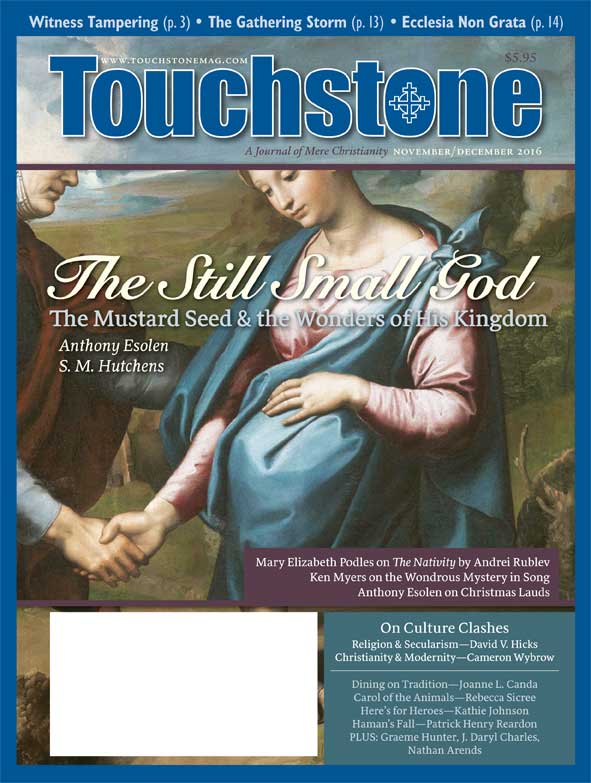
The Advent of the Everlasting Day
by Anthony Esolen
One of the marks of despair is a loss of the sense that time is going anywhere. Consider Macbeth before his final battle. When he learns of the death of his wife—and rumor has it, as Malcolm says when Macbeth's severed head is displayed before the true men of Scotland, that she has taken her own life "with self and violent hands"—Macbeth seems to resign his soul to the vanity of time:
Tomorrow and tomorrow and tomorrow
Creeps in this petty pace from day to day
To the last syllable of recorded time,
And all our yesterdays have lighted fools
The way to dusty death.
Call it the cold-weather Scottish counterpart to what the ungodly men of Judah say: "Let us eat, drink, and be merry, for tomorrow we die." And then there is the modern progressive form of the same despair, made manifest as a loathing of the past, impatience with the present, and a desperate commitment to some paradise that can be built up, stone on stone, in the future, if only the correct people control things, and can obliterate the memories of foolish little people apt to get in their way. Says Isaac Watts:
Time, like an ever-rolling stream,
Bears all its sons away;
They fly, forgotten, as a dream
Dies at the opening day.
But that cannot be the last word for a Christian, and indeed it is not so in that consoling old hymn: we pray to "God, our help in ages past, / Our hope for years to come." We remember the gracious works of our God, and that lends us the strength now to hope for help again.
Yet even that is not sufficient. Odysseus might put his sometimes uneasy trust in the goddess Athena, hoping that since she had helped him often in the past, she might do so once again as he faces the throng of angry and desperate suitors. That still does not really move us on toward glory. Odysseus has done a lot of traveling, and to be sure his restless curiosity is a leitmotif, for good and for ill, throughout Western civilization. But at the end of the Odyssey, after he has slain his rivals, there is no sense that he will be going anywhere again. Order has been restored; time flows on; men are born and grow old and die; there is no new world.
The Home We Long For
The Christian experience of time is not so. We feel, as all men do, the pounding waves of mutability washing over the prow of our little boat. We remember, as Odysseus does, and we know the pain of longing for return: nostalgia. We look ahead, as the secular progressives do, understanding that our true home is not here, not yet.
But the home we long for is neither the old stone house in Ithaca nor the never-resting fantasy of madmen; our memory is not simply a record of things gone by, and our looking forward is not simply the dreaming of things that might be. Our salvation has already come. All that has been, and that is, and that is to come has already been brought among us in the seed and the bud and the first flower; and that is not by an act of our imagination, but by the design of the eternal God, who, unlike Athena and unlike whatever deity it is for whom the modern progressive offers up his soul, possesses all times at once, and all times in each time. He is the God who made the Sabbath: the seventh day, the day that has a morning, and no evening.
A Scene from Judah
Anthony Esolen is Distinguished Professor of Humanities at Thales College and the author of over 30 books, including Real Music: A Guide to the Timeless Hymns of the Church (Tan, with a CD), Out of the Ashes: Rebuilding American Culture (Regnery), and The Hundredfold: Songs for the Lord (Ignatius). He has also translated Dante’s Divine Comedy (Random House) and, with his wife Debra, publishes the web magazine Word and Song (anthonyesolen.substack.com). He is a senior editor of Touchstone.
A Journal of Mere Christianity—Delivered to Your Door
- Essays on theology, culture, and the Church
- Contributors from across the Christian traditions

Six print issues (one year) of Touchstone, plus full online access and PDF downloads for only $39.95.

Get a one-year full-access subscription to the Touchstone online archives for only $19.95.
bulk subscriptions
Order Touchstone subscriptions in bulk and save $10 per sub! Each subscription includes 6 issues of Touchstone plus full online access to touchstonemag.com—including archives, videos, and pdf downloads of recent issues for only $29.95 each! Great for churches or study groups.
Transactions will be processed on a secure server.
more from the online archives

32.4—July/August 2019
on Probability, Death & the Existence of God by Graeme Hunter
29.5—Sept/Oct 2016
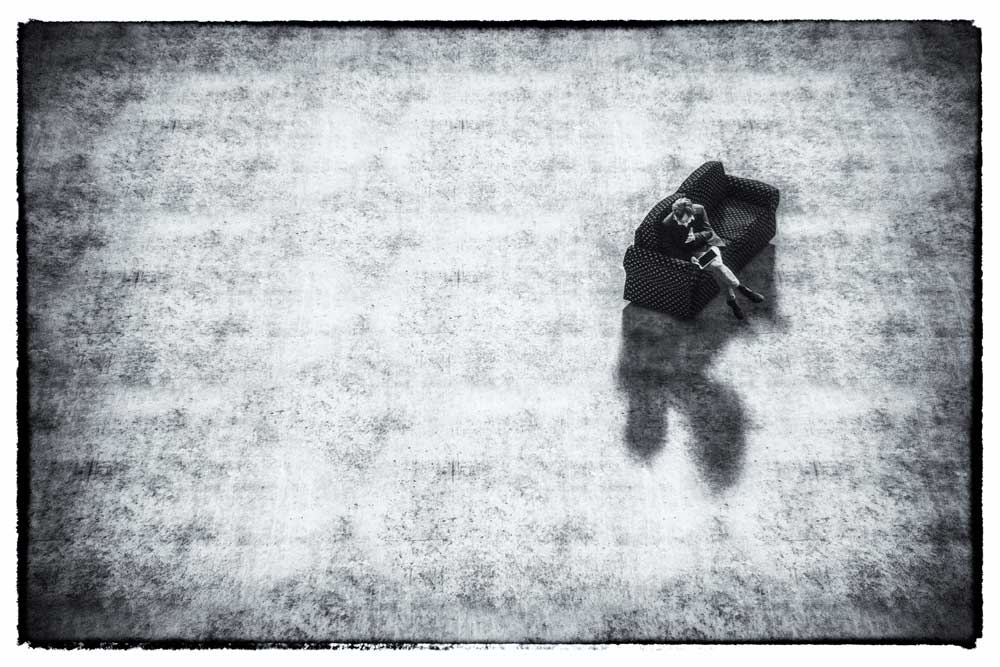
on the Loss of True Community & Rising Political Desperation by Karl D. Stephan

calling all readers
Please Donate
"There are magazines worth reading but few worth saving . . . Touchstone is just such a magazine."
—Alice von Hildebrand
"Here we do not concede one square millimeter of territory to falsehood, folly, contemporary sentimentality, or fashion. We speak the truth, and let God be our judge. . . . Touchstone is the one committedly Christian conservative journal."
—Anthony Esolen, Touchstone senior editor
