Rethinking Lockean Liberty by J. Daryl Charles

Book Review

Rethinking Lockean Liberty

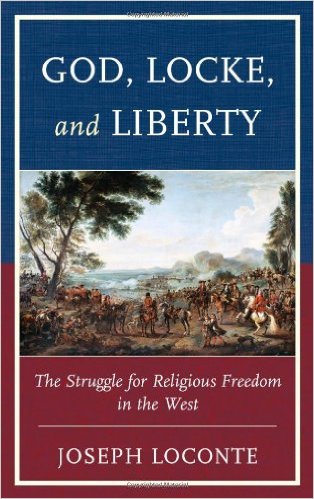
God, Locke, and Liberty: The Struggle
for Religious Freedom in the West

by Joseph Loconte

Lexington Books, 2014
(261 pages, $95.00, hardcover)
With the "bloody century" and its manifold forms of political-social totalitarianism barely behind us, scarcely a day goes by without news of either some religiously motivated atrocity or some denial of religious freedom. While many in the West anticipated a post-Cold War era of unprecedented peace and freedom, two decades into the twenty-first century it is precisely those developments since the end of the Cold War that vex us relentlessly, developments that come as a shock to those who had assumed Enlightenment thinking and secularizing forces would solve the political-religious problem. Religiously motivated crises and violence around the globe, fostered chiefly by resurgent Islam, have exposed the fragility of secularism as a comprehensive doctrine, causing post-secular second thoughts to emerge among even the staunchest apologists of its dogma.

Joseph Loconte, associate professor of history at The King's College in New York City, has written God, Locke, and Liberty in awareness that unless the current revolutions taking place globally produce societies that protect basic human rights, the political and social results will be catastrophic. The book does not concern current events, nor does it offer a prognosis of the future of religious freedom in Western societies, despite the somewhat misleading subtitle. Rather, its focus is late seventeenth-century Europe, where religiously motivated violence, despite official ends to Europe's religious wars, "continued to disrupt the social order and undermine political regimes."

The Necessary Reconciliation

While no single event, in Loconte's view, was responsible for a transition toward religious diversity and political stability during these years, a handful of individuals, among them John Locke, "sought to create a new reconciliation between faith and politics." Locke's chief contribution, as Loconte sees it, was to argue for religious toleration as a civic and political norm. Locke's most authoritative response to the strife of his day, A Letter Concerning Toleration (1689), ranks as "the most important defense of religious liberty in the Western tradition." In a way not previously known, Locke "reconceived religious diversity as a source of social and political stability." Christian piety, he insisted, "could lay the foundation for a more just and tolerant society."

The central burden of Loconte's treatise is that despite renewed scholarly attention to Locke in recent decades, the religious character of A Letter Concerning Toleration has in many ways been slighted. Specifically, due to "primarily political interpretations" that render him "the father of modern empiricism," there has been insufficient attention to Locke's conspicuously Christian ideals and objectives. Loconte wishes to demonstrate that Locke embraced "an earlier reform movement within Christianity, the Christian humanist tradition," with a view to advancing his defense of religious toleration.

In recovering Locke's religious views, Loconte refuses to be sidetracked, as are many observers, by Locke's doctrinal peculiarities (the "Puritan Locke," the "Socinian Locke," the "Calvinist Locke," the "rationalist Locke," the "revolutionary Locke," and so on). None of these portraits does justice to the person, inasmuch as Locke found virtue, wisdom, and truth wherever it was to be found. Rather, the relatively "unexamined" Christian elements that helped shape Locke's moral imagination—and the subsequent manner in which this imagination molded his understanding of religious toleration, his social-political vision, and his accent on preserving the common good—are in need of thorough examination.

What people are saying about Touchstone:


The Lockean Idea: Context & Derivation

The structure of God, Locke, and Liberty is fourfold: it attempts to elucidate (1) the context in which late seventeenth-century debates over freedom of conscience took place; (2) the English context in which Locke operated; (3) the influence of Dutch reformers, notably those in the Erasmian tradition, who contributed to Locke's thinking; and (4) the religious and political logic of Locke's toleration rhetoric (what Loconte—perhaps unhelpfully—calls a "politics of Jesus") as expressed chiefly in A Letter. Locke targeted his message first to religious leaders, given their cultural authority and the European tendency to collapse the distinctions between ecclesiastical and political authority. Of all things, it is the liberty of conscience that stands out in his writing. No one, no entity, no authority—ecclesiastical or political—can coerce a person into belief and conviction. Where coercion or repression reigns, both church and state suffer, with the result that the common civic good is undermined, if not destroyed.


J. Daryl Charles is the Acton Institute Affiliated Scholar in Theology & Ethics. He is the author or editor of twenty books, including Retrieving the Natural Law (2008), Natural Law and Religious Freedom (2018), and, most recently, Just War and Christian Traditions (forthcoming). He is also co-editor of Abraham Kuyper, Common Grace: God's Gifts for a Fallen World, Volume 3 (2020). He is a contributing editor to Touchstone.

A Journal of Mere Christianity—Delivered to Your Door

  • Essays on theology, culture, and the Church
  • Contributors from across the Christian traditions

Subscribe (Print + Online)

Six print issues (one year) of Touchstone, plus full online access and PDF downloads for only $39.95.

Subscribe (Online Only)

Get a one-year full-access subscription to the Touchstone online archives for only $19.95.


bulk subscriptions

Order Touchstone subscriptions in bulk and save $10 per sub! Each subscription includes 6 issues of Touchstone plus full online access to touchstonemag.com—including archives, videos, and pdf downloads of recent issues for only $29.95 each! Great for churches or study groups.

Transactions will be processed on a secure server.


more on religious liberty from the online archives
24.6—Nov/Dec 2011

Statutes of Liberty

on the Tyranny of Modern Freedom versus the Freedom of Jesus by Gillis J. Harp

24.6—Nov/Dec 2011

Liberty, Conscience & Autonomy

How the Culture War of the Roaring Twenties Set the Stage for Today’s Catholic & Evangelical Alliance by Barry Hankins
27.3—May/June 2014

Religious Freedom & Why It Matters

Working in the Spirit of John Leland by Robert P. George


more from the online archives

32.4—July/August 2019

Malaise in Malaysia

Will Islamicization Become Its New Future by Peter Riddell

25.4—July/August 2012

All the Lonely People

The Corrosive & Far-Reaching Fallout of the Sexual Revolution by Anthony Esolen

22.6—July/August 2009

Unhappy Fault

on the Integration of Anger into the Virtuous Life by Leon J. Podles

calling all readers

Please Donate

"There are magazines worth reading but few worth saving . . . Touchstone is just such a magazine."
—Alice von Hildebrand

"Here we do not concede one square millimeter of territory to falsehood, folly, contemporary sentimentality, or fashion. We speak the truth, and let God be our judge. . . . Touchstone is the one committedly Christian conservative journal."
—Anthony Esolen, Touchstone senior editor

Support Touchstone

00