Odium Generis Humani
The War on Humans by Wesley J. Smith
Discovery Institute Press, 2014
(240 pages, $14.95, paperback)
reviewed by Richard Weikart
In August 2005 the London Zoo opened a special primate display—a four-day exhibit of Homo sapiens. A zoo spokesperson proclaimed that this display "teaches members of the public that the human is just another primate." Worse yet, the zoo issued a communiqué explaining that the intent of the exhibit was "to highlight the spread of man as a plague species." The notion that humans are a "plague species," a cancer on the earth, and a dangerous pathogen that needs to be eliminated, is increasing in forcefulness in our society. Where did this come from, and how influential is it?
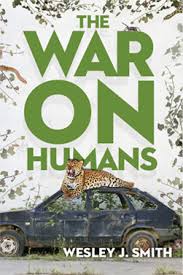
Bioethics expert and lawyer Wesley Smith explains in his new book, The War on Humans, that environmentalism took a wrong turn in the 1960s. Before that time, most environmentalists concentrated on conservation and cleaning up pollution. This style of environmentalism had salutary effects on human health and well-being. Radical environmentalists in the 1960s, however, became increasingly anti-human in their approach. The Canadian science broadcaster David Suzuki reflected this agenda in 1972 when he said humans are maggots "defecating all over the environment." As Smith compellingly demonstrates in this short book, Suzuki's radical perspective has in the intervening decades become mainstream in the environmental movement.

Having at It Again: Surplus Population
Smith identifies and explains four key issues that exemplify the anti-human thrust of the environmental movement.
First is the call for drastic reductions in the human population. The sixties craze for Zero Population Growth is not radical enough for these anti-human environmentalists. The Norwegian philosopher Arne Dekke Eide Næss, influential founder of Deep Ecology, advocated that we reduce the human population to 100 million. British scientist James Lovelock, the formulator of the trendy Gaia Theory, suggested a reduction to one billion would suffice. Either way, billions of humans would have to go. Smith warns: "If actually implemented, Gaia Theory and Deep Ecology would lead to the collapse of modern civilization" (22).
Many of these radical environmentalists openly disparage humanity. For instance, Paul Watson of the Sea Shepherd Conservation Society claims that humans are a pathogen. He insists we are the "AIDS of the Earth." Eric Pianka, a University of Texas herpetologist and evolutionary ecologist, asserts, "Humans are no better than bacteria." He hopes for the 90-percent reduction in human population that could be efficiently produced by an agent like the Ebola virus, believes such a reduction is inevitable, and thinks it good in the sense that it will serve the cause of ecological balance between species, none of which can rightly claim superiority over the other.
Global Warming, Rights of Nature & Ecocide
Second, Smith takes on the anti-human side of the global warming hysteria. While professing agnosticism about whether humans are its cause, he exposes some of the more ridiculous claims and false predictions of the doomsday climate prophets. More importantly, he vigorously protests against the way that global warming has been used to promote the war on humans: It is bad enough that school-children are being taught by scaremongers to loathe themselves and other humans for our allegedly deleterious effects on our planet. Worse yet, policies restricting carbon emissions will likely result in continuing widespread poverty in the developing world and thus contribute to human suffering and death.
Third, the movement toward granting rights to nature has ominous implications for humanity. Alongside human rights, Ecuador has incorporated the "rights" of nature into its constitution. Bolivia and thirty U.S. municipalities, including Pittsburgh, have passed laws granting such rights. Environmentalist lawyers have begun barraging courts worldwide with lawsuits on behalf of primates and even orcas. The philosopher Michael Marder has even argued that we humans should refrain from eating all annual plants, such as peas and wheat, because they have rights, too.
Richard Weikart is professor of history at California State University, Stanislaus, and author of From Darwin to Hitler: Evolutionary Ethics, Eugenics, and Racism in Germany and Hitler's Ethic: The Nazi Pursuit of Evolutionary Progress (both from Palgrave Macmillan). Some of his writings can be found at www.csustan.edu/history/faculty/weikart.
A Journal of Mere Christianity—Delivered to Your Door
- Essays on theology, culture, and the Church
- Contributors from across the Christian traditions

Six print issues (one year) of Touchstone, plus full online access and PDF downloads for only $39.95.

Get a one-year full-access subscription to the Touchstone online archives for only $19.95.
bulk subscriptions
Order Touchstone subscriptions in bulk and save $10 per sub! Each subscription includes 6 issues of Touchstone plus full online access to touchstonemag.com—including archives, videos, and pdf downloads of recent issues for only $29.95 each! Great for churches or study groups.
Transactions will be processed on a secure server.
more from the online archives

calling all readers
Please Donate
"There are magazines worth reading but few worth saving . . . Touchstone is just such a magazine."
—Alice von Hildebrand
"Here we do not concede one square millimeter of territory to falsehood, folly, contemporary sentimentality, or fashion. We speak the truth, and let God be our judge. . . . Touchstone is the one committedly Christian conservative journal."
—Anthony Esolen, Touchstone senior editor