




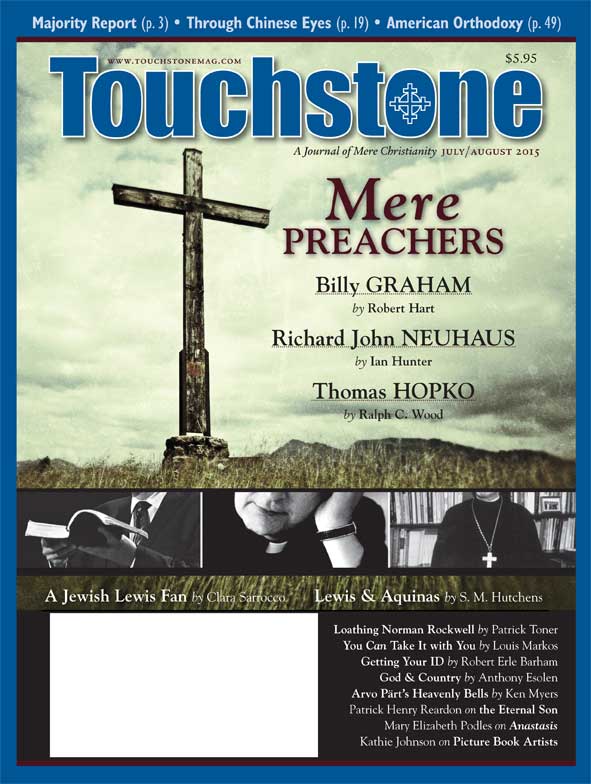
Feature
The Prophetic Preacher
In Memoriam: Father Thomas Hopko
by Ralph C. Wood
There are many who knew our dear friend of blessed memory, Father Thomas Hopko, much better than I did. An encompassing assessment of his life and work belongs to them. I spent a total of six days in his presence—three at a retreat in South Carolina during the late 1980s and three more during the mid-1990s, when I sponsored his giving of endowed lectures at Wake Forest University. Yet during these brief encounters, and then in subsequent correspondence, he shaped my Christian existence in ways so transformative that they call for gratitude from one who still calls himself a Baptist. And I would call him a preacher of the gospel.
With his engaging eye contact, his trim goatee, his high-pitched voice, and glasses that could serve as paperweights, Tom Hopko was easy to like. We found an immediate kinship of soul because he shared my admiration of Flannery O'Connor, especially her angular humor. Because the gospel always exists as a drastic New Thing in a dying world, its expression must be radical rather than bland. He could quote entire swatches of O'Connor's thorny work, including a splendid retrogressive passage from her second novel, The Violent Bear It Away.

The narrator is inside the mind of a wild backwoods prophet named Mason Tarwater. He has kidnapped his great-nephew Francis Marion to baptize him and therefore to catechize him with a far superior course of study than the boy would have received in a public school. There, the truculent prophet observes, young Francis would have been herded into a room together with other children his age to do little more than "cut out paper pumpkins under the direction of a woman." Over against such anodyne and effete training, the elder prophet has taught the abducted youth not only the basic disciplines but also the grand narrative of the world's salvation. Thus will he not be trapped in the small-minded categories of secular learning but instead made "free for the pursuit of wisdom":
His uncle had taught him Figures, Reading, Writing, and History beginning with Adam expelled from the Garden and going on down through the presidents to Herbert Hoover and on in speculation toward the Second Coming and the Day of Judgement. . . . [T]he companions of his spirit [were] Abel and Enoch and Noah and Job, Abraham and Moses, King David and Solomon, and all the prophets, from Elijah who escaped death, to John whose severed head struck terror from a dish.
As he finished his recitation of this passage, Tom would throw his head back in howling repetition of the fright given to mighty Herod by the martyred Baptizer: whose severed head struck terror from a dish.
No Light-Hearted Affair
Hopko's strong regard for the primitive folk Christianity of the American South—not really fundamentalist so much as sweated and serious—also made him sympathetic to the gaffes of priests within his own tradition. He told of a young Russian priest whose command of English was far from complete, and who thus led the congregation in an unusual recitation of the Apostles' Creed: "I believe in God the Father almighty, Maker of heaven and earth, and in Jesus Christ his only Son-in-Law"!
Yet Fr. Tom's life as a pastor was never a light-hearted affair. He told me of the grandmothers who came asking that their grandson be baptized. Hopko explained to them that baptism requires the participation of the parents. After a good deal of mumbling and side-stepping, the dark truth emerged: these serious Christian ladies wanted this child to be sacramentally incorporated into the Body of Christ but also in the absence of his gangster parents. In a barely heated sanctuary, so cold that one's breath was visible, and with the baby shrieking furiously, Fr. Tom began pouring water over the child's head while reciting the baptismal formula. Whether from the shock of the water or the exorcism of the devil, the infant suddenly checked his scream. A janitor at the back of the church could not contain his astonishment, albeit in fractured English: "What make-a the baby stop-a to cry?"
Looking up at the source of this rude intrusion, Hopko also spotted a young couple peering through the barely opened vestibule doors. Clearly these were the child's parents, hoping anonymously to witness the baptism and chrismation of their boy. In a moment of Holy Ghost inspiration, Fr. Tom found himself announcing the words of Matthew 18:6: "If anyone shall offend one of these little ones who believe in me, it would be better that a millstone be hung around his neck, and that he be drowned in the depth of the sea." For several months the grandmothers brought the child with them to the Liturgy, but then Fr. Tom noted his absence. He asked for an explanation, and they told him that the parents had abandoned their mobster life, moved to a suburb, and become faithful Orthodox communicants. It's not only Catholics who understand the meaning of ex opere operato.
Ralph C. Wood was, until his retirement, University Professor of Theology and Literature at Baylor University in Waco, Texas. His books include The Comedy of Redemption (University of Notre Dame Press), Flannery O’Connor and the Christ-Haunted South (Eerdmans), and Chesterton: The Nightmare Goodness of God (Baylor University Press).
A Journal of Mere Christianity—Delivered to Your Door
- Essays on theology, culture, and the Church
- Contributors from across the Christian traditions

Six print issues (one year) of Touchstone, plus full online access and PDF downloads for only $39.95.

Get a one-year full-access subscription to the Touchstone online archives for only $19.95.
bulk subscriptions
Order Touchstone subscriptions in bulk and save $10 per sub! Each subscription includes 6 issues of Touchstone plus full online access to touchstonemag.com—including archives, videos, and pdf downloads of recent issues for only $29.95 each! Great for churches or study groups.
Transactions will be processed on a secure server.
more on biographical from the online archives
more from the online archives
32.1—January/February 2019
Sex, Women's Ordination & the Rejection of Hierarchy & Equality by James A. Altena
29.4—July/August 2016
Russell Kirk: American Conservative by Bradley J. Birzer by Hunter Baker

33.3—May/June 2020
on the Wisdom of the Good Doctor Edmund Pellegrino by Allen H. Roberts II
calling all readers
Please Donate
"There are magazines worth reading but few worth saving . . . Touchstone is just such a magazine."
—Alice von Hildebrand
"Here we do not concede one square millimeter of territory to falsehood, folly, contemporary sentimentality, or fashion. We speak the truth, and let God be our judge. . . . Touchstone is the one committedly Christian conservative journal."
—Anthony Esolen, Touchstone senior editor
