





Column: From Heavenly Harmony
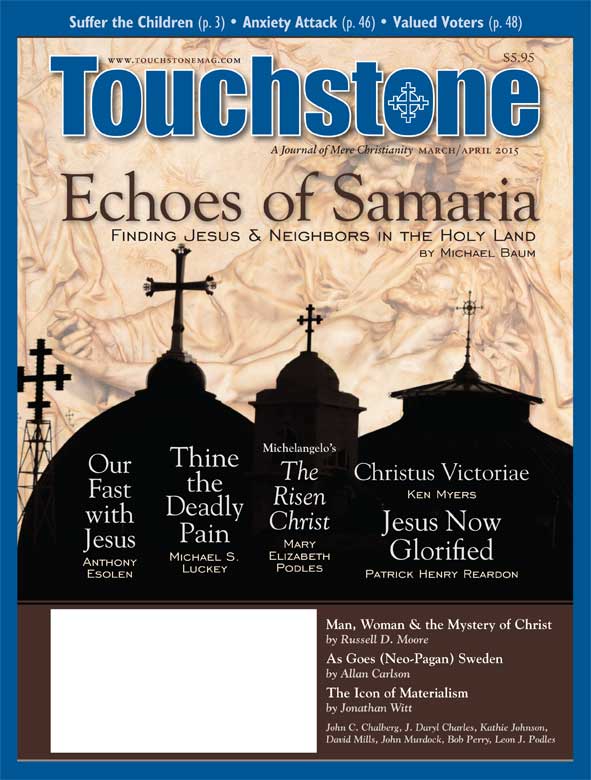
Christus Victoriae
by Ken Myers
The medieval city of Ávila, seventy miles northwest of Madrid, is best known to Christians as the birthplace of St. Teresa de Jesus, the sixteenth-century Carmelite nun, mystic, and reformer. Captured by Moors in a.d. 714, the city was retaken by Christian forces in 1088, after which a network of massive stone walls and towers was constructed to protect the city and its new cathedral, construction of which began around 1091. The apse of the cathedral is one of the turrets in the city walls, possibly evoking echoes of Psalm 46 to generations of believers: "The Lord of hosts is with us; the God of Jacob is our fortress."
Ávila may be the same city as ancient Abula, evangelized by the first-century missionary martyr bishop St. Secundus, who was traditionally numbered among the Seven Apostolic Men commissioned by Saints Peter and Paul to preach to the two Roman provinces of Hispania. Even if the identification of Ávila with Abula is incorrect, it seems that Ávila is a place where Christians have been active in the spiritual combat of prayer and worship for a long time.
THIS ARTICLE ONLY AVAILABLE TO SUBSCRIBERS.
FOR QUICK ACCESS:
Ken Myers is the host and producer of the Mars Hill Audio Journal. Formerly an arts editor with National Public Radio, he also serves as music director at All Saints Anglican Church in Ivy, Virginia. He is a contributing editor for Touchstone.
subscription options
Order
Print/Online Subscription

Get six issues (one year) of Touchstone PLUS full online access including pdf downloads for only $39.95. That's only $3.34 per month!
Order
Online Only
Subscription

Get a one-year full-access subscription to the Touchstone online archives for only $19.95. That's only $1.66 per month!
bulk subscriptions
Order Touchstone subscriptions in bulk and save $10 per sub! Each subscription includes 6 issues of Touchstone plus full online access to touchstonemag.com—including archives, videos, and pdf downloads of recent issues for only $29.95 each! Great for churches or study groups.
Transactions will be processed on a secure server.
more from the online archives
29.1—Jan/Feb 2016
on Marriage, Moral Corruption & the Christian Duty of Witness by Regis Nicoll

32.4—July/August 2019
on Probability, Death & the Existence of God by Graeme Hunter
33.1—January/February 2020
on a Saint's Charism That Cures Toxic Perfectionism by Colleen Carroll Campbell
calling all readers
Please Donate
"There are magazines worth reading but few worth saving . . . Touchstone is just such a magazine."
—Alice von Hildebrand
"Here we do not concede one square millimeter of territory to falsehood, folly, contemporary sentimentality, or fashion. We speak the truth, and let God be our judge. . . . Touchstone is the one committedly Christian conservative journal."
—Anthony Esolen, Touchstone senior editor
