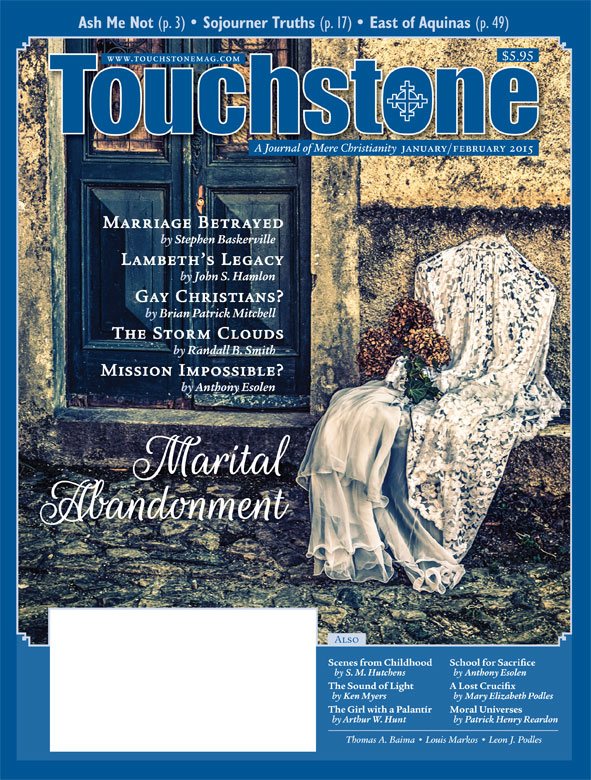
Gay Christians? by Brian Patrick Mitchell

Feature

Gay Christians?

The Grave Danger Coming Out Poses to Christian Churches
by Brian Patrick Mitchell

Conflict makes people uncomfortable, so in mixed company, people watch what they say. Instead of speaking their minds on controversial issues, they trim their opinions to fit those around them—sometimes out of charity, sometimes out of prudence, but often out of cowardice.

Gays count on cowardice when they "come out." They know that announcing themselves as gay will silence most objections to gayness. The person who comes out dares others to disagree with him on the matter, challenging them to either accept him as gay or make him their enemy. Not surprisingly, the closer one is to someone who comes out, the harder it is to maintain one's disapproval of homosexuality. Pew Research reports that people who know a lot of gays are twice as likely to support gay marriage as people who know none. Even for many professed Christians, family blood is ultimately thicker than the water of Holy Baptism. Witness Senator Rob Portman's recent conversion to the cause of gay marriage at the urging of his gay son.

Coming out therefore poses a special danger to Christianity, but not in the way many might think. The greater danger is not from gays openly living the gay lifestyle while still claiming to be Christians. Most such gays will migrate to churches accepting of the gay lifestyle and thus leave other churches undisturbed. The greater danger is from Christians who profess to be both "gay" and chaste—Christians who openly identify themselves as "gay" on account of their attraction to members of their own sex, yet who accept their church's condemnation of homosexual relations as sinful.

In her new book Gay and Catholic (Ave Maria Press, 2014) and in an article in The American Conservative entitled "Coming Out Christian: How faithful homosexuals are transforming our churches," self-styled "gay Christian" Eve Tushnet touts the benefits of coming out for both gays and churches. In the article, she writes that coming out is a matter of

honesty and integrity—no more "pronoun games," no more hedging and sudden silence when the conversation turns to romance or visions of one's future. The coming-out narrative transforms a source of shame and stigma into a freely accepted, simple truth, which no longer excludes one from the ordinary social world. Coming out allows deeper bonds to be formed: not only romantic relationships but deeper friendships, more honest familial ties, and more pointed and relevant relationships with spiritual guides such as confessors and pastors.

Make no mistake: "coming out" does not mean confiding one's struggle against same-sex attraction in a close friend or pastor; it means openly declaring one's orientation to effect a fundamental change in one's church. The "gay Christians" Tushnet quotes say that coming out makes churches more -welcoming and Christ-like; it shifts the focus of pastoral concern away from "the ex-gay narrative" toward assisting gays in simply living with their desires without indulging them; gays can even witness to straights by demonstrating that celibacy is not only possible but required of all single Christians; so instead of the "prosperity gospel" and a "sentimental, Disney view of marriage," more Christians will learn the lonely, painful way of the Cross.

There is, of course, some truth to this, but there is also a great danger, for openly "gay" Christians present churches with extremely difficult problems of both faith and discipline—problems that have lately tended to undermine the faithfulness of whole communions.

What Is a "Gay Christian"?

The first problem is the term "gay Christian," which can mean either kind of gay—the professed Christian who lives gay or the professed gay who lives Christian. This ambiguity complicates the discourse, causing considerable uncertainty about how each self-styled "gay Christian" sees himself or herself and about what his or her public plea for acceptance might entail for other Christians. Since those who call themselves "gay Christians" differ greatly in what they mean and want, traditional Christians are justified in objecting to the term on the grounds that it is likely to cause misunderstanding and lead people to presume that it approves more than it should.


A Journal of Mere Christianity—Delivered to Your Door

  • Essays on theology, culture, and the Church
  • Contributors from across the Christian traditions

Subscribe (Print + Online)

Six print issues (one year) of Touchstone, plus full online access and PDF downloads for only $39.95.

Subscribe (Online Only)

Get a one-year full-access subscription to the Touchstone online archives for only $19.95.


bulk subscriptions

Order Touchstone subscriptions in bulk and save $10 per sub! Each subscription includes 6 issues of Touchstone plus full online access to touchstonemag.com—including archives, videos, and pdf downloads of recent issues for only $29.95 each! Great for churches or study groups.

Transactions will be processed on a secure server.


more on Sex from the online archives

33.1—January/February 2020

Forbidden Lies

Speaking Truth About the Sexes Is Not Optional by Anthony Esolen

31.6—November/December 2018

Of Single Importance

on the Church's Response to the Anti-marriage Tide by Diane Woerner

27.6—Nov/Dec 2014

Tales of Forbidden Stereotypes

Real-Life Men & Women & the Tragic Loss of Human Comedy by Anthony Esolen


more from the online archives

23.6—November/December 2010

Darwin, Design & Thomas Aquinas

The Mythical Conflict Between Thomism & Intelligent Design by Logan Paul Gage

28.3—May/June 2015

Dumb Sheep

on the Truth About a Slanderous Accusation by James S. Spiegel

29.5—Sept/Oct 2016

The True Atheist Myth

on Past & Present Atheism & the Invention of Happiness by Jordan Bissell

calling all readers

Please Donate

"There are magazines worth reading but few worth saving . . . Touchstone is just such a magazine."
—Alice von Hildebrand

"Here we do not concede one square millimeter of territory to falsehood, folly, contemporary sentimentality, or fashion. We speak the truth, and let God be our judge. . . . Touchstone is the one committedly Christian conservative journal."
—Anthony Esolen, Touchstone senior editor

Support Touchstone

00