




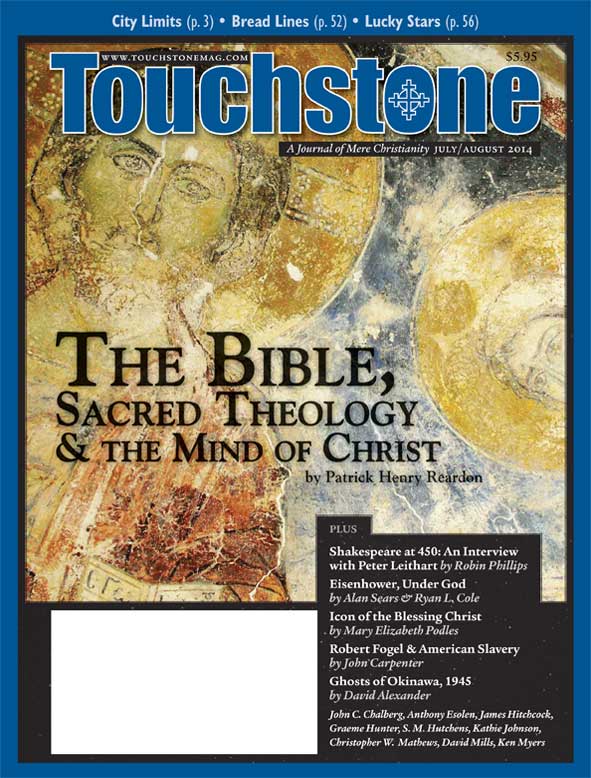
The Stars of Abraham
Bible-readers do not have to advance very far into the text before they find the Lord's invitation and promise to Abraham: "Look now toward heaven, and count the stars if you are able to number them. . . . So shall your descendants be" (Gen. 15:5).
Now, most of us would agree, I believe, that this text refers to the numerous promised progeny of Abraham. The command to "count the stars" appears to imply as much.
Well, not so fast. The verb saphar does, indeed, mean "to count." The etymological root of the word, however, is richer and a tad more complicated. In its various forms and contexts, sphr can mean not only "to count," but also "to recount," or "to take account of," or "to make accounting of." That is to say, the purely numerical sense of the root rather quickly extends to forms of narrative and interpretation. The heavens, according to the Psalmist, declare (mesapharim, give an account of) the glory of God; the stars transcribe a story. Stars form the handwriting on the surface of the sky. They hang in the heavens in order to be read.
God could be telling Abraham something like this: Take a good look at those stars and consider them well, because your own descendents are going to be very much like them; they will be exalted like the stars.
Fanciful? I don't think so, and mine is hardly the first imagination to run in this direction.
Consider, for instance, the following interpretation by Sirach in the second century before Christ:
Therefore by an oath [God] gave him glory in his posterity, that he should increase as the dust of the earth, and that He would, like the stars, exalt his seed (hos astra anypsosai to sperma avtou), and they should inherit from sea to sea, and from the river to the ends of the earth. (44:21)
Observe that the dust of the earth here is a metaphor for Abraham's numerous children, whereas their likeness to the stars has to do with a certain "exaltation." That is to say, the metaphor of the dust is quantitative, whereas that of the stars is qualitative; Abraham's descendents will resemble the stars.
Not convinced? Well, consider how Philo of Alexandria reads the text two centuries after Sirach:
And after [God] has conducted [Abraham] out, he says to him, "Look up to heaven, and count the stars, if thou art able to number them; thus shall be your seed." He says quite appropriately, "Thus (houtos) shall be your seed," not "so many" (tosouton), as though equal in number to the stars. He does not allude here merely to their number, but also to certain other features, which pertain to perfect and complete happiness. The seed shall be, he declares, like the ethereal light displayed before him, heavenly (ouranion) as it is, pure and unshadowed, because night is banished from the heavens, and darkness from the ether. It shall be the likeness of the stars (asteroeidestaton). (Heir of Divine Things 86–87).
If this interpretation still seems improbable, you may want to consult Irenaeus of Lyons a century later. He writes, "And that Abraham might know, not only the great number, but also the splendor of his seed, God led him out at night and told him, 'See if you can count the stars in heaven; thus will be your seed'" (Demonstration 24). The difference here, of course, is that Irenaeus is reading the text as a Christian; he goes on to comment,
Patrick Henry Reardon is pastor emeritus of All Saints Antiochian Orthodox Church in Chicago, Illinois, and the author of numerous books, including, most recently, Out of Step with God: Orthodox Christian Reflections on the Book of Numbers (Ancient Faith Publishing, 2019).
A Journal of Mere Christianity—Delivered to Your Door
- Essays on theology, culture, and the Church
- Contributors from across the Christian traditions
Subscribe (Print + Online) 
Six print issues (one year) of Touchstone, plus full online access and PDF downloads for only $39.95.
Subscribe (Online Only) 
Get a one-year full-access subscription to the Touchstone online archives for only $19.95.
bulk subscriptions
Order Touchstone subscriptions in bulk and save $10 per sub! Each subscription includes 6 issues of Touchstone plus full online access to touchstonemag.com—including archives, videos, and pdf downloads of recent issues for only $29.95 each! Great for churches or study groups.
Transactions will be processed on a secure server.
more from the online archives
24.1—January/February 2011
Marriage Thrives in Reality, Not in Our Dreams by Nathan Schlueter
31.6—November/December 2018
The Slow Vindication of Leon Podles by S. M. Hutchens

32.2—March/April 2019
Reality Shows, Even in a Popular TV Series by C. E. Smith
calling all readers
Please Donate
"There are magazines worth reading but few worth saving . . . Touchstone is just such a magazine."
—Alice von Hildebrand"Here we do not concede one square millimeter of territory to falsehood, folly, contemporary sentimentality, or fashion. We speak the truth, and let God be our judge. . . . Touchstone is the one committedly Christian conservative journal."
Support Touchstone
—Anthony Esolen, Touchstone senior editor
