




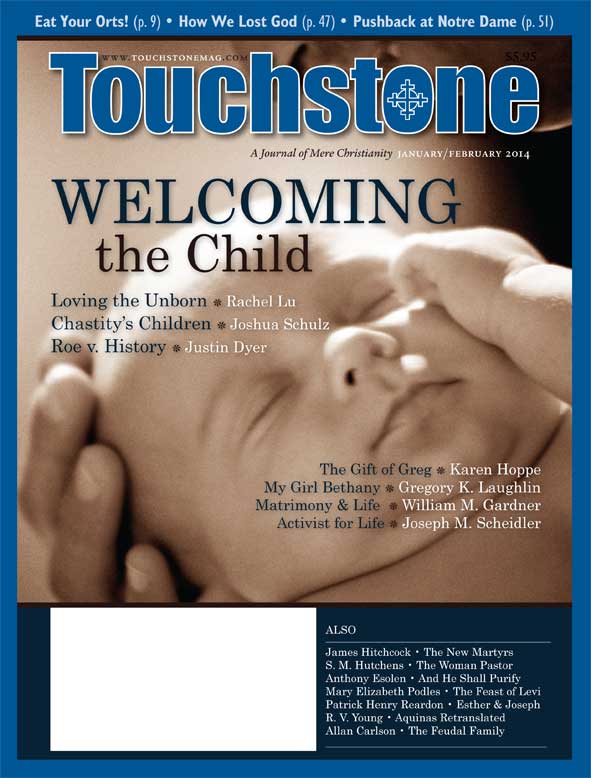
Review
Fallen Family
How the West Really Lost God: A New Theory of Secularization by Mary Eberstadt
Templeton Press, 2013
(268 pages, $19.37, hardcover)
reviewed by C. R. Wiley
We can hope that Western civilization is in the early stages of awakening from a bad dream. Mary Eberstadt's new book may help with that. It is more a stirring nudge than a blaring alarm—in part because it is an accessible work of social science, not a moral treatise. Throughout, she reassures us that she is just looking for the truth—the truth being amoral and merely factual in this case. Apart from my own doubts about the possibility or desirability of knowing facts as such, anyone who favors life over death, or meaning over the void, cannot help but feel a moral stirring.
Her thesis, which she labels the "Family Factor," is straightforward: As goes the natural family, so goes religion, especially Christianity. She uses the double helix structure of DNA to illustrate this interdependency. DNA's structure is like a twisted ladder, whose two side rails are linked by rungs of biochemical information. Similarly, religion and the natural family are "the double helix of society." Religion directs biological reproduction towards meaningful social and spiritual ends. Without it, family life loses its connection to those ends. But without the natural family, religion loses an important support. In a world with central heating and agribusiness, the natural family is the last direct connection most people have to a natural order. With its demise, traditional religion loses an important justification for its sacrifices.
It is Eberstadt's contention that the natural family fell first. This is the real reason the West lost God.
But this is not how the story of secularization is usually told. It usually goes something like this: Once upon a time, Western man lived in the ignorance and superstition of religion. Then the light of reason dawned. In that light, religion was revealed to be a bogy. Now, with the aid of empirical science and liberal democracy, Western man boldly makes a world for himself. There are vestiges of religion lurking in the benighted nooks and crannies, but someday even those dark places will be filled with the light of knowledge, and religion will be no more.
Eberstadt spends the first half of the book explaining why this and similar mythologies fail to give a full accounting of secularization. It is useful reading, and for those who believe that ideas are communicated exclusively through propositions, it is important reading. But for those of us inclined to take a more sacramental view of things, who already know that messing around with the forms of social life can alter beliefs, the best part of the book is the second half.
The Demise of the Family
Eberstadt fingers the usual suspects for the demise of the family: the industrial revolution, the welfare state, and contraception. Anyone who has read Robert Nisbet or Christopher Lasch will be familiar with her functionalist account of the fall of the natural family in modern times, an account I find convincing.
Here's a quick summary of that story: Once upon a time, the natural family was a school for children, a nursing home for the aged, and, most importantly, a productive and largely self-sufficient economy. But with the rise of the factory and the exchange of the family's most physically productive member for money, the center of economic life moved out of the home. Fathers now spent most of their time someplace else.
This weakened the natural family and made it dependent. Eventually, many of its traditional social-welfare functions were outsourced: education to public schools, care for the aged to nursing homes. Households were downgraded to outlets for recreation and personal expression. Children were no longer valued for their contributions to the household, but now rather resembled pets—creatures to lavish ourselves upon, but unnecessary. With the industrial revolution, religion was called upon to justify the burden of these little, clinging liabilities. Then came the sexual revolution.
C. R. Wiley is a pastor living in the Pacific Northwest. He is the author of The Household and the War for the Cosmos and In the House of Tom Bombadil. He is also a co-host of The Theology Pugcast. He is a senior editor of Touchstone.
A Journal of Mere Christianity—Delivered to Your Door
- Essays on theology, culture, and the Church
- Contributors from across the Christian traditions

Six print issues (one year) of Touchstone, plus full online access and PDF downloads for only $39.95.

Get a one-year full-access subscription to the Touchstone online archives for only $19.95.
bulk subscriptions
Order Touchstone subscriptions in bulk and save $10 per sub! Each subscription includes 6 issues of Touchstone plus full online access to touchstonemag.com—including archives, videos, and pdf downloads of recent issues for only $29.95 each! Great for churches or study groups.
Transactions will be processed on a secure server.
more on family from the online archives
34.1—January/February 2021
Jesus' Astonishing Other Teaching on Marriage by James Ware
36.1—Jan/Feb 2023
A History of the Protestant Debate over Contraception by James A. Altena

more from the online archives

30.5—Sept/Oct 2017
The Christian Cure for What Ails Modern Politics by David Bradshaw

32.2—March/April 2019
Finding Him Again Through the Patriarchal Group by Anthony Esolen

calling all readers
Please Donate
"There are magazines worth reading but few worth saving . . . Touchstone is just such a magazine."
—Alice von Hildebrand
"Here we do not concede one square millimeter of territory to falsehood, folly, contemporary sentimentality, or fashion. We speak the truth, and let God be our judge. . . . Touchstone is the one committedly Christian conservative journal."
—Anthony Esolen, Touchstone senior editor
