




A Thousand Words
Raffaello Sanzio's
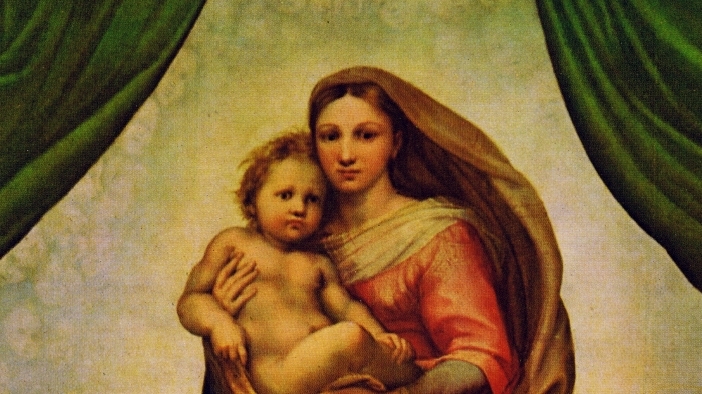
The Sistine Madonna
by Mary Elizabeth Podles
.jpg)
St. Sixtus (left), St. Barbara (right)
While it is seldom polite to mention a lady's age, the Sistine Madonna celebrated a landmark birthday last year when she turned 500. The years have treated her well. The painting is one of an established type known as a sacra conversazione, in which the viewer is granted a vision of the Madonna and Child conversing with selected saints in heaven.
In Raphael's version, a curtain has just been pulled back to reveal the Virgin coming towards us on the clouds, against a backdrop of a heavenly choir of cherubic heads. On her right, St. Sixtus, an early pope, looks upward at her and gestures actively outward toward us, the viewers outside the fictive heavenly space; and on her left, St. Barbara looks down contemplatively at the little angels who rest against the parapet that divides their space from ours.
A golden light glows outward from the center, as if the Virgin were indeed clothed with the sun (and the curve of Sixtus's cope may be meant to suggest the curve of the moon beneath her feet). The whole of the painting demonstrates the Renaissance notion of a dynamic repose, an iconic stillness with the potential for full movement. Its apparent simplicity and naturalness are in fact the result of a carefully contrived counterpoint of dynamic balances that, in the end, present a near-perfect harmony to the eye.
Precursor Icons
The Madonna herself is a Renaissance response to an older iconic type, the Byzantine Mother of God Sweet Kissing, in which mother and child nestle cheek to cheek to express their own tender relationship and, by implication, their intercession for us to the mercy of God. Within the history of art, there is a continual swing between the poles of abstraction and naturalism: where the Byzantine Madonna is highly stylized and abstract, Raphael's answer to it is fully realistic and humanized, a sublime expression of the central mystery of the Incarnation.
There is probably a more direct Byzantine antecedent, too: in 1499, the icon known as Our Lady of Perpetual Help came to Rome, where Raphael would surely have seen it. In Byzantine iconology, this is the Theotokos of the Passion. To the right and left, archangels show the infant Jesus the cross and the instruments of the Passion; he has run in fear to his mother and nestles against her for comfort. So fast did he run that his sandal has come loose. Mary, in her turn, gazes sorrowfully outward at us: it is our sins that cause her son's distress.
In Raphael's version, the byplay is subtler and reaches across the barrier between our space and theirs: St. Sixtus points outward as if to introduce and recommend the congregation below him to the Virgin's intercession. But also, in the original setting of the painting in the Benedictine Church of San Sisto in Piacenza, the saint would have been pointing directly at the real crucifix within the chapel.
What people are saying about Touchstone:

Personal Meaning of the Saints
Both St. Sixtus and St. Barbara have connections with the Church of San Sisto. Sixtus, who served as pope from a.d. 115 to 124, was obviously the patronal saint of the church, and relics of St. Barbara were housed there, too. But both saints also carry a layer of more personal meaning for the painting's patron. In 1500, Giuliano Cardinal della Rovere made a substantial contribution to the rebuilding of San Sisto; in 1503, he was elected pope and took the name Julius II. He chose the name Julius partly after his fourth-century predecessor, but also in reference to Julius Caesar. He saw himself as an emperor-pope, consolidating his temporal authority over Rome and its environs, and restoring the ancient city to its earlier splendor through his patronage of the arts.
By June of 1512, most of the foreign powers that threatened the pope's political sovereignty had been expelled, and during the victory celebrations a delegation from Piacenza arrived to ally themselves voluntarily with the Papal States. In gratitude, Julius commissioned Raphael to paint this Madonna for their church, San Sisto.
It is likely that Julius specified the subject matter. St. Sixtus was the patron saint of the Della Rovere family, and Julius's uncle, with whom he was very close, had chosen the name Sixtus IV when he was elected pope in 1471. Furthermore, the ordinances of the original Pope Sixtus had reinforced the power of the papacy, a point at issue in the sixteenth century, and, like Julius, he was a famous patron of the arts.
It has been suggested that Pope Julius may have wanted this painting eventually to decorate his own tomb. St. Barbara, whom we can identify by her attribute, the tower behind her shoulder, was one of the patronesses of a good death. Therefore she often is included in paintings with a funerary connection.
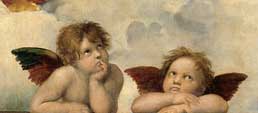
The two little angels leaning on the parapet, too, speak of mourning: in the Renaissance language of gesture, the chin in hand would have been understood to represent melancholy (as in Dürer's Melencolia I), and the wreathed arms sadness and idleness. Raphael may have meant them to suggest that, with the death of his great patron, the arts themselves would lapse into melancholy and idleness. In fact, Julius died the year after the commissioning of the picture, in 1513, and the painting remained in Piacenza.
The Angels' Career
The little angels, incidentally, have enjoyed a solo career in advertising for roughly a century and a half. The Sistine Madonna was acquired by Augustus III, the Elector of Saxony, in 1754 and moved to Dresden. In a famous gesture of reverence, Augustus vacated his throne and set the Madonna in his place. She has been much beloved of the Germans ever since and has exerted an important influence on the course of German art. And on German taste as well: in the nineteenth century the wistful cherubs began to advertise such earthly delights as German chocolate, and they have continued to this day to promote a variety of products. Most recently they have graced the Kleenex box, as if to imply that the paper tissues inside are worthy to wipe away their angelic tears. •
Mary Elizabeth Podles is the retired curator of Renaissance and Baroque art at the Walters Art Museum in Baltimore, Maryland. She is the author of A Thousand Words: Reflections on Art and Christianity (St. James Press, 2023). She and her husband Leon, a Touchstone senior editor, have six children and live in Baltimore, Maryland. She is a contributing editor for Touchstone.
A Journal of Mere Christianity—Delivered to Your Door
- Essays on theology, culture, and the Church
- Contributors from across the Christian traditions

Six print issues (one year) of Touchstone, plus full online access and PDF downloads for only $39.95.

Get a one-year full-access subscription to the Touchstone online archives for only $19.95.
bulk subscriptions
Order Touchstone subscriptions in bulk and save $10 per sub! Each subscription includes 6 issues of Touchstone plus full online access to touchstonemag.com—including archives, videos, and pdf downloads of recent issues for only $29.95 each! Great for churches or study groups.
Transactions will be processed on a secure server.
more on art from the online archives
32.4—July/August 2019
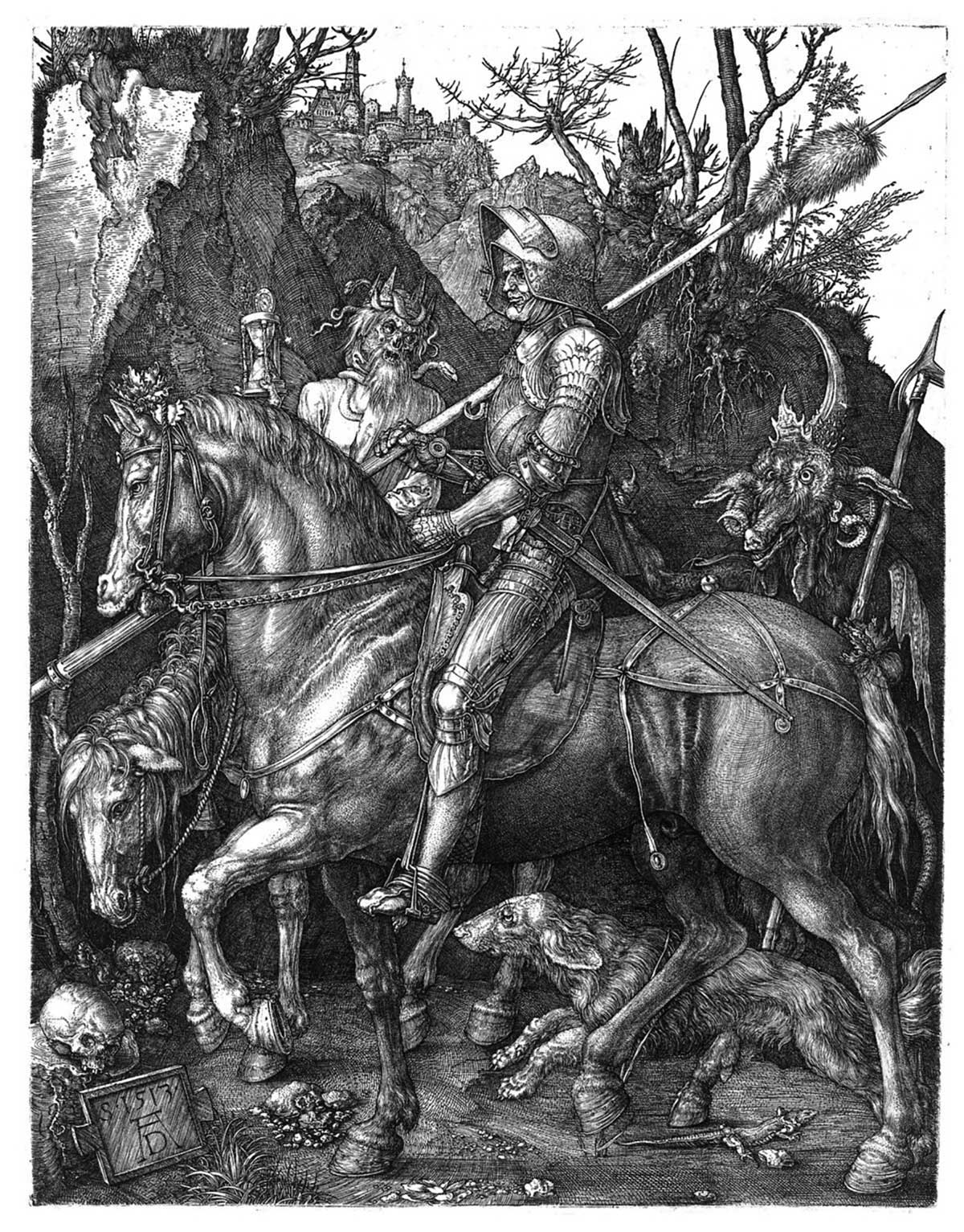
on Single-Mindedness in Durer's Ritter, Tod, und Teufel by Anthony Costello
33.2—March/April 2020
An Architectural Sign of Mere Christianity by Michael Ward
more from the online archives
32.2—March/April 2019
Misguided Mercy & Dante's Infernal Purgation by Joshua Hren

31.6—November/December 2018
on the Church's Response to the Anti-marriage Tide by Diane Woerner
calling all readers
Please Donate
"There are magazines worth reading but few worth saving . . . Touchstone is just such a magazine."
—Alice von Hildebrand
"Here we do not concede one square millimeter of territory to falsehood, folly, contemporary sentimentality, or fashion. We speak the truth, and let God be our judge. . . . Touchstone is the one committedly Christian conservative journal."
—Anthony Esolen, Touchstone senior editor

