





View
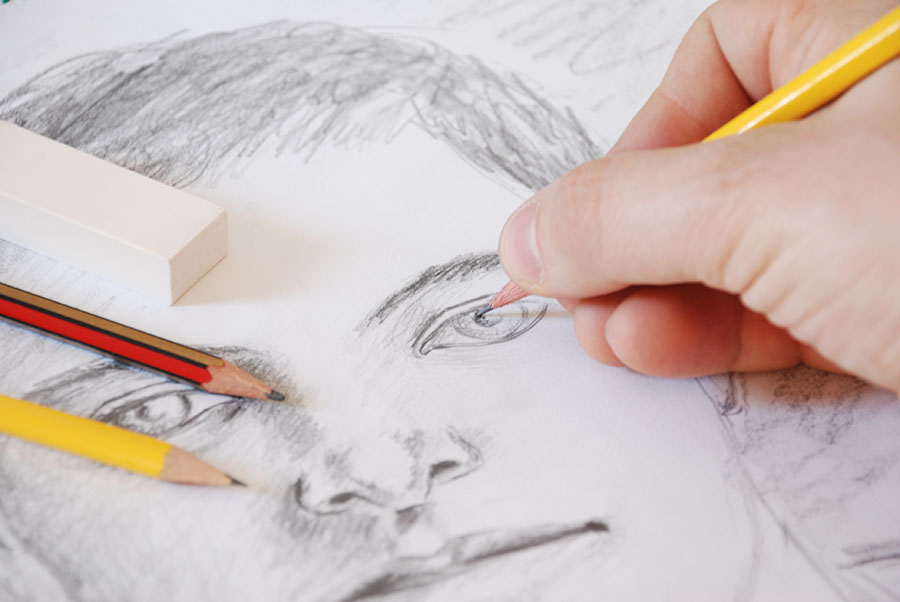
The Man Who Was Doodling
Dan DeWitt on G. K. Chesterton & the Art of Casual Sketching
I stopped being embarrassed about my joy of sketching shortly after meeting Gilbert Keith Chesterton. The introduction was made by none other than Clive Staples Lewis, who, I later learned, was an amateur artist himself. Their company was joined shortly thereafter by Lewis's fellow Inkling, John Ronald Reuel Tolkien, a gifted illustrator in his own right (to name but one of his monumental gifts), and by Dorothy Sayers, who provided an apologetic for art in her book The Mind of the Maker. Lewis was my literary gatekeeper to another world.
The Inklings opened my eyes to the power (and pleasure) of art appreciation as a Christian, but no one has more normalized artistic expression for me than G. K. Chesterton. This is not to say that he has offered me a theological framework for drawing, though I'm sure reading hundreds of pages of his printed work has contributed something to my appreciation for aesthetics. I simply mean that he gave me license to care about theological and philosophical reflection without giving up what some might consider the whimsical hobby of doodling.

THIS ARTICLE ONLY AVAILABLE TO SUBSCRIBERS.
FOR QUICK ACCESS:
Dan DeWitt is the dean of Boyce College, the undergraduate school of the Southern Baptist Theological Seminary, where he also teaches courses on worldview, philosophy, and apologetics. He is the author of Jesus or Nothing (Crossway, 2014) and posts regularly on his blog Theolatte.com. Dan and his wife April have four children and reside in Louisville, Kentucky.
A Journal of Mere Christianity—Delivered to Your Door
- Essays on theology, culture, and the Church
- Contributors from across the Christian traditions

Six print issues (one year) of Touchstone, plus full online access and PDF downloads for only $39.95.

Get a one-year full-access subscription to the Touchstone online archives for only $19.95.
bulk subscriptions
Order Touchstone subscriptions in bulk and save $10 per sub! Each subscription includes 6 issues of Touchstone plus full online access to touchstonemag.com—including archives, videos, and pdf downloads of recent issues for only $29.95 each! Great for churches or study groups.
Transactions will be processed on a secure server.
more on imagination from the online archives

19.10—December 2006
Training Up a Child Requires a Well-Formed Imagination by David Mills

18.4—May 2005
The Idylls, Idols & Devils That Corrupt the Moral Imagination by Vigen Guroian

11.5—September/October 1998
Speaking the Truths Only the Imagination May Grasp
An Essay on Myth & 'Real Life' by Stratford Caldecott
more from the online archives


14.6—July/August 2001
Three Bad Ideas for Women & What to Do About Them by Frederica Mathewes-Green

24.6—Nov/Dec 2011
Liberty, Conscience & Autonomy
How the Culture War of the Roaring Twenties Set the Stage for Today’s Catholic & Evangelical Alliance by Barry Hankins
calling all readers
Please Donate
"There are magazines worth reading but few worth saving . . . Touchstone is just such a magazine."
—Alice von Hildebrand
"Here we do not concede one square millimeter of territory to falsehood, folly, contemporary sentimentality, or fashion. We speak the truth, and let God be our judge. . . . Touchstone is the one committedly Christian conservative journal."
—Anthony Esolen, Touchstone senior editor
