




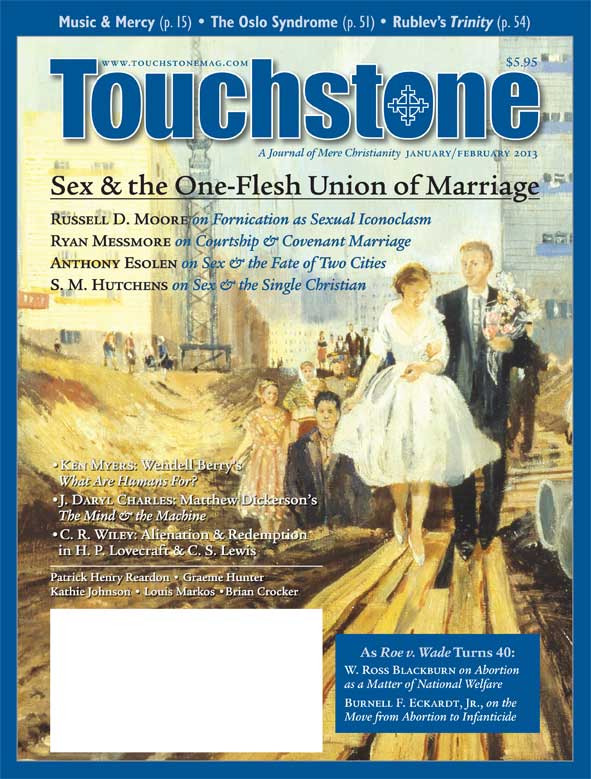
Book Review
Matter & Humanity
The Mind and the Machine: What It Means to Be Human and Why It Matters
by Matthew Dickerson
Brazos, 2011
(258 pages, variously priced, paperback)
reviewed by J. Daryl Charles
Ours is a most intriguing age. It bears the mark of schizophrenia yet stridency, of epistemological uncertainty yet deep-seated incorrigibility, of ethical ambiguity yet stunning intransigence. What consensually has been assumed by both ancients and moderns—namely, that the species Homo sapiens (literally, the knowing, wise, or rational species) is unique among all living forms, capable of dignity and depravity, of moral splendor and moral degeneracy, and that human beings are significantly free (and thus self-responsible) moral agents—is increasingly challenged today. This thoughtful volume, written by a professor of computer science and environmental studies at Middlebury College, responds to the present challenge by investigating the roots and ramifications of a post-consensus "physicalist" understanding of human nature.
THIS ARTICLE ONLY AVAILABLE TO SUBSCRIBERS.
FOR QUICK ACCESS:
J. Daryl Charles is the Acton Institute Affiliated Scholar in Theology & Ethics. He is the author or editor of twenty books, including Retrieving the Natural Law (2008), Natural Law and Religious Freedom (2018), and, most recently, Just War and Christian Traditions (forthcoming). He is also co-editor of Abraham Kuyper, Common Grace: God's Gifts for a Fallen World, Volume 3 (2020). He is a contributing editor to Touchstone.
A Journal of Mere Christianity—Delivered to Your Door
- Essays on theology, culture, and the Church
- Contributors from across the Christian traditions

Six print issues (one year) of Touchstone, plus full online access and PDF downloads for only $39.95.

Get a one-year full-access subscription to the Touchstone online archives for only $19.95.
bulk subscriptions
Order Touchstone subscriptions in bulk and save $10 per sub! Each subscription includes 6 issues of Touchstone plus full online access to touchstonemag.com—including archives, videos, and pdf downloads of recent issues for only $29.95 each! Great for churches or study groups.
Transactions will be processed on a secure server.
more from the online archives

37.5—Sept/Oct 2024
Why Law Schools Can't Teach Law
A sidebar to How Law Lost Its Way by Adam MacLeod
15.6—July/August 2002
Things Hidden Since the Beginning of the World
The Shape of Divine Providence & Human History by James Hitchcock
30.2—March/April 2017
Our Path to Holiness Runs Straight Through Calvary by Robin Phillips
calling all readers
Please Donate
"There are magazines worth reading but few worth saving . . . Touchstone is just such a magazine."
—Alice von Hildebrand
"Here we do not concede one square millimeter of territory to falsehood, folly, contemporary sentimentality, or fashion. We speak the truth, and let God be our judge. . . . Touchstone is the one committedly Christian conservative journal."
—Anthony Esolen, Touchstone senior editor
