






View
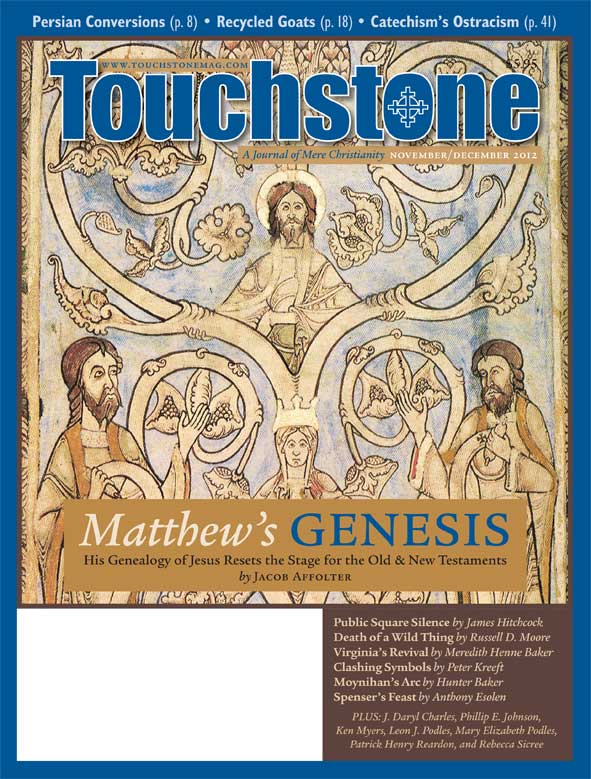
Spenser's Feast
Anthony Esolen on the Theological Depth of a Neglected Wedding Hymn
One of the great pleasures I enjoy as a teacher of poetry is witnessing the astonishment of my students when I begin to reveal to them the subtle, manifold, and sometimes maddeningly complex craftsmanship the artists of the ancient world, the Middle Ages, and the Renaissance employed. It is a pleasure mingled with a touch of scorn, I confess, because once one has beheld it, most of the art of our time, and especially what is consciously modern, seems pretty jejune—seems like a dry crust of white bread in place of a banquet.
Yet that lends us Christians a tremendous opportunity, both to recover the glories of our heritage and to apply their lessons to the world that God has sent us to evangelize. Let me take for example Edmund Spenser's wedding hymn, the Epithalamion.
THIS ARTICLE ONLY AVAILABLE TO SUBSCRIBERS.
FOR QUICK ACCESS:
Anthony Esolen is Distinguished Professor of Humanities at Thales College and the author of over 30 books, including Real Music: A Guide to the Timeless Hymns of the Church (Tan, with a CD), Out of the Ashes: Rebuilding American Culture (Regnery), and The Hundredfold: Songs for the Lord (Ignatius). He has also translated Dante’s Divine Comedy (Random House) and, with his wife Debra, publishes the web magazine Word and Song (anthonyesolen.substack.com). He is a senior editor of Touchstone.
A Journal of Mere Christianity—Delivered to Your Door
- Essays on theology, culture, and the Church
- Contributors from across the Christian traditions

Six print issues (one year) of Touchstone, plus full online access and PDF downloads for only $39.95.

Get a one-year full-access subscription to the Touchstone online archives for only $19.95.
bulk subscriptions
Order Touchstone subscriptions in bulk and save $10 per sub! Each subscription includes 6 issues of Touchstone plus full online access to touchstonemag.com—including archives, videos, and pdf downloads of recent issues for only $29.95 each! Great for churches or study groups.
Transactions will be processed on a secure server.
more from the online archives


32.6—November/December 2019
An Open Letter to Christian Readers of Jordan Peterson & Roger Scruton by James Bryson
calling all readers
Please Donate
"There are magazines worth reading but few worth saving . . . Touchstone is just such a magazine."
—Alice von Hildebrand
"Here we do not concede one square millimeter of territory to falsehood, folly, contemporary sentimentality, or fashion. We speak the truth, and let God be our judge. . . . Touchstone is the one committedly Christian conservative journal."
—Anthony Esolen, Touchstone senior editor
