




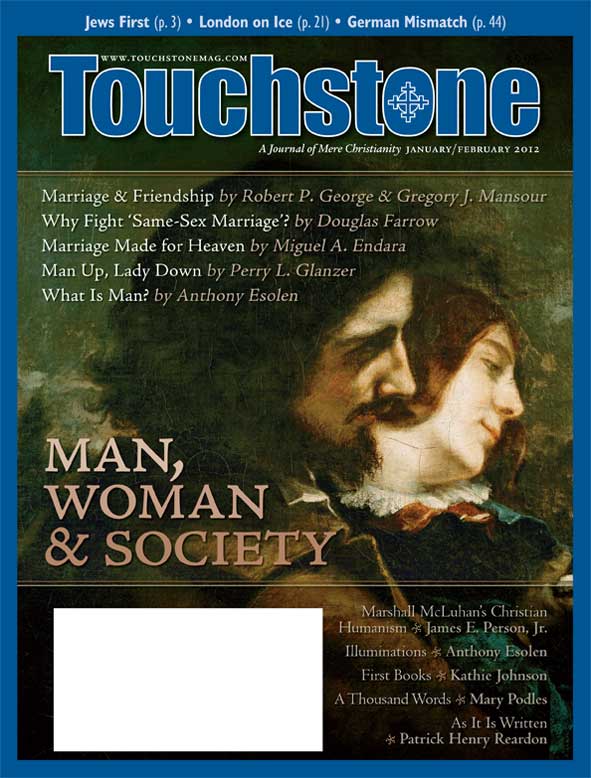
View
Man Up, Lady Down
Perry L. Glanzeron the Demise of Ladies & Gentlemen in Higher Education
This past year, sixteen female students and alumni from Yale University filed a complaint under Title IX of the Civil Rights Act claiming that Yale University failed to address a “hostile sexual environment.” The major incident sparking the complaint was a pledge ritual by members of the Delta Kappa Epsilon (DKE) fraternity, who marched pledges around campus and told them to shout phrases such as “No means yes, yes means anal” and “My name is Jack, I’m a necrophiliac, I f— dead women.” Clearly, wisdom and high SAT scores do not always go together.
After the unsurprising campus outcry and the filing of the complaint, the leaders of DKE apologized to the Yale Women’s Center. The apology failed to spare DKE a five-year suspension. The moral of the story: Don’t create a hostile environment for Yale women, because they’ll sue your pants off (only figuratively, of course). This is the moral philosophy behind most college behavioral admonitions these days: “Behave—or we’ll sue you.”
THIS ARTICLE ONLY AVAILABLE TO SUBSCRIBERS.
FOR QUICK ACCESS:
Perry Glanzer is an Assistant Professor in the School of Education at Baylor University and the author of The Quest for Russia?s Soul (Baylor University Press). He attends First Baptist Church in Woodway, Texas.
A Journal of Mere Christianity—Delivered to Your Door
- Essays on theology, culture, and the Church
- Contributors from across the Christian traditions

Six print issues (one year) of Touchstone, plus full online access and PDF downloads for only $39.95.

Get a one-year full-access subscription to the Touchstone online archives for only $19.95.
bulk subscriptions
Order Touchstone subscriptions in bulk and save $10 per sub! Each subscription includes 6 issues of Touchstone plus full online access to touchstonemag.com—including archives, videos, and pdf downloads of recent issues for only $29.95 each! Great for churches or study groups.
Transactions will be processed on a secure server.
more on education from the online archives

26.5—Sept/Oct 2013
The Perils of Pragmatism in Christian Attitudes Toward the Liberal Arts by Robin Phillips

27.2—March/April 2014
Higher Education Should Advance the Glorious Liberty of the Sons of God by Anthony Esolen
more from the online archives

32.6—November/December 2019
An Open Letter to Christian Readers of Jordan Peterson & Roger Scruton by James Bryson

32.6—November/December 2019
The Year of Our Lord 1943: Christian Humanism in an Age of Crisis by Alan Jacobs by Jesse Russell

24.4—July/August 2011
The Cultural Marxists’ Strategic Assault on Religion, Life & Family by Patrick F. Fagan
calling all readers
Please Donate
"There are magazines worth reading but few worth saving . . . Touchstone is just such a magazine."
—Alice von Hildebrand
"Here we do not concede one square millimeter of territory to falsehood, folly, contemporary sentimentality, or fashion. We speak the truth, and let God be our judge. . . . Touchstone is the one committedly Christian conservative journal."
—Anthony Esolen, Touchstone senior editor
