




Feature
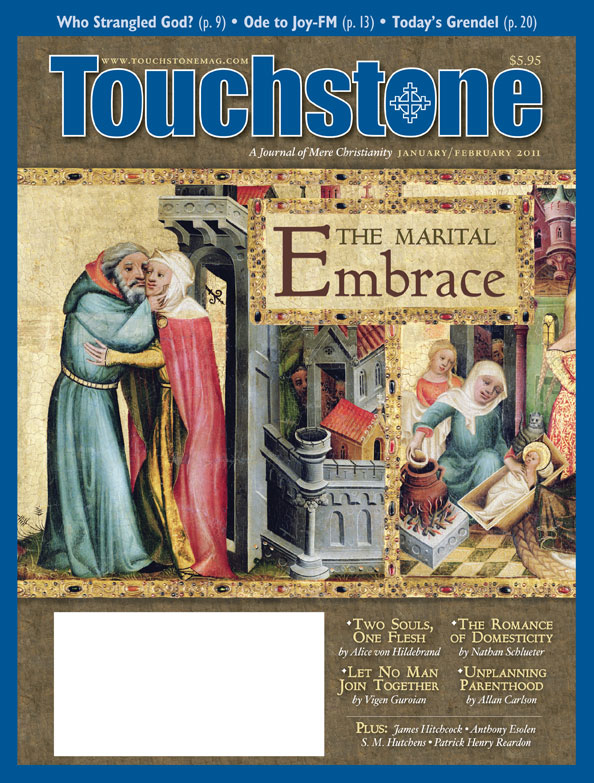
Two Souls, One Flesh
The Divine Invention of Man & Marriage Is a Prodigious Mystery
When at age eleven, I took a course on seventeenth-century French literature—French is my beautiful mother tongue—I made the discovery of Pascal, and started reading his Pensées. Not only did he overwhelm me with the beauty of his style, but he also awakened in me a profound philosophical interest. I started memorizing many of his most beautiful thoughts, and I recall reciting them over and over again as I walked along the Belgian seashore where my parents had a summer home.
A portion of one pensée (72) deserves special attention:
Man is to himself the most surprising (prodigieux) object in nature; for he cannot conceive what the body (corps) is, still less what the spirit (esprit) is, and least of all how a body should be united to a spirit. This is the consummation of his difficulties, and yet it is his very being.
It is simple, after all, to be just an animal, or even to be a purely spiritual being. It is so easy to be a chimpanzee: you are born, you eat, you drink, you reproduce, you jump from tree to tree, and that’s all there is to it. Also, it must be marvelous to be an angel, pure spirit, without the limitations of a body.
But we are neither angels nor chimpanzees. Man—whose complex nature deserves to be called a divine invention—is made up of body and soul so deeply linked that to be a human being does not mean to have just a spiritual soul or just a material body, but to possess both in a mysterious combination. The German language expresses this by saying that man has a Leib, whereas animals have a Körper.
For man to have a body made up of matter that can be seen, heard, smelled, and measured, that occupies space, that is divisible and mortal, and also a soul which shares none of these characteristics and continues to exist even after it is brutally separated from its material companion by death—this sheds light on Pascal’s amazement.
Yet body and soul are meant to be so deeply united that even though the soul continues to exist after the body dies and decomposes, it “longs” to be reunited with the body. This is why I suggest that we say of one who has died, “The soul is now in a state of widowhood, waiting for the blessed moment when it will be reunited with the body.” The “resurrection of the body” is an amazing dogma that sheds full light on the mystery called a human being. Indeed, God alone could have invented such an enigmatic creature.
Repeating and repeating Pascal’s words, while the sun was setting over the North Sea, made me keenly aware of both man’s complex nature and his fragility—like the sun sinking, we are heading toward death.
The Seal of Personhood
Genesis is explicit about this when it states that God chose to create man in his image and likeness. That is to say, from the very moment of his existence, man is a person, for God is Person. Man is a very imperfect person, but fully and truly one. One cannot be “more or less” a person. Either one is a person or is not. Those who claim that a baby at the very beginning of its existence is just a clump of tissue that only later turns into a human person are talking metaphysical nonsense. That implies that a being changes its nature, which amounts to magic, rather than sound metaphysics.
A Journal of Mere Christianity—Delivered to Your Door
- Essays on theology, culture, and the Church
- Contributors from across the Christian traditions

Six print issues (one year) of Touchstone, plus full online access and PDF downloads for only $39.95.

Get a one-year full-access subscription to the Touchstone online archives for only $19.95.
bulk subscriptions
Order Touchstone subscriptions in bulk and save $10 per sub! Each subscription includes 6 issues of Touchstone plus full online access to touchstonemag.com—including archives, videos, and pdf downloads of recent issues for only $29.95 each! Great for churches or study groups.
Transactions will be processed on a secure server.
more on marriage from the online archives


24.1—January/February 2011
Marriage Thrives in Reality, Not in Our Dreams by Nathan Schlueter

28.1—January/February 2015
on State Impositions & Church Acquiescence by Stephen Baskerville
more from the online archives
22.5—June 2009
C. S. Lewis on Civilization & the Natural Order by Timothy L. Hall
35.4—Jul/Aug 2022
The Death Rattle of a Tradition
Contemporary Catholic Thinking on the Question of War by Andrew Latham
32.4—July/August 2019
Does Biblical Language for Man Matter? by Stephen F. Noll
calling all readers
Please Donate
"There are magazines worth reading but few worth saving . . . Touchstone is just such a magazine."
—Alice von Hildebrand
"Here we do not concede one square millimeter of territory to falsehood, folly, contemporary sentimentality, or fashion. We speak the truth, and let God be our judge. . . . Touchstone is the one committedly Christian conservative journal."
—Anthony Esolen, Touchstone senior editor
