




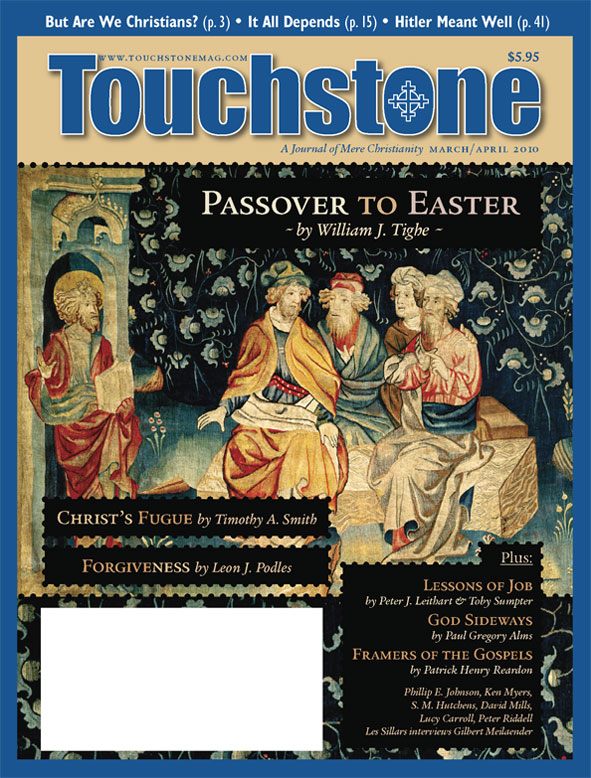
England Sings
Singing and the Imagination of Devotion:
Vocal Aesthetics in Early English Protestant Culture
by Susan Tara Brown
Paternoster, 2008
(350 pages, $29.90, hardcover)
reviewed by Lucy E. Carroll
As the great liturgies of the Western and Eastern churches developed, much of their music came to be reserved for singing by a schola cantorum or choir, although some segments of the Ordinary, the unchanging prayers of the Mass, could be sung by the faithful. The great body of early hymnody, though, grew up not for singing in the Eucharistic liturgies, but for the Divine Office, and for devotions such as Benediction, novenas, and the like.
With the advent of Protestantism, greater emphasis was placed on the participation of the faithful in religious services through the singing of hymns and psalms. The personal nature of many hymns fit the Protestant approach of individual response to God’s word. In time, the singing of the congregation became more important than that of scholas and choirs. Tracing this transition in England is the goal of Susan Tara Brown’s Singing and the Imagination of Devotion.
Brown’s examination of attitudes toward singing and hymnody in the late sixteenth through the eighteenth centuries is exhaustive in its scope. While a basic knowledge of music history is needed to understand all of her references, she illustrates her topic with intriguing and illuminating quotations from period writers both well-known and obscure. The many books, letters, and documents she has uncovered show that, far from being dour and dispassionate in their approach to singing, English Protestants looked on singing as both an important and a pleasurable method of prayer.
Historical Background
When Henry VIII, after breaking with Rome, ordered the suppression of the monasteries, the English church lost a valuable resource: the monastery choir schools. Henry closed some 2,000 of these schools, leaving only a few in royal chapels and universities. Choir schools did grow up in the cathedrals, and the new, shorter service, in English, gave rise to a new tradition of choral anthems.
However, in smaller towns and villages, singing was often led by the parish clerk, with poor results. To correct this deficiency, such figures as Isaac Watts, Thomas Morley, Thomas Mace, and Cotton Mather began to write books and articles stressing the importance of good form in singing. Rather than stressing the mechanics of the voice, their works taught theory and improvisatory singing, and stressed good posture and clear articulation of the text.
From the Restoration in 1660 until about 1770, secular and theatrical music prospered in England, and visiting Italian singers, with their bel canto style, were much admired. These singers, most of whom were Roman Catholic, were not permitted to sing in the royal chapels or cathedrals, but they were hired for entertainment even for royal events. Gradually, elements of the Italian style of singing were merged with the less ornate English style.
Emphasis on the Word
Singing was of great importance in the Protestant churches, for there the emphasis was on the Word itself, and singing was a fit vehicle to carry that Word. Thus, writers of church music looked first to Scripture, particularly to the psalms. Psalters proliferated; the Sternhold and Hopkins Psalter went through 600 editions in some 270 years, and was even brought to America. Originally supplying only melodies, the psalm settings eventually began to include harmony. The faithful were urged to sing psalms at home as well as in church, thus making the home a little chapel and a source of edification to others.
After psalms, individual hymns proliferated. The subjects of these were often extremely personal and homely; many seventeenth-century hymns were written for ordinary day-to-day activities, such as “When we put on our apparel,” “A hymn whilst we are washing,” and “When we are walking in a garden,” or for specific situations, such as the “Lamentation in times of excessive rain.”
Since fidelity to the Word was paramount, most sacred music was vocal music, and the Puritans and Nonconformists questioned any use of instrumental music at all. Many Anglican leaders, however, pointed to the use of instruments in the Old Testament as validation for their use, as well as for the inclusion of more ornate passages in vocal music.
Acting a Grace
English Protestants even equated singing with meditation, believing that the inner life was nurtured through the emotions and feelings generated in song. This was quite different from the meditative methods of Catholic mystics, who sought union with God through silent meditation.
Puritan and Anglican divines called singing “acting a grace”: Since it combined the intellect with the affections, imagination, and whole body, it implied a wholeness, a happy union of the rational and emotive sides of the soul. Brown concludes that the early English Protestants could reconcile holiness and pleasure, spirit and body, reason and imagination, through their music. This wholeness, she writes, was a more complex approach to singing as prayer than is understood today. Their singing was a source of both pleasure and transcendence to the English Protestants, and gave them a foretaste of the fullness of song to be enjoyed in heaven.
A Journal of Mere Christianity—Delivered to Your Door
- Essays on theology, culture, and the Church
- Contributors from across the Christian traditions

Six print issues (one year) of Touchstone, plus full online access and PDF downloads for only $39.95.

Get a one-year full-access subscription to the Touchstone online archives for only $19.95.
bulk subscriptions
Order Touchstone subscriptions in bulk and save $10 per sub! Each subscription includes 6 issues of Touchstone plus full online access to touchstonemag.com—including archives, videos, and pdf downloads of recent issues for only $29.95 each! Great for churches or study groups.
Transactions will be processed on a secure server.
more on culture from the online archives
35.2—Mar/Apr 2022
on Fatigued Christians Deciding to Engage the Culture by Keith Lowery

34.1—January/February 2021
Live Not by Lies: A Manual for Christian Dissidents by Rod Dreher by Hans Boersma

more from the online archives
27.5—Sept/Oct 2014
The Culture of Death's Campaign Against the Catholic Church by Brantly Millegan

31.5—September/October 2018
The Secular State Without the Decalogue by James M. Kushiner
30.2—March/April 2017
Our Path to Holiness Runs Straight Through Calvary by Robin Phillips
calling all readers
Please Donate
"There are magazines worth reading but few worth saving . . . Touchstone is just such a magazine."
—Alice von Hildebrand
"Here we do not concede one square millimeter of territory to falsehood, folly, contemporary sentimentality, or fashion. We speak the truth, and let God be our judge. . . . Touchstone is the one committedly Christian conservative journal."
—Anthony Esolen, Touchstone senior editor
