




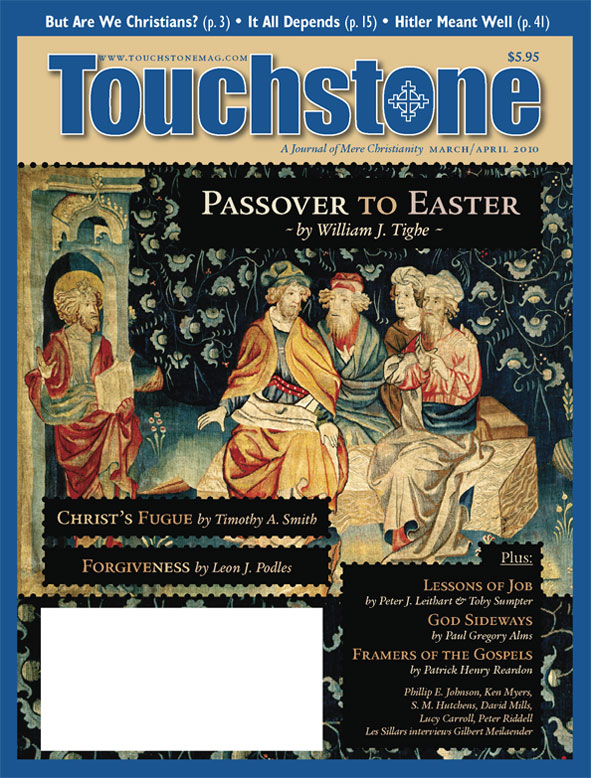
Bioethics & Dignity
A Q&A with Gilbert Meilaender
In June of 2009 the Obama White House announced that the services of the President’s Council on Bioethics would no longer be needed. President George W. Bush had established the council to promote public discussion of bioethical issues in the wake of the controversy over his 2001 policy limiting federal funding for stem-cell research to existing cell lines. The Obama administration apparently wanted an advisory body that was a little more “practical.” A White House spokesman said, according to the New York Times, that the problem with the old council was that it “favored discussion over developing a shared consensus.” In other words, it favored thinking through issues instead of pushing agendas.
In late November 2009, Obama signed an executive order creating a new council, called the Presidential Commission for the Study of Bioethical Issues. He named Amy Gutmann, president of the University of Pennsylvania, to serve as its chair and James W. Wagner, president of Emory University, as vice-chair.
Valparaiso University theology professor Gilbert Meilaender was a member of the original council from 2002 until it was disbanded last summer. In August, he released a brief but insightful new book, Neither Beast nor God: The Dignity of the Human Person (New Atlantis, 2009), that should give pause to the members of the new council.
Meilaender begins by making a distinction between human dignity and personal dignity. The former recognizes that we are a little lower than the angels but something more than beasts; thus, to embrace our human dignity is to recognize how a human being is a unity of body and spirit, with characteristic strengths and weaknesses.
Personal dignity recognizes the equal value of each individual; every person, simply by “virtue of his humanity, is one whose dignity calls for our respect.” Personal dignity is grounded in the theological assertion that we have all received life—equally—as a gift from God.
Our greatest temptation, Meilaender suggests, is to imagine that our limitations undermine our dignity. We sometimes think that we become god-like by mastering our bodies, by abolishing illness and, perhaps one day, death itself. But we need to ask, Meilaender writes, “whether being human means nothing more than the freedom to shape and reshape ourselves, or whether it also means honoring the embodied character of our life and affirming some of its limits.”
The stakes, both financial and ethical, for how we understand human dignity are huge, and the public debate over health care reform has brought the tensions to the surface. What, exactly, do we as a society owe people who are sick? If we (whether as individuals, a private association, or the government) are obligated to provide a certain level of care, shouldn’t “we” have a say in end-of-life decisions? If health care resources are limited, whose dignity gets preference? Is dying always an unqualified evil?
Ultimately, writes Meilaender, we must affirm both human dignity and personal dignity. But it’s not going to be easy. In the Q&A below, he discusses some of the concerns.
Les Sillars (LS): What role did the President’s Council on Bioethics play in shaping public debate, and what do you expect on bioethics from the new council under the Obama administration? What stance is it likely to take on the protection of human dignity?
Gilbert Meilaender (GM): The President’s Council on Bioethics was the object of public attention in large part because it took up—and was charged to take up—a few controversial issues (having to do with the moral status of human embryos, stem-cell research, and cloning). But I think its more important service was that it reclaimed public debate for the public. The issues it discussed and wrote about are not matters for researchers and bioethicists alone to debate and decide. Indeed, I incline to think that decisions about them should be made by elected officials, whom we can hold accountable. And despite all the criticism he received from some quarters, President Bush clearly seemed to realize that.
Les Sillars teaches journalism at Patrick Henry College and is on staff at WORLD magazine; his first book, Intended for Evil: A Survivor's Story of Love, Faith, and Courage in the Cambodian Killing Fields, was released by Baker in 2016.
A Journal of Mere Christianity—Delivered to Your Door
- Essays on theology, culture, and the Church
- Contributors from across the Christian traditions

Six print issues (one year) of Touchstone, plus full online access and PDF downloads for only $39.95.

Get a one-year full-access subscription to the Touchstone online archives for only $19.95.
bulk subscriptions
Order Touchstone subscriptions in bulk and save $10 per sub! Each subscription includes 6 issues of Touchstone plus full online access to touchstonemag.com—including archives, videos, and pdf downloads of recent issues for only $29.95 each! Great for churches or study groups.
Transactions will be processed on a secure server.
more on Politics from the online archives
29.5—Sept/Oct 2016
on the Loss of True Community & Rising Political Desperation by Karl D. Stephan
32.2—March/April 2019
on Properly Rendering Things to Caesar & to God by Peter J. Leithart
more from the online archives
27.6—Nov/Dec 2014
Tales of Forbidden Stereotypes
Real-Life Men & Women & the Tragic Loss of Human Comedy by Anthony Esolen
27.3—May/June 2014
Religious Freedom & Why It Matters
Working in the Spirit of John Leland by Robert P. George

33.1—January/February 2020
Do You Know Your Child’s Doctor?
The Politicization of Pediatrics in America by Alexander F. C. Webster
calling all readers
Please Donate
"There are magazines worth reading but few worth saving . . . Touchstone is just such a magazine."
—Alice von Hildebrand
"Here we do not concede one square millimeter of territory to falsehood, folly, contemporary sentimentality, or fashion. We speak the truth, and let God be our judge. . . . Touchstone is the one committedly Christian conservative journal."
—Anthony Esolen, Touchstone senior editor
