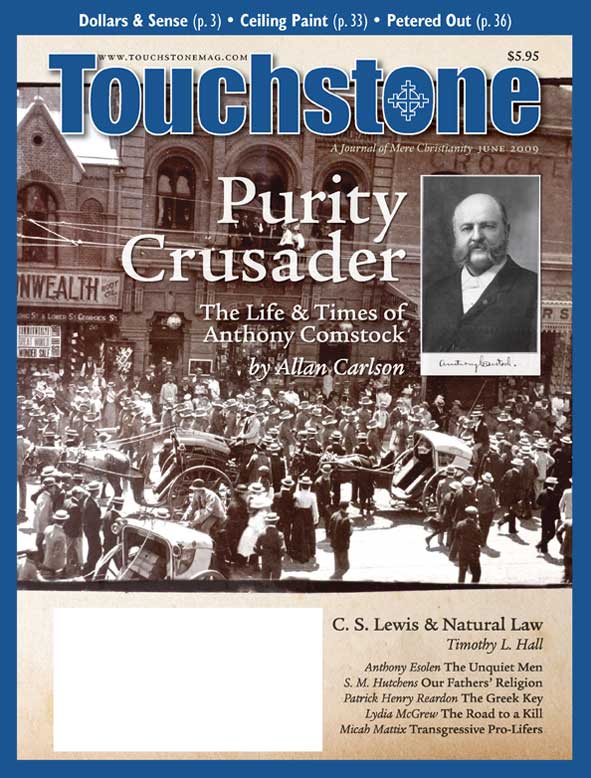
Pure Visionary by Allan Carlson

Feature

Pure Visionary

The Life & Times of Anthony Comstock, Moral Crusader

The foes of nineteenth-century purity crusader Anthony Comstock commonly spoke in fulminations. His “free love” contemporary D. M. Bennett called Comstock “a first-class Torquemada” who had shown “the same energy, the same cruelty, [and] the same intolerance” as “the envenomed persecutors of the past centuries.” Bennett continued: “It is seriously doubted whether the church has ever had a cruel zealot in its employ who has labored with more resolution and zest than this active agent of the Young Men’s Christian Association.” Another “free love” advocate, Ezra Hervey Heywood, called Comstock “a religio-monomaniac” whom the United States Congress and “the lascivious fanaticism of the Young Men’s Christian Association” had empowered to suppress free thought.

Even Comstock’s political “descendants” in contemporary America, the socially conservative Religious Right, are largely oblivious of his legacy. My informal survey of a dozen contemporary American pro-family leaders found only one who had even heard of him; this despite the fact that Comstock succeeded in almost every aspect of his purity campaign: from crushing the pornography industry to suppressing abortion and contraception. Indeed, under any fair comparison, the current pro-family and pro-life movements have been failures.

Who Was Comstock?

Biographers Heywood Broun and Margaret Leech are correct to say that Comstock was not really born for the late nineteenth century. Living out of time, “he was the apotheosis, the fine flower of Puritanism.”

Comstock was a product of Connecticut. During the 1840s, this state held the reputation of being the most socially conservative and religiously orthodox corner of the land; and its many Congregationalist churches were still predominantly conservative in theology and evangelical in spirit.

Born March 7, 1844, in New Canaan, Comstock claimed Puritan ancestry on both sides of his family. His father Thomas was a successful farmer. His mother—Polly Lockwood Comstock—was the real influence in his life. Bearing ten children, she reared them in the stern Puritan faith most recently invigorated by the spiritual enthusiasms of the Second Great Awakening. While Polly Comstock died when Anthony was only age ten, her Bible readings, morality tales, prayer life, and frequent church attendance profoundly shaped his character.

Young Comstock attended the district school near his farm and then enrolled in the New Academy run by the New Canaan Congregational Church. Here, he learned writing and gained his frame of reference, his vocabulary, and his perception of duty. His Christian faith was strong. Common to him were the sentiments he recorded in his diary in Spring 1863, at age 19: “One of the sweetest days of my life, so near to Jesus. . . . Not myself, not a whit, but all, all in Christ. His grace shed abroad in my heart. O to praise him with a pure heart in Spirit and Truth.”

Into the YMCA

Shortly thereafter, Comstock’s older brother Samuel died from wounds received at Gettysburg, and Anthony felt duty-bound to enlist in his place. He mostly saw occupation duty in a peaceful corner of Florida. Appalled by “the oaths of wicked men” heard in the barracks, he recruited a circle of about 25 young soldiers who took a contrary oath that “they would not swear, drink, nor chew tobacco.” Comstock’s lack of compassion for public sinners showed as he poured his whiskey and rum rations on the ground before his drinking comrades-in-arms. During the last few months of his enlistment, Comstock became an agent of the Christian Commission, a ministry to the military organized by the new and ambitious Young Men’s Christian Association.

The years immediately following the Civil War were in their own way harrowing and disturbing, nowhere more so than in New York City. Memories of that city’s anti-draft riots of July 1863 were still vivid, when mobs roamed the streets, sacked homes, stores, and armories, and killed eighteen people. A semblance of calm came only after federal soldiers shot 400 rioters dead. City authorities faced the “dreadful revelations” that “a great, ignorant, irresponsible class” and “the fires of a social revolution” lay “just beneath their feet.” There was a veritable explosion in the number of New York saloons, gambling halls, and houses of prostitution. As Margaret Leech has ably summarized: “All that was vulgar in the Republic, all that was raw and crude, rose to the surface and floated there.”


Allan C. Carlson is the author of numerous books, including Family Questions: Reflections on the American Social Crisis and The American Way: Family and Community in the Shaping of the American Identity. He attends St. Paul Lutheran Church in Rockford, Illinois. He is a senior editor of Touchstone.

A Journal of Mere Christianity—Delivered to Your Door

  • Essays on theology, culture, and the Church
  • Contributors from across the Christian traditions

Subscribe (Print + Online)

Six print issues (one year) of Touchstone, plus full online access and PDF downloads for only $39.95.

Subscribe (Online Only)

Get a one-year full-access subscription to the Touchstone online archives for only $19.95.


bulk subscriptions

Order Touchstone subscriptions in bulk and save $10 per sub! Each subscription includes 6 issues of Touchstone plus full online access to touchstonemag.com—including archives, videos, and pdf downloads of recent issues for only $29.95 each! Great for churches or study groups.

Transactions will be processed on a secure server.


more on culture from the online archives

29.3—May/June 2016

The Master's Voice

Our Choice Is Obedience or Jesus as Anti-Christ by Anthony Esolen

32.6—November/December 2019

Listening Up

Historical Truth, Beguiling Stories & Three Kinds of Hearers by Anthony Esolen

34.1—January/February 2021

Fighting for Love

What the World Needs Now It Hardly Knows by Anthony Esolen


more from the online archives

33.5—September/October 2020

Killing Homicide

on Missing Fathers & Redemption in Prison by Bob Perry

24.6—Nov/Dec 2011

Liberty, Conscience & Autonomy

How the Culture War of the Roaring Twenties Set the Stage for Today’s Catholic & Evangelical Alliance by Barry Hankins

18.8—October 2005

XXX-Communicated

on Why Pornography Is Not the Sin We Say It Is by Anthony Esolen

calling all readers

Please Donate

"There are magazines worth reading but few worth saving . . . Touchstone is just such a magazine."
—Alice von Hildebrand

"Here we do not concede one square millimeter of territory to falsehood, folly, contemporary sentimentality, or fashion. We speak the truth, and let God be our judge. . . . Touchstone is the one committedly Christian conservative journal."
—Anthony Esolen, Touchstone senior editor

Support Touchstone

00