






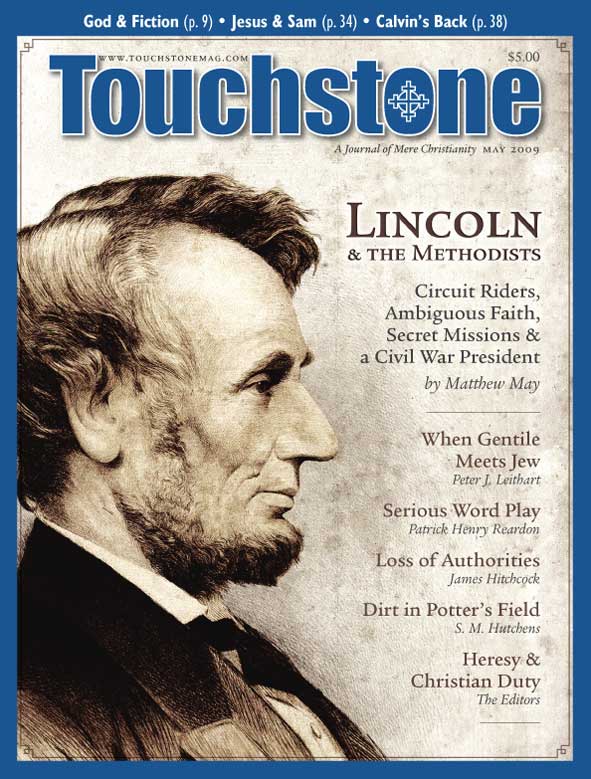
Feature
When Gentile Meets Jew
A Christian Reading of Ruth & the Hebrew Scriptures
Nostra Aetate, the Second Vatican Council’s Declaration on the Relation of the Church to Non-Christian Religions, is widely seen as a breakthrough in Christian relations with Jews. Implicitly chiding centuries of anti-Jewish polemic, Pope Paul VI proclaimed that while “the Jewish authorities and those who followed their lead pressed for the death of Christ,” yet “what happened in His passion cannot be charged against all the Jews, without distinction, then alive, nor against the Jews of today.” Thus, “the Jews should not be presented as rejected or accursed by God, as if this followed from the Holy Scriptures.”
The Supersessionist Critique
THIS ARTICLE ONLY AVAILABLE TO SUBSCRIBERS.
FOR QUICK ACCESS:
Peter J. Leithart is an ordained minister in the Presbyterian Church in America and the president of Trinity House Institute for Biblical, Liturgical & Cultural Studies in Birmingham, Alabama. His many books include Defending Constantine (InterVarsity), Between Babel and Beast (Cascade), and, most recently, Gratitude: An Intellectual History (Baylor University Press). His weblog can be found at www.leithart.com. He is a contributing editor of Touchstone.
A Journal of Mere Christianity—Delivered to Your Door
- Essays on theology, culture, and the Church
- Contributors from across the Christian traditions

Six print issues (one year) of Touchstone, plus full online access and PDF downloads for only $39.95.

Get a one-year full-access subscription to the Touchstone online archives for only $19.95.
bulk subscriptions
Order Touchstone subscriptions in bulk and save $10 per sub! Each subscription includes 6 issues of Touchstone plus full online access to touchstonemag.com—including archives, videos, and pdf downloads of recent issues for only $29.95 each! Great for churches or study groups.
Transactions will be processed on a secure server.
more on bible from the online archives

32.2—March/April 2019
on Preserving Physical & Spiritual Nourishment by Nathanael Devlin
32.3—May/June 2019
on the Implications of Changing the Pater Noster by John M. McCarthy
more from the online archives


30.2—March/April 2017
The Education of Children Takes Generations of Fidelity by W. Ross Blackburn
32.4—July/August 2019
Does Biblical Language for Man Matter? by Stephen F. Noll
calling all readers
Please Donate
"There are magazines worth reading but few worth saving . . . Touchstone is just such a magazine."
—Alice von Hildebrand
"Here we do not concede one square millimeter of territory to falsehood, folly, contemporary sentimentality, or fashion. We speak the truth, and let God be our judge. . . . Touchstone is the one committedly Christian conservative journal."
—Anthony Esolen, Touchstone senior editor
