




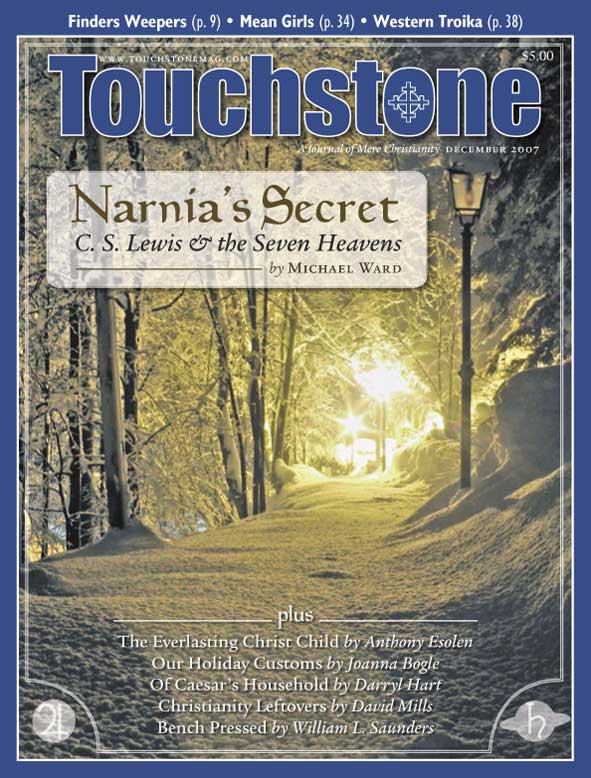
Finders Weepers
Anothony Esolen on the Books We Discover but Fear to Read
A page from an old primer: “See the kings of Judah. They are little boys. They play tag among the idols. The Temple is large, and has many idols. See them flirt with the whores (horz). The ladies knead their dough. They make cakes for the queen of heaven. Children, gather the wood! Women, shake the bells! Men, kindle the fire!”
What insights into a culture can an old textbook provide. No dreary life was that, beribboned and smoking with food, in the shadow of sultry Ashtaroth and bedroom Baalim. Yet one lad, King Josiah, only eight when he began his reign in Judah, turned his devotion to the Lord.
How that happened we are not told. It did not follow a tradition of royal fidelity. About most of the kings of Judah, and all of the kings of Israel, Scripture says exactly what it says about Josiah’s father: “Amon did that which was evil in the sight of the Lord, as his father Manasseh did.”
Finding the Law
No doubt everyone had a dim idea of God, and the priests had read the Torah—but as the single defining feature of Hebrew life, the Law had faded into neglect. Then Josiah, this young king with a strong sense of piety, took it into his head to repair the Temple.
That old building had long been used, by good kings and wicked, to collect monies to buy off an Assyrian warlord here or a Pharaoh there. It had fallen on hard times. Maybe rats had tunneled through a crumbled corner. Maybe grass was growing on the roof tiles.
So Josiah said to his servant, “Go up to Hilkiah the high priest, that he may sum the silver which is brought into the house of the Lord, which the keepers of the door have gathered of the people: And let them deliver it into the hand of the doers of the work . . . to repair the breaches of the house.”
In the course of the repairs, rummaging about, Hilkiah the high priest did something a high priest should not have had to do. He found the book of the Law. Or perhaps he did not find it; perhaps he knew where it was all along, and in timid resignation sounded out its sentences now and again alone, and only used this opportunity to reveal its existence to Josiah.
It struck the king to the heart, though it did not yet strike the people. He heard the words, and rent his robes.
What follows is breathtaking. Josiah consults the prophetess Huldah (not, note, Hilkiah), who interprets the book with prophetical starkness. Because the people have abandoned the Lord, says she, paying no attention to the Judean army or gross domestic product, their great city shall fall. Yet because Josiah has returned to the ways of his forefather David, he shall be gathered to his grave in peace and shall not see the destruction to come. Enough consultation for Josiah.
Anthony Esolen is Distinguished Professor of Humanities at Thales College and the author of over 30 books, including Real Music: A Guide to the Timeless Hymns of the Church (Tan, with a CD), Out of the Ashes: Rebuilding American Culture (Regnery), and The Hundredfold: Songs for the Lord (Ignatius). He has also translated Dante’s Divine Comedy (Random House) and, with his wife Debra, publishes the web magazine Word and Song (anthonyesolen.substack.com). He is a senior editor of Touchstone.
A Journal of Mere Christianity—Delivered to Your Door
- Essays on theology, culture, and the Church
- Contributors from across the Christian traditions

Six print issues (one year) of Touchstone, plus full online access and PDF downloads for only $39.95.

Get a one-year full-access subscription to the Touchstone online archives for only $19.95.
bulk subscriptions
Order Touchstone subscriptions in bulk and save $10 per sub! Each subscription includes 6 issues of Touchstone plus full online access to touchstonemag.com—including archives, videos, and pdf downloads of recent issues for only $29.95 each! Great for churches or study groups.
Transactions will be processed on a secure server.
more from the online archives
31.6—November/December 2018
The Slow Vindication of Leon Podles by S. M. Hutchens
22.5—June 2009
C. S. Lewis on Civilization & the Natural Order by Timothy L. Hall
calling all readers
Please Donate
"There are magazines worth reading but few worth saving . . . Touchstone is just such a magazine."
—Alice von Hildebrand
"Here we do not concede one square millimeter of territory to falsehood, folly, contemporary sentimentality, or fashion. We speak the truth, and let God be our judge. . . . Touchstone is the one committedly Christian conservative journal."
—Anthony Esolen, Touchstone senior editor
