




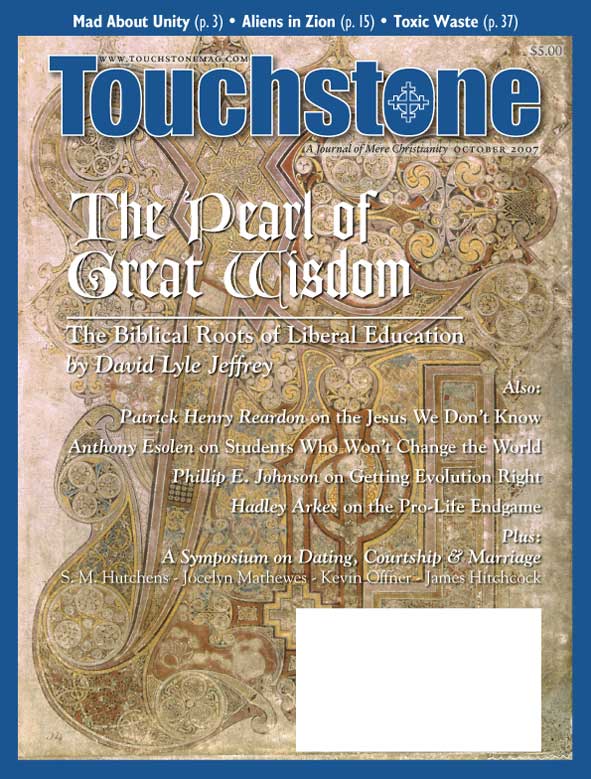
Quite Beyond Us
Patrick Henry Reardon on the Unfathomable Self-Consciousness of Jesus
Jesus, as he appears in the Gospels, resists man’s efforts to comprehend him. There is a sense in which this is true of all human beings, I concede, but in the singular case of Jesus this resistance to interpretation is marked in a unique and special way. The “who” of Jesus, which he pointedly put in question form, remains utterly elusive apart from a special revelation (Matt. 16:15–17).
We have at least some chance of understanding other men “from within,” by recourse to the principle of intersubjectivity, the assumption of the common structure of self-awareness in all human souls. Each of us goes inside and finds a “self,” nor does the experience differ essentially from person to person.
This is what allows us to talk to one another. It is the premise of all rational discourse, the implicit starting point of all conversation, the necessary basis of all argument.
Thus, no one attempts to convince me of anything except by first supposing that his consciousness and mine share an identical shape, a radical “who,” of which to be “self-aware.” No matter how separate we are, we have at least this much in common: that we can be self-conscious in the same way.
Hence, no matter how individual the two of us remain, that other person is able to enter into his own soul, examine his own experience, and through a process of analogy (which I suggest we call the “analogy of subjectivity”) gain some idea of what is going on in my soul. What is human and therefore native to him is also human and native to me. He can interpret me by self-reflection.
Biographers presume that the inner content of their chosen subject—that is to say, the person’s subjectivity—is in some measure accessible by a consideration of what makes all human souls “tick.” It is probably impossible to write biography without some recourse to this process of analogy, which often enough produces a psychological portrait of its subject.
What Made Him Tick
Now a great deal of contemporary biblical scholarship is convinced that it is possible to do the same thing with Jesus. Exegetes of this persuasion, basing their efforts on the analogy of subjectivity, attempt to understand Jesus by recourse to the same sorts of internal information that are used to interpret other individuals in history. They study the social, environmental, and educational influences by which they believe the man Jesus can be rendered intelligible. They discover what made him “tick.” Psychology provides a foundation for exegesis.
These scholars go on to explain Jesus in various ways, depending on what influences were brought to bear upon him. Observing his compassion, for instance, they perceive in his soul the impact of the social prophets of the eighth century. Or, taking note of the marked apocalyptic element in Jesus’ preaching, they feel safe in explaining that phenomenon as part of the general apocalyptic atmosphere of first-century Judaism.
Current impulses of messianism gave shape to his sense of vocation. At his baptism, they claim, Jesus fell under the influence of John the Baptist and thus became aware of his own historical destiny. He became a man with a mission. And so on.
Patrick Henry Reardon is pastor emeritus of All Saints Antiochian Orthodox Church in Chicago, Illinois, and the author of numerous books, including, most recently, Out of Step with God: Orthodox Christian Reflections on the Book of Numbers (Ancient Faith Publishing, 2019).
A Journal of Mere Christianity—Delivered to Your Door
- Essays on theology, culture, and the Church
- Contributors from across the Christian traditions

Six print issues (one year) of Touchstone, plus full online access and PDF downloads for only $39.95.

Get a one-year full-access subscription to the Touchstone online archives for only $19.95.
bulk subscriptions
Order Touchstone subscriptions in bulk and save $10 per sub! Each subscription includes 6 issues of Touchstone plus full online access to touchstonemag.com—including archives, videos, and pdf downloads of recent issues for only $29.95 each! Great for churches or study groups.
Transactions will be processed on a secure server.
more from the online archives
31.6—November/December 2018
on Futility & the Open Door to Deliverance by Patrick Henry Reardon

27.3—May/June 2014
Religious Freedom & Why It Matters
Working in the Spirit of John Leland by Robert P. George

28.3—May/June 2015
Whittaker Chambers's Lonely War Against Godless Collectivism by Hunter Baker
calling all readers
Please Donate
"There are magazines worth reading but few worth saving . . . Touchstone is just such a magazine."
—Alice von Hildebrand
"Here we do not concede one square millimeter of territory to falsehood, folly, contemporary sentimentality, or fashion. We speak the truth, and let God be our judge. . . . Touchstone is the one committedly Christian conservative journal."
—Anthony Esolen, Touchstone senior editor
