




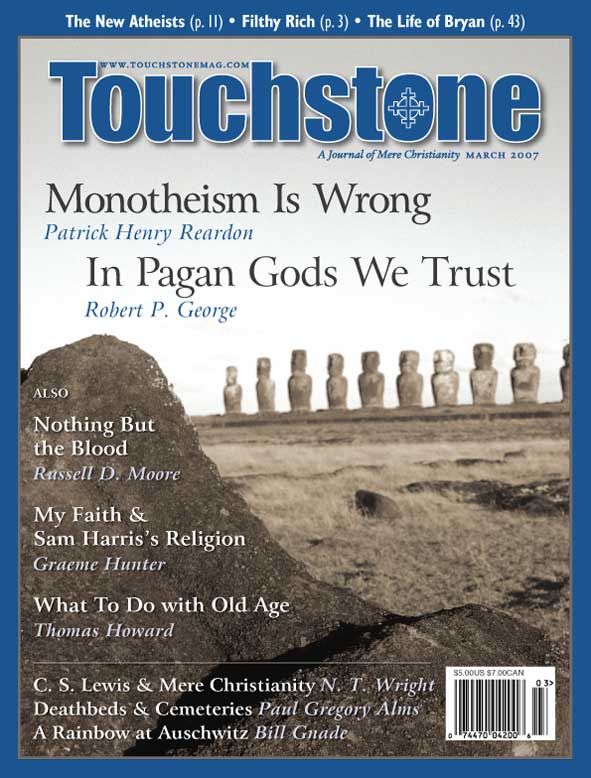
Sinai’s Height
Patrick Henry Reardon on the Problem with Popular Monotheism
At the risk, I suppose, of being taken for a polytheist, I confess to a strong personal misgiving about contemporary popular monotheism. Let me describe what I mean. Modern popular monotheism is usually expressed along the following lines: “Since there is only one God, those who worship only one God must all be worshiping the same God.” Those who think this way go on to urge us, often enough, to find our common moral roots in this supposedly shared monotheism.
This effort, they assure us, will lessen international tensions and prepare the way for world peace. They have even been known to get together in large congresses to pray for world peace, as though they were all seeking this blessing from the same divinity.
There are two things wrong with this kind of monotheism. The first is logical, and the second biblical.
First, as a simple a priori, why should we suppose that an agreement about “one” divinity implies an agreement about who that divinity is? Let me take what I think is a workable analogy. Let us say that two American prisoners during World War II were discussing who won the most recent World Series, about which their captors had kept them in ignorance.
They would agree, of course, that there was only one winner, for the simple reason that there could only be one winner. The “oneness” of the winner, which was a logical necessity, could tell them nothing about the identity of the winner.
Second, this modern popular monotheism is unbiblical. Biblical monotheism is not simply an agreement about a quantitative proposition with respect to the divinity. It is not just a matter of confessing one god, as distinct from two or more. I suggest four considerations here by way of explanation.
History, Not Mathematics
First, those who confess only a Superior Being (a being who happens to be superior to other beings, that is to say) are not really monotheists, even if they deny the existence of all other gods. It is not the shortage of extra gods that renders a man a monotheist.
Second, the difference between polytheism and biblical monotheism is not merely quantitative. Monotheism is not a mathematical truth, nor is polytheism a mathematical problem. The thing is not quantitative. You can’t get “close” to biblical monotheism. The confession of two gods comes no nearer to monotheism than the confession of a hundred. Biblical monotheism has nothing to do with the number of gods but with the nature of God.
Nor does man arrive at monotheism by a process of reduction, as it were, eliminating all other gods until only one is left. (Indeed, if a man goes at monotheism in this way, he may as well keep going to atheism, freeing himself at last from the final burden of the process.) Biblical monotheism is not the logical inference drawn from a set of verifiable premises.
Patrick Henry Reardon is pastor emeritus of All Saints Antiochian Orthodox Church in Chicago, Illinois, and the author of numerous books, including, most recently, Out of Step with God: Orthodox Christian Reflections on the Book of Numbers (Ancient Faith Publishing, 2019).
A Journal of Mere Christianity—Delivered to Your Door
- Essays on theology, culture, and the Church
- Contributors from across the Christian traditions

Six print issues (one year) of Touchstone, plus full online access and PDF downloads for only $39.95.

Get a one-year full-access subscription to the Touchstone online archives for only $19.95.
bulk subscriptions
Order Touchstone subscriptions in bulk and save $10 per sub! Each subscription includes 6 issues of Touchstone plus full online access to touchstonemag.com—including archives, videos, and pdf downloads of recent issues for only $29.95 each! Great for churches or study groups.
Transactions will be processed on a secure server.
more from the online archives

24.5—Sept/Oct 2011
A Critical Memoir of Thomas Merton at Gethsemani Abbey by Patrick Henry Reardon

32.2—March/April 2019
Reality Shows, Even in a Popular TV Series by C. E. Smith

31.6—November/December 2018
on the Church's Response to the Anti-marriage Tide by Diane Woerner
calling all readers
Please Donate
"There are magazines worth reading but few worth saving . . . Touchstone is just such a magazine."
—Alice von Hildebrand
"Here we do not concede one square millimeter of territory to falsehood, folly, contemporary sentimentality, or fashion. We speak the truth, and let God be our judge. . . . Touchstone is the one committedly Christian conservative journal."
—Anthony Esolen, Touchstone senior editor
