





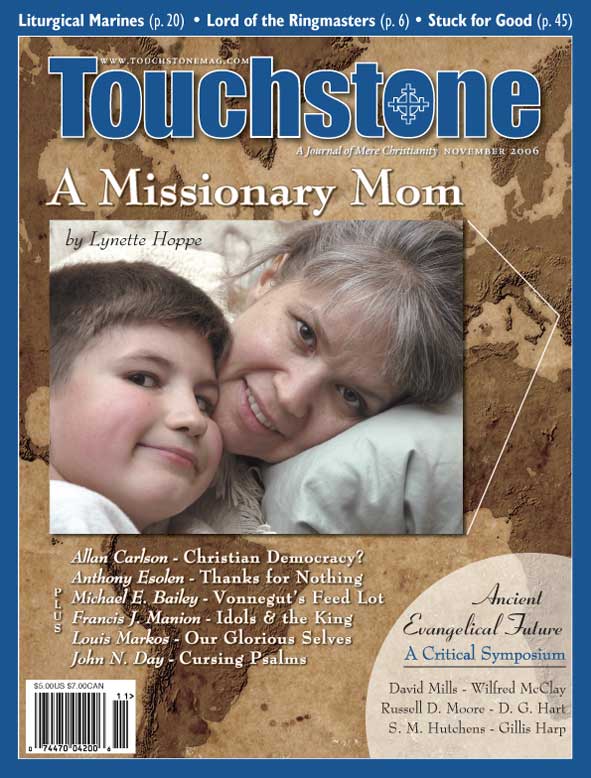
Priest of the Cosmos
The Day Without Yesterday: Lemaître, Einstein, and the Birth of Modern
Cosmology
by John Farrell
Thunder’s Mouth Press, 2005
(262 pages, $24.95, hardcover)
reviewed by Guillermo Gonzalez & Jay W. Richards
Can a priest be a first-rate scientist? Doesn’t religion dull one’s scientific acumen, destroy one’s objectivity, and bind one to espouse unscientific doctrines? Such, at least, is the caricature. But in reality, most of the founders of modern science were Christians—a fact known to most science historians if not to science textbook writers.
THIS ARTICLE ONLY AVAILABLE TO SUBSCRIBERS.
FOR QUICK ACCESS:
A Journal of Mere Christianity—Delivered to Your Door
- Essays on theology, culture, and the Church
- Contributors from across the Christian traditions

Six print issues (one year) of Touchstone, plus full online access and PDF downloads for only $39.95.

Get a one-year full-access subscription to the Touchstone online archives for only $19.95.
bulk subscriptions
Order Touchstone subscriptions in bulk and save $10 per sub! Each subscription includes 6 issues of Touchstone plus full online access to touchstonemag.com—including archives, videos, and pdf downloads of recent issues for only $29.95 each! Great for churches or study groups.
Transactions will be processed on a secure server.
more on ministry from the online archives

32.1—January/February 2019
Sex, Women's Ordination & the Rejection of Hierarchy & Equality by James A. Altena

more from the online archives

24.6—Nov/Dec 2011
Liberty, Conscience & Autonomy
How the Culture War of the Roaring Twenties Set the Stage for Today’s Catholic & Evangelical Alliance by Barry Hankins

33.2—March/April 2020
Encounters with Faith & Forgiveness in Communities of Faith by Nicole M. King

33.1—January/February 2020
on the Consequences of One Birth Before Roe v. Wade by Craig Kellogg Galer
calling all readers
Please Donate
"There are magazines worth reading but few worth saving . . . Touchstone is just such a magazine."
—Alice von Hildebrand
"Here we do not concede one square millimeter of territory to falsehood, folly, contemporary sentimentality, or fashion. We speak the truth, and let God be our judge. . . . Touchstone is the one committedly Christian conservative journal."
—Anthony Esolen, Touchstone senior editor
