John & the Agony by Patrick Henry Reardon

John & the Agony

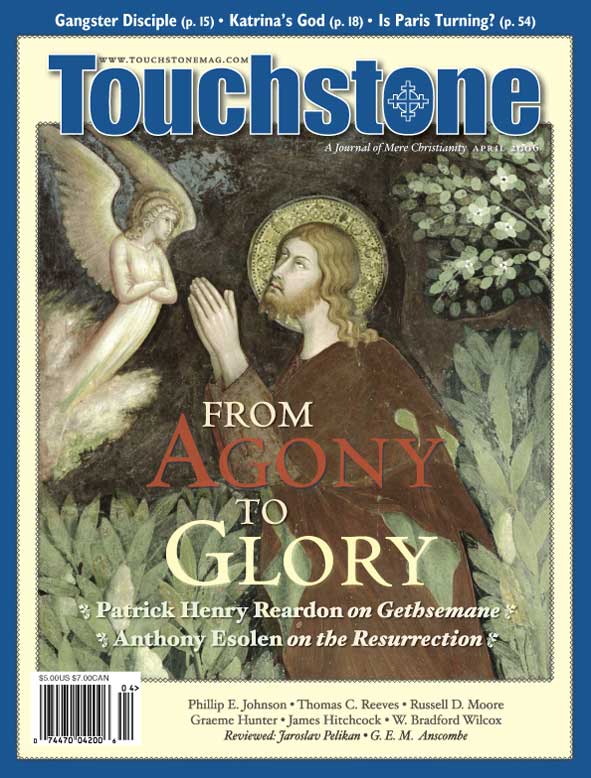
Although the Gospel of John does not record the Lord’s agony in the garden, it does include several texts that put us in mind of that scene. These Johannine passages reflect, furthermore, the sentiments and resolution expressed by Jesus during the agony as recorded in the other Gospels.

For example, our Lord’s determination to obey the Father’s will, a resolve so essential to his prayer in the garden, is expressed earlier in John in what he says to the disciples at the Samaritan well: “My food is to do the will of him who sent me, and to finish his work” (4:34). In the next chapter of John, Jesus speaks again of this intended obedience: “I do not seek my own will but the will of the Father who sent me” (5:30).

Exactly the same resolution on Jesus’ part appears in the chapter after that: “I have come down from heaven, not to do my own will, but the will of him who sent me” (6:38). Two chapters later, Jesus says of his Father, “I always do those things that please him” (8:29).

In John’s Last Supper discourse, Jesus explains that this obedience to the Father is inspired by love: “I love the Father, and as the Father gave me commandment, so I do” (14:31).

In John’s Gospel, Jesus’ obedience to the Father is directed to glorifying the Father: “He who speaks from himself seeks his own glory; but he who seeks the glory of the One who sent him is true, and no unrighteousness is in him” (7:18).

This theme of Jesus’ obedience to the Father’s will takes on a more explicitly active tone in John, because this evangelist goes to some length to portray Jesus as disposing of his own destiny. That is to say, John describes Jesus, not as passively submitting to the Father’s will, but resolutely and actively seeking it. In the parable of the Good Shepherd, Jesus announces, “I lay down my life that I may take it again. No one takes it from me, but I lay it down of myself. I have power to lay it down, and I have power to take it again. This command I have received from my Father” (10:17–18).

This more active quality of the Lord’s obedience is likewise indicated in the manner of Jesus’ arrest in the garden. When his would-be captors came to seize him, they were unable until he gave them leave to do so. Thus, when Jesus identified himself to them, John records, “they drew back and fell to the ground” (18:6). Truly, no one could take his life. It remained his, to be freely laid down in obedience to the Father’s command.

In a sort of culminating scene, where the language is very reminiscent of the agony in the garden, John again writes of Jesus’ set purpose to glorify God by obedience. In the chapter immediately before the Last Supper, the Lord speaks of his coming death as the burial of a grain of wheat in the ground (12:24–25). Next, he describes that death as being “lifted up,” a reference to his crucifixion. (“This he said, signifying by what death he would die”—12:33.)

Between these two descriptions of his ap-proaching death, the Lord speaks of his distress thereat. “Now my soul is troubled” (12:27), says he, in a sentence that reminds us of his agony as portrayed in the Synoptic Gospels (Matt. 26:38; Mark 14:33; Luke 22:44). Even in this troubled state, however, Jesus does not pray that the hour of his passion will pass him by: “Now my soul is troubled, and what shall I say? ‘Father, save me from this hour’? But for this purpose I came to this hour. Father, glorify your name” (John 12:27–28).

This reference to Jesus’ troubled soul is as close as John comes to an equivalent of the Synoptics’ agony in the garden. Even as he faces death by crucifixion, the Jesus in John’s Gospel remains ascendant in the circumstances of that death. He will not pray to be spared the hour of his passion. With complete command of his own destiny, he lays down his life out of love for the Father. When the hour of the Cross arrives, Jesus and his Father speak to one another only of glory: “‘Father, glorify your name.’ Then a voice came from heaven, saying, ‘I have both glorified it and will glorify it again’” (12:28). And finally, “Father, the hour has come. Glorify your Son, that your Son also may glorify you. . . . And now, O Father, glorify me together with yourself, with the glory which I had with you before the world was” (17:1,5).

Patrick Henry Reardon is pastor emeritus of All Saints Antiochian Orthodox Church in Chicago, Illinois, and the author of numerous books, including, most recently, Out of Step with God: Orthodox Christian Reflections on the Book of Numbers (Ancient Faith Publishing, 2019).

A Journal of Mere Christianity—Delivered to Your Door

  • Essays on theology, culture, and the Church
  • Contributors from across the Christian traditions

Subscribe (Print + Online)

Six print issues (one year) of Touchstone, plus full online access and PDF downloads for only $39.95.

Subscribe (Online Only)

Get a one-year full-access subscription to the Touchstone online archives for only $19.95.


bulk subscriptions

Order Touchstone subscriptions in bulk and save $10 per sub! Each subscription includes 6 issues of Touchstone plus full online access to touchstonemag.com—including archives, videos, and pdf downloads of recent issues for only $29.95 each! Great for churches or study groups.

Transactions will be processed on a secure server.


more from the online archives

35.4—Jul/Aug 2022

The Death Rattle of a Tradition

Contemporary Catholic Thinking on the Question of War by Andrew Latham

33.1—January/February 2020

Do You Know Your Child’s Doctor?

The Politicization of Pediatrics in America by Alexander F. C. Webster

32.5—September/October 2019

Looking for Jacobs

Some Trivial Thoughts on the Study of Philosophy by Graeme Hunter

calling all readers

Please Donate

"There are magazines worth reading but few worth saving . . . Touchstone is just such a magazine."
—Alice von Hildebrand

"Here we do not concede one square millimeter of territory to falsehood, folly, contemporary sentimentality, or fashion. We speak the truth, and let God be our judge. . . . Touchstone is the one committedly Christian conservative journal."
—Anthony Esolen, Touchstone senior editor

Support Touchstone

00