




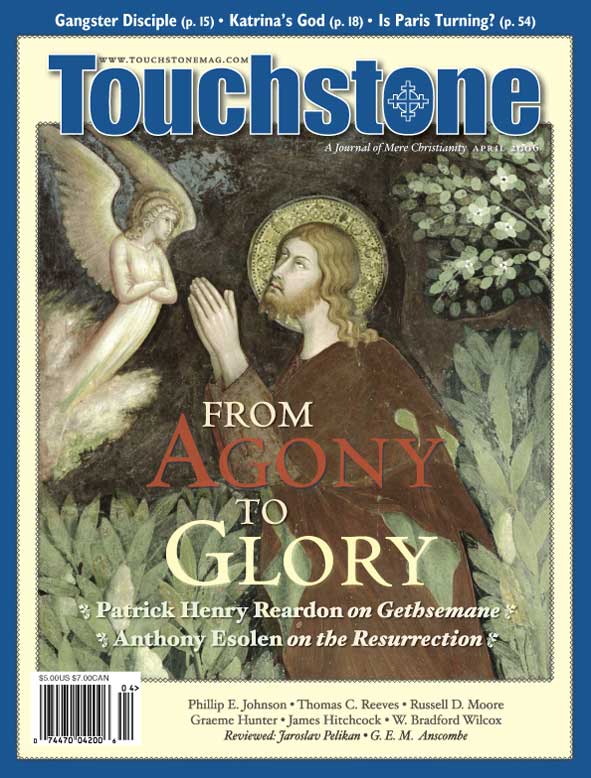
Body & Soul Uplifted
Dante’s Magnificent Vision of the Resurrection of the Flesh
by Anthony Esolen
Mars Hill, about A.D. 51. You’re a raffish Jew from the outback, one Paul of Tarsus, by way of Palestine, Antioch, and all the cowtowns of Asia Minor. You’re going to preach the Good News to well-heeled Athenians who have long lost any vibrant belief in the gods, or any real devotion to their country; though they probably still practice gymnastics, and a couple of them may recite Homer.
You’re no great orator, and you don’t have much of a body, but that’s all right. The Athenians will be polite enough to listen to you anyway. What else do they have to do? Not a lot, as your friend Luke will remark.
So you preach the one God by whom we live and move and have our being. The Athenians have a vague insight about him already, you tell them: You’ve seen their shrine to “the unknown god.” They don’t necessarily believe all that rubbish about Zeus sleeping with his sister Hera; that may be for plowboys in Thessaly, but not for Athenians. One ruler of the universe? They’re not surprised, nor did you think they would be. A Son of God? Depends on what you mean by “Son”; they’ll keep listening.
The immortality of the soul? Really smart people (Athenians, for example) are flattered by the notion. Their own Plato suggested it; maybe the soul lives on in some timeless realm of ideas; maybe it is absorbed into universal being; maybe it returns after a thousand years for another cycle of plants and animals and lawyers and human beings. Why not stop there, with God and his Son and our immortal souls?
But Paul had to talk about the resurrection of the body, knowing that unless Christ is raised in the body our faith is vain. And when they hear that, the Athenians look at the rumpled little Jew, probably wondering why he would want that body back again, shake their heads, smile, and go home.
The Strangest Tenet
There is no stranger tenet of the Creed—to us as much as to the Greeks—than that of the resurrection of the body, this limited and lumpish thing that grows old and decays and dies. If it is hard to see how the body can rise again, it may be harder to see why we would want it to rise again. Why not do what Plato would recommend, and slip this husk of flesh and be free? The Greek symbol for the psyche was the butterfly. Butterflies don’t want their cocoons back—why should man?
Not that we have a choice. Scripture clearly reveals that Christ rose in the body, and that everyone else will, too. And after the Incarnation, no good Christian dare scoff at mere flesh. “By his stripes,” says the prophet, “we were healed.” Not by his grim Stoic fortitude, but by his stripes: his obedience in the body, unto death. The resurrection of the body follows from Christ’s having assumed a body to save mankind and return us to our original and fleshly innocence. What Christ assumes, Christ redeems.
And why not? Tertullian compares the flesh, limned by the hand of God, to a setting for a jewel. If together body and soul have sinned on earth, then body and soul redeemed together should be made lovely in the life to come. The tongue that sang God’s praises on earth should sing his praises hereafter. Indeed, you might say that the tongue was made for just that purpose: not to speak here on earth, and then be exalted as a glorified vocal appendage in Heaven, but to sing those very praises in Heaven, for which our early and still stuttering songs here on earth prepare us.
Anthony Esolen is Distinguished Professor of Humanities at Thales College and the author of over 30 books, including Real Music: A Guide to the Timeless Hymns of the Church (Tan, with a CD), Out of the Ashes: Rebuilding American Culture (Regnery), and The Hundredfold: Songs for the Lord (Ignatius). He has also translated Dante’s Divine Comedy (Random House) and, with his wife Debra, publishes the web magazine Word and Song (anthonyesolen.substack.com). He is a senior editor of Touchstone.
A Journal of Mere Christianity—Delivered to Your Door
- Essays on theology, culture, and the Church
- Contributors from across the Christian traditions

Six print issues (one year) of Touchstone, plus full online access and PDF downloads for only $39.95.

Get a one-year full-access subscription to the Touchstone online archives for only $19.95.
bulk subscriptions
Order Touchstone subscriptions in bulk and save $10 per sub! Each subscription includes 6 issues of Touchstone plus full online access to touchstonemag.com—including archives, videos, and pdf downloads of recent issues for only $29.95 each! Great for churches or study groups.
Transactions will be processed on a secure server.
more from the online archives

26.5—Sept/Oct 2013
The Perils of Pragmatism in Christian Attitudes Toward the Liberal Arts by Robin Phillips
15.6—July/August 2002
Things Hidden Since the Beginning of the World
The Shape of Divine Providence & Human History by James Hitchcock
29.2—March/April 2016
The History of Family Strength in America May Reveal Good News by Allan C. Carlson
calling all readers
Please Donate
"There are magazines worth reading but few worth saving . . . Touchstone is just such a magazine."
—Alice von Hildebrand
"Here we do not concede one square millimeter of territory to falsehood, folly, contemporary sentimentality, or fashion. We speak the truth, and let God be our judge. . . . Touchstone is the one committedly Christian conservative journal."
—Anthony Esolen, Touchstone senior editor
