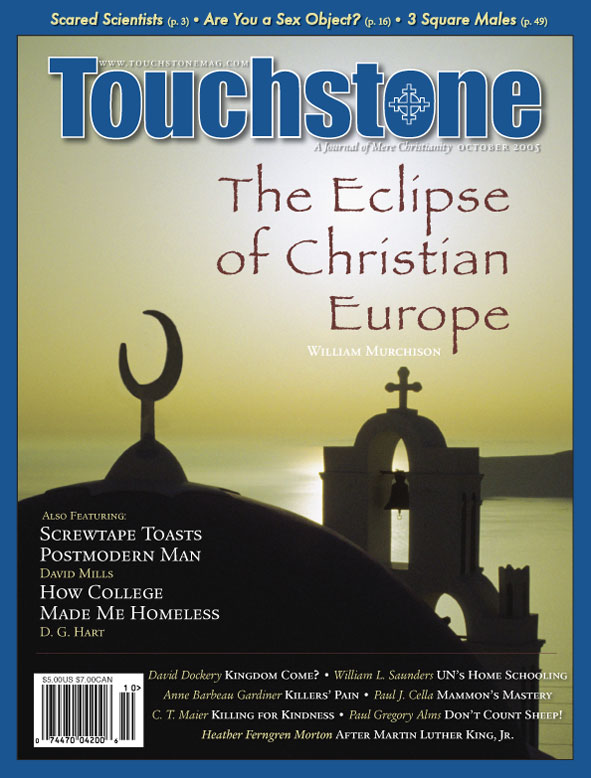
The Rights of Reconciliation by Heather Ferngren Morton

The Rights of Reconciliation

The Beloved Community by Charles Marsh

The Beloved Community: How Faith Shapes Social Justice, from the Civil Rights Movement to Today
Basic Books, 2005
(292 pages, $26.00, hardcover)

reviewed by Heather Ferngren Morton

During the final days of the 1956 Montgomery Bus Boycott, Martin Luther King, Jr., addressed a victorious if beleaguered group of protesters at the Holt Street Baptist Church in Montgomery, Alabama. Though the Supreme Court had recently declared segregation of public transportation facilities illegal, King reminded his audience that a mere legal victory was not their ultimate goal. “The end is reconciliation, the end is redemption,” he said. “The end is the creation of the beloved community.”

In The Beloved Community: How Faith Shapes Social Justice, from the Civil Rights Movement to Today , University of Virginia professor Charles Marsh chronicles the Civil Rights movement, beginning with the Montgomery Bus Boycott, to argue that sustainable, transformative social justice in America has been rooted most often in Christian faith. He shows how the movement in many respects failed to achieve the beloved community King envisioned, but contends that, in a “parallel history,” Christians across the country have worked in pockets of poverty for decades to realize that vision.

Hate Well Met

Marsh, author of the award-winning God’s Long Summer: Stories of Faith and Civil Rights, analyzes key moments in the Civil Rights movement to make his case for the centrality of religious conviction. A robust, “theologically specific” faith transformed King from a comfortable middle-class minister, preoccupied with respectability and content to maintain the status quo in Jim Crow Alabama, to a courageous young activist who called his fellow protestors to “meet hate with love.”

A radical faith led the white Southern Baptist preacher Clarence Jordan to found Koinonia, a cooperative farm in Georgia where Christians in pursuit of racial reconciliation took vows of poverty and practiced the common purse. And an “exuberantly faithful” and eclectic Christianity inspired the founding of the Student Nonviolent Coordinating Committee, which excelled at grassroots mobilization among the poor.

According to Marsh, the movement fragmented when Civil Rights leaders lost their theological grounding and their footing in religious communities. Moreover, by the mid-1960s, other movements—black separatism, opposition to the Vietnam War, and women’s liberation—replaced a single-minded focus on nonviolent racial reconciliation. By 1967, as the war increasingly came to dominate the national psyche, King worried that America’s soul had become “totally poisoned.”

The vision of beloved community did not die with King’s 1968 assassination. Yet from looking at the secularist left that emerged from the 1960s counterculture—more academic than activist, more concerned with theory than with the mundane realities of social reform—one might think it had.

In the latter half of the book, Marsh tells an alternative, more hopeful story. That story begins with John Perkins, founder of Voice of Calvary, whose decades-long work with Mississippi’s poor has “charted a new course for building beloved community in America.” No single character in Marsh’s book better exemplifies the kind of “radical Christianity” to which Marsh calls his readers than Perkins.


Heather Ferngren Morton is a freelance writer based in Cheverly, Maryland, where she lives with her husband and three children. Read more of her work at heatherfmorton.com.

A Journal of Mere Christianity—Delivered to Your Door

  • Essays on theology, culture, and the Church
  • Contributors from across the Christian traditions

Subscribe (Print + Online)

Six print issues (one year) of Touchstone, plus full online access and PDF downloads for only $39.95.

Subscribe (Online Only)

Get a one-year full-access subscription to the Touchstone online archives for only $19.95.


bulk subscriptions

Order Touchstone subscriptions in bulk and save $10 per sub! Each subscription includes 6 issues of Touchstone plus full online access to touchstonemag.com—including archives, videos, and pdf downloads of recent issues for only $29.95 each! Great for churches or study groups.

Transactions will be processed on a secure server.


more from the online archives

32.4—July/August 2019

A Case of Win-Win

on Probability, Death & the Existence of God by Graeme Hunter

31.6—November/December 2018

Virtue Gone Mad

Victimhood Culture Scapegoats Its Very Source by Michael P. Foley

33.3—May/June 2020

Deliberation, Inc.

Human & Divine Societies Require Careful Thought & Discourse by Anthony Esolen

calling all readers

Please Donate

"There are magazines worth reading but few worth saving . . . Touchstone is just such a magazine."
—Alice von Hildebrand

"Here we do not concede one square millimeter of territory to falsehood, folly, contemporary sentimentality, or fashion. We speak the truth, and let God be our judge. . . . Touchstone is the one committedly Christian conservative journal."
—Anthony Esolen, Touchstone senior editor

Support Touchstone

00