




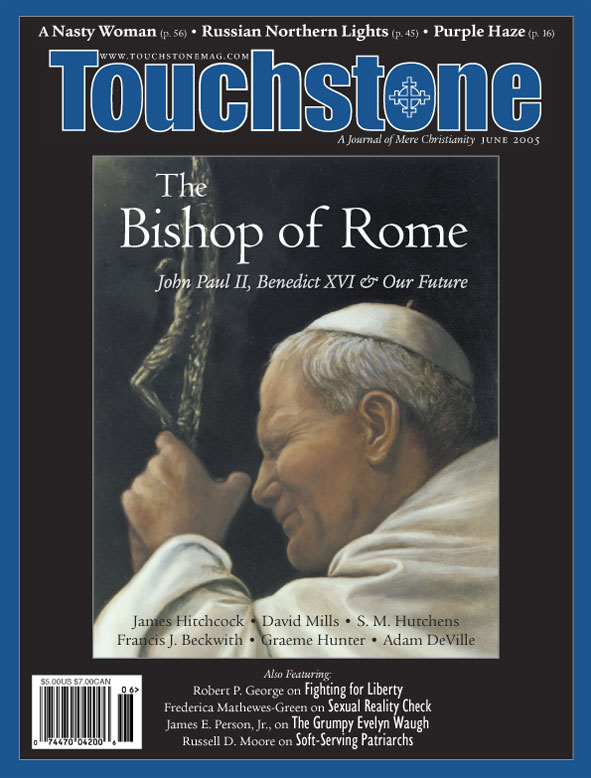
Paper Tiber
How Pope John Paul’s Critics Would Tame the Church of Rome
by David Mills
Perhaps the most interesting of the responses to the death of John Paul II were those of critics who used his death to offer their vision for the Catholic Church, and by extension for Christianity in general. It may be useful to look at what they said, because they followed a pattern used whenever a major orthodox religious figure needs taking down a peg.
The treatment of Pope John Paul II is especially revealing because he was so important and substantial that his critics—the more thoughtful ones—could not dismiss him with the contempt they show for American “fundamentalists.” The critic must work at bringing him down.
Two articles published in the English newspaper The Daily Telegraph offer good examples, partly because it is politically the most conservative of the major English newspapers (it has run pro-life editorials, for example). The editors chose two learned critics: Ferdinand Mount, former editor of The Times Literary Supplement, and Geza Vermes, Professor Emeritus of Jewish Studies at the University of Oxford.
Mount describes himself as “only an occasional churchgoer” in the Church of England. Vermes is, though the article does not tell you this, a former Catholic priest who had renounced his orders and then his church. Though they are only on the fringe of the Christian religion, they are not secularists.
And are therefore the more effective critics. The average reader will assume the purely secular writer to be arguing a case, but think the somewhat religious writer to be in general sympathy with the thing he is attacking. He may in fact be even more hostile to orthodox Christianity than the secularist, because he cares more about it and wants it to be something else, but the naive reader (and most readers will be naive) will read him as a friend of Christianity.
John Paul’s Failure
The critics work from a mind or a worldview that may not be entirely clear even to them. Here are three of the assumptions that seem to support their case against the traditional Christian like John Paul II.
Sex is the test. As you would expect, John Paul II failed mainly in not approving the theory and practice of modern sexuality. Remove the sex and gender issues and Mount would have no article, while Vermes would have a very short one. Did Christianity not insist on chastity as a public good, no such critic would bother with it.
To the secular and semi-secular mind, sex is something we cannot control. The church’s teaching is impossible to follow, at least for man in the mass, and therefore needs to be abandoned. Abstinence, writes Mount, “as recommended by the Church, is a good thing, too, but is it any more likely to work in the long run than the rhythm method?” The answer he wants is, “Of course not, so let’s hand out the condoms so people won’t get pregnant or AIDS.”
David Mills has been editor of Touchstone and executive editor of First Things. He edits the opinion page of the Pittsburgh Post-Gazette.
A Journal of Mere Christianity—Delivered to Your Door
- Essays on theology, culture, and the Church
- Contributors from across the Christian traditions

Six print issues (one year) of Touchstone, plus full online access and PDF downloads for only $39.95.

Get a one-year full-access subscription to the Touchstone online archives for only $19.95.
bulk subscriptions
Order Touchstone subscriptions in bulk and save $10 per sub! Each subscription includes 6 issues of Touchstone plus full online access to touchstonemag.com—including archives, videos, and pdf downloads of recent issues for only $29.95 each! Great for churches or study groups.
Transactions will be processed on a secure server.
more from the online archives

31.1—January/February 2018
Getting Sex Wrong Is a Foundational Error by James M. Kushiner
15.6—July/August 2002
Things Hidden Since the Beginning of the World
The Shape of Divine Providence & Human History by James Hitchcock
calling all readers
Please Donate
"There are magazines worth reading but few worth saving . . . Touchstone is just such a magazine."
—Alice von Hildebrand
"Here we do not concede one square millimeter of territory to falsehood, folly, contemporary sentimentality, or fashion. We speak the truth, and let God be our judge. . . . Touchstone is the one committedly Christian conservative journal."
—Anthony Esolen, Touchstone senior editor
