





The Heart’s Guarantee
It is well known that commerce tends to dominate the transmission of culture across geographical divides and ethnic lines. It is the merchants, arriving from afar, who chiefly barter the achievements and accoutrements of diverse civilizations; it is businessmen who tie the world together.
Knowing this, we are hardly surprised to learn that history’s earliest examples of shared international vocabulary—words and phrases commonly adopted across deep linguistic divisions—derived from the lexicon of commerce. The traveling salesman, as he transported his commodities, transmitted also the terms of trade. When merchandise made its way across the world, mercantile expressions tagged along, if only in the sense of a price tag. As the products became common, so did the words.
A perfect illustration of this phenomenon is the ancient Semitic word ‘erabon, meaning “pledge” or “guarantee.” At the beginning of the second millennium b.c. the Akkadians in Mesopotamia were already using that term. Over the ensuing centuries it was adopted by the roving hordes who descended from the Caucasus. These, along with the fleeing Hebrews they drove before them, carried the word across to the western side of the Fertile Crescent, where the Phoenicians took it in hand and bore it to Carthage, whence it went to Spain. Elsewhere in the Mediterranean, it was adopted by a new mercantile power called Rome. Earlier in that journey the word had already slipped further south, as well, wending its way into Arabic.
THIS ARTICLE ONLY AVAILABLE TO SUBSCRIBERS.
FOR QUICK ACCESS:
Patrick Henry Reardon is pastor emeritus of All Saints Antiochian Orthodox Church in Chicago, Illinois, and the author of numerous books, including, most recently, Out of Step with God: Orthodox Christian Reflections on the Book of Numbers (Ancient Faith Publishing, 2019).
subscription options
Order
Print/Online Subscription

Get six issues (one year) of Touchstone PLUS full online access including pdf downloads for only $39.95. That's only $3.34 per month!
Order
Online Only
Subscription

Get a one-year full-access subscription to the Touchstone online archives for only $19.95. That's only $1.66 per month!
bulk subscriptions
Order Touchstone subscriptions in bulk and save $10 per sub! Each subscription includes 6 issues of Touchstone plus full online access to touchstonemag.com—including archives, videos, and pdf downloads of recent issues for only $29.95 each! Great for churches or study groups.
Transactions will be processed on a secure server.
more from the online archives
35.6—Nov/Dec 2022
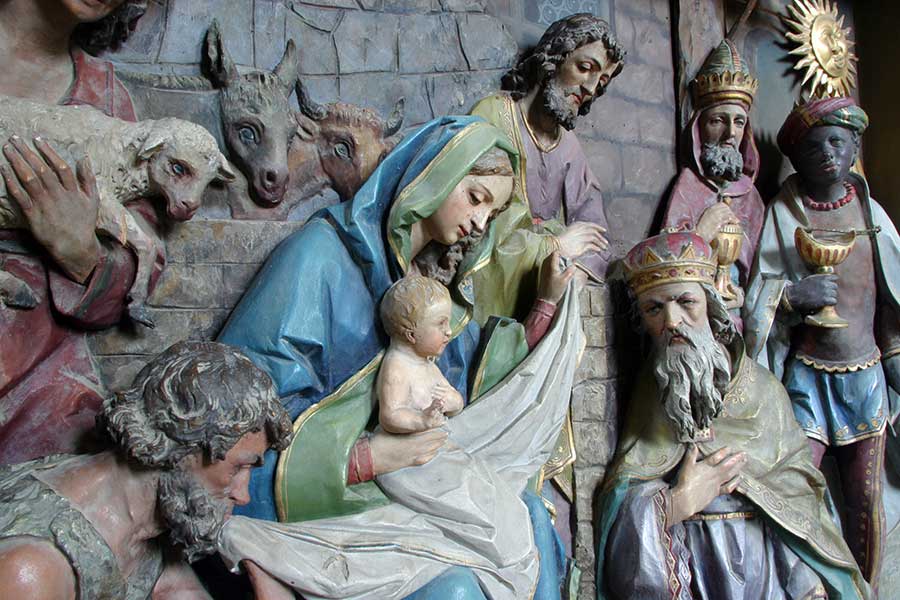
on the Divine Promise Fulfilled by the Child of Bethlehem by James M. Kushiner

31.2—March/April 2018
The Transmission of Christianity Is Not a New Task by Nathanael Devlin

33.2—March/April 2020
Encounters with Faith & Forgiveness in Communities of Faith by Nicole M. King
calling all readers
Please Donate
"There are magazines worth reading but few worth saving . . . Touchstone is just such a magazine."
—Alice von Hildebrand
"Here we do not concede one square millimeter of territory to falsehood, folly, contemporary sentimentality, or fashion. We speak the truth, and let God be our judge. . . . Touchstone is the one committedly Christian conservative journal."
—Anthony Esolen, Touchstone senior editor
