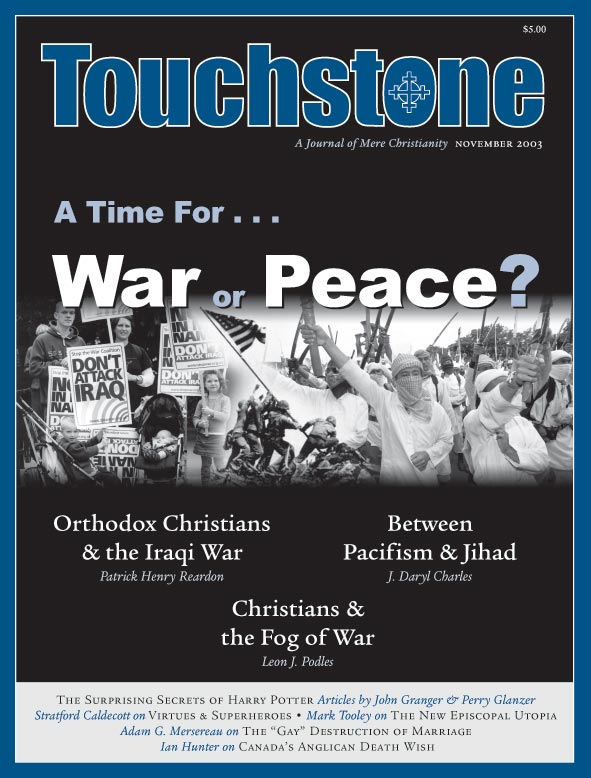
Declining Spirits
The Self-Inflicted Wounds of the Anglican Church
by Ian Hunter
The collapse of the Anglican Church in Canada has been swifter than its detractors predicted, more abject than its adherents can credit. StatsCan reported recently that in the decade 1991–2001, the Anglican Church lost more than 150,000 members approaching 10 percent of its total membership. Worse, this is only formal membership; the drop in actual church attendance has been far steeper. And since 2001, the pace of decline has accelerated.
I take no pleasure in writing this. I am a long-term Anglican, baptized and nurtured within that church, albeit now casting about for some more secure denominational anchorage in which to face the oncoming tempests.
Why? What precipitated it? Three developments, I suggest, all rooted in a desire to obey the “spirit of the age” as seen by a certain sort of churchman, a spirit the people who have hitherto filled the pews are far less inclined to follow.
Banality & Duplicity
First came a revolution that began in the 1960s with the promise of “relevance” and petered out in the nineties with the reality of mind-numbing banality. This is most clearly seen in the rejection of classic Anglican worship for new forms that (their advocates energetically claimed) better met the needs and desires of “the modern person.” For centuries, the defining feature of Anglican worship was that it was “common”; I do not mean that it was low or meretricious but that it was universal. One could worship anywhere in the English-speaking world and expect worship to be conducted in a language that conveyed the numinous.
Why? Because the Liturgy would have been based on Thomas Cranmer’s Book of Common Prayer. Shakespeare knew the prayer book; it appeared 15 years before his birth, and his plays and sonnets resonate with its phrases and cadences. Even as late as 1962, the Canadian Book of Common Prayer was dedicated (in the Preface) “to the reverent and seemly worship of Almighty God.”
But what had satisfied worshipers for centuries was seen as inadequate in the 1970s. Trendy priests (often under pressure from trendy bishops) abandoned the Prayer Book for a green book infelicitously called The Book of Alternative Services (BAS). The green book featured politically correct prose, a palsy-walsy approach to the Almighty, and liturgies written by and for the tone deaf. In most Anglican churches, the green book soon became the Only Book of Services. The dumbing-down of theology evident throughout the BAS sat easily with graduates from almost all the Anglican seminaries, institutions where ideology had come to trump theology.
The precipitate decline in Anglican attendance coincides with the coming of the BAS. Parishioners, who had once come to church hungry for transcendence, now found enforced jollity and egalitarian claptrap the order of the day. They voted with their feet.
A second cause of decline was the duplicity of Anglican bishops over the residential schools litigation. From the beginning, everyone who considered the issue realized that most of the claims of physical and sexual abuse and cultural genocide were spurious. Yet it suited the bishops to pretend that they were all genuine, in order (a favorite phrase) “to show solidarity with our native sisters and brothers in Christ.” Put simply, the church subordinated the truth to political correctness. That was disillusioning.
Ian Hunter is Professor Emeritus in the Faculty of Law at the University of Western Ontario. He is the author of biographies of Robert Burns, Hesketh Pearson, and Malcolm Muggeridge.
A Journal of Mere Christianity—Delivered to Your Door
- Essays on theology, culture, and the Church
- Contributors from across the Christian traditions

Six print issues (one year) of Touchstone, plus full online access and PDF downloads for only $39.95.

Get a one-year full-access subscription to the Touchstone online archives for only $19.95.
bulk subscriptions
Order Touchstone subscriptions in bulk and save $10 per sub! Each subscription includes 6 issues of Touchstone plus full online access to touchstonemag.com—including archives, videos, and pdf downloads of recent issues for only $29.95 each! Great for churches or study groups.
Transactions will be processed on a secure server.
more from the online archives

calling all readers
Please Donate
"There are magazines worth reading but few worth saving . . . Touchstone is just such a magazine."
—Alice von Hildebrand
"Here we do not concede one square millimeter of territory to falsehood, folly, contemporary sentimentality, or fashion. We speak the truth, and let God be our judge. . . . Touchstone is the one committedly Christian conservative journal."
—Anthony Esolen, Touchstone senior editor