




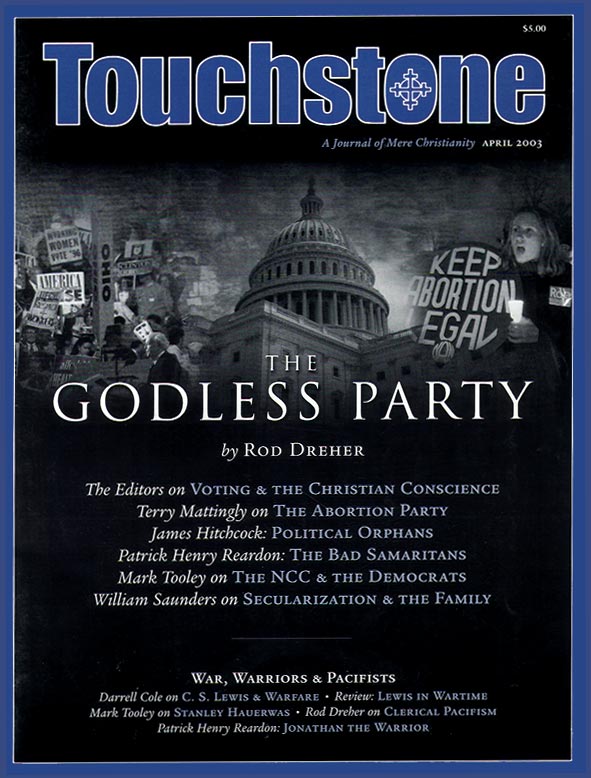
Feature
The Good of Religion
What the Facts Show About Religion, Marriage & Society
It is odd that the Democratic Party has become the party of secularism. It is odd because it is unwise. After all, the practice of religion is critical to a flourishing society. Hostility to religion—shown by Bolce and De Maio to be common among Democratic Party elites—is hostility to a healthy society.
Religion, simply put, is a human good. It is good for individuals, and it is good for society. Beyond the question of whether a particular religion is true, social science research has shown that religious practice has many measurable benefits.
The practice of religion (1) increases one’s sense of personal well-being, (2) contributes significantly to physical health, (3) is a significant predictor of future earnings potential, and (4) decreases drug and alcohol use.1
The practice of religion plays a significant part in increased life expectancy,2 and significantly decreases the rate of suicide.3 It also plays a significant role in binding local communities together.4 Youth who practice religion are less likely to cohabit and are more likely to marry.5
Marriage is itself, of course, an important social good. Married people (1) are happier, (2) experience better emotional as well as physical health, and (3) have higher incomes and greater assets than unmarried people. Married women suffer the lowest rates of physical abuse.6 Children are safer when living in a married household. Such children are less likely to engage in premarital sexual activity, and they have greater educational success.7
Correspondingly, (1) single mothers are more likely to live in poverty and to have emotional problems; (2) single fathers are likely to have less education and income; and (3) children living in single-parent families are likely to suffer economically.8
However, the institution of marriage has been greatly weakened in our society over the past 30 years. In 1996, the marriage rate was the lowest it has ever been. Based on current rates, 50 percent of marriages will end in divorce. Between 1970 and 1996, the percentage of children living with a single parent increased from 11.9 percent to 25.4 percent.9
Divorced women and their children are more likely to suffer from serious depression. These children are themselves more likely to divorce when they marry.10
Religion is a significant factor in decreasing the chances of divorce. “Regular church attendance is the critical factor in marital stability across denominations and overrides effects of doctrinal teaching on divorce.”11 Furthermore, youth who practice religion are less likely to engage in premarital sex.12 This, in turn, significantly decreases the chance of divorce when they subsequently marry.13
Religion clearly is a social good, contributing significantly to the health of individuals, strengthening marriages (as well as the institution of marriage), and decreasing the risk that individuals will engage in antisocial behavior. In these and in many other ways religion strengthens society.
William L. Saunders is Senior Vice President and Senior Counsel at Americans United for Life.
A Journal of Mere Christianity—Delivered to Your Door
- Essays on theology, culture, and the Church
- Contributors from across the Christian traditions

Six print issues (one year) of Touchstone, plus full online access and PDF downloads for only $39.95.

Get a one-year full-access subscription to the Touchstone online archives for only $19.95.
bulk subscriptions
Order Touchstone subscriptions in bulk and save $10 per sub! Each subscription includes 6 issues of Touchstone plus full online access to touchstonemag.com—including archives, videos, and pdf downloads of recent issues for only $29.95 each! Great for churches or study groups.
Transactions will be processed on a secure server.
more on marriage from the online archives


29.1—Jan/Feb 2016
on Marriage, Moral Corruption & the Christian Duty of Witness by Regis Nicoll
more from the online archives
28.5—Sept/Oct 2015
Remembering Angka & the Idolatry of the Khmer Rouge 40 Years Later by Les Sillars

15.6—July/August 2002
Things Hidden Since the Beginning of the World
The Shape of Divine Providence & Human History by James Hitchcock
calling all readers
Please Donate
"There are magazines worth reading but few worth saving . . . Touchstone is just such a magazine."
—Alice von Hildebrand
"Here we do not concede one square millimeter of territory to falsehood, folly, contemporary sentimentality, or fashion. We speak the truth, and let God be our judge. . . . Touchstone is the one committedly Christian conservative journal."
—Anthony Esolen, Touchstone senior editor
