




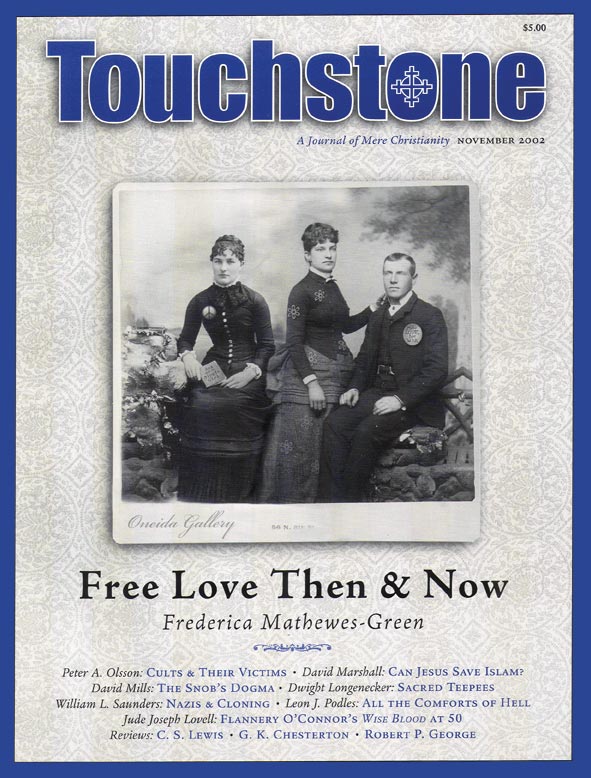
The Snob’s Dogma
David Mills on Modernizing the Gospels
In the 1930s, the New Testament scholar Rudolf Bultmann declared that people who use electric lights cannot believe in the supernatural world described in the Bible. He meant that modern man cannot believe in the biblical miracle stories, including the story of the Incarnation. This assertion he did not, as far as I know, ever defend, yet it justified his attempt to “de-mythologize” the Bible.
It certainly seems a dubious idea, aside from the plain fact that all sorts of learned men and women flip light switches and believe in God at the very same time. Even if one asserts, as I think Bultmann would have done, that these people have somehow kept a premodern mind while living in the modern world, the idea that greater knowledge of the world around us must change our knowledge of the other world does not make sense. That we can in nature discover and use forces like electricity does not mean that we have made up the story of a supernature that has revealed itself to us. If anything, it suggests the opposite, for a design of such complexity implies the existence of a Designer.
In our own day, an Episcopal bishop has said the same thing and said it as bluntly as Bultmann. He declared that people who fly in jet airplanes cannot believe in the God of the Bible, although (1) a lot of us do both and are actually intelligent (he would doubt this), and (2) the invention of the jet engine can tell us nothing whatever about whether the Son of God became man.
That we can do more and more in the world does not tell us who or what created and maintains the cosmos. You might as well say that the people who first used rocks to grind their corn could no longer believe in the gods of their fathers, or that the bishop’s children cannot accept his God—whoever, exactly, that is—because the computer was invented after he was born. Or the space shuttle, digital television, and fluoride toothpaste.
To claim the authority of science to justify liberalism is cheating. “A man can be a Christian at the end of the world, for the simple reason that a man could have been an atheist from the beginning of it,” G. K. Chesterton explained in All Things Considered. The case for atheism was the obvious one and did not need modern science at all.
A man who has lived and loved falls down dead and the worms eat him. That is materialism if you like. That is atheism if you like. If mankind has believed in spite of that, it can believe in spite of anything. But why our human lot is made any more hopeless because we know the names of all the worms that eat him, or the names of all the parts of him that they eat, is to a thoughtful mind somewhat difficult to discover.
The skeptics usually invoke modern man’s greater knowledge of the physical world and try to associate belief in the Christian God with belief in a flat earth. They often use the tools of sociology and psychology to explain away religious belief, as when they claim that people believed in spiritual creatures like demons because they did not know anything about abnormal psychology. Sometimes they insist that modern man’s greater tolerance is proof that the old views can no longer be held, though the number of people killed by their governments in the last century makes this claim, to use the current academic jargon, “problematic.”
In any case, it is a silly idea, the claim that new inventions have made religious belief impossible, but it is the idea upon which much modern liberalism rests.
The Modern Mind
It is a settled conviction of a certain sort of modern mind—which tends to call itself the modern mind, to put the rest of us in our place—that something happened in the last few hundred years to make the Bible fundamentally unbelievable. For Dr. Bultmann this event is symbolized in the electric light, for the bishop in the jet airplane.
David Mills has been editor of Touchstone and executive editor of First Things. He edits the opinion page of the Pittsburgh Post-Gazette.
A Journal of Mere Christianity—Delivered to Your Door
- Essays on theology, culture, and the Church
- Contributors from across the Christian traditions

Six print issues (one year) of Touchstone, plus full online access and PDF downloads for only $39.95.

Get a one-year full-access subscription to the Touchstone online archives for only $19.95.
bulk subscriptions
Order Touchstone subscriptions in bulk and save $10 per sub! Each subscription includes 6 issues of Touchstone plus full online access to touchstonemag.com—including archives, videos, and pdf downloads of recent issues for only $29.95 each! Great for churches or study groups.
Transactions will be processed on a secure server.
more from the online archives


37.5—Sept/Oct 2024
The Death of Conservatism & the Negative World by J. Douglas Johnson
32.5—September/October 2019
Some Trivial Thoughts on the Study of Philosophy by Graeme Hunter
calling all readers
Please Donate
"There are magazines worth reading but few worth saving . . . Touchstone is just such a magazine."
—Alice von Hildebrand
"Here we do not concede one square millimeter of territory to falsehood, folly, contemporary sentimentality, or fashion. We speak the truth, and let God be our judge. . . . Touchstone is the one committedly Christian conservative journal."
—Anthony Esolen, Touchstone senior editor
