Our Food from God by Christopher Killheffer

Our Food from God

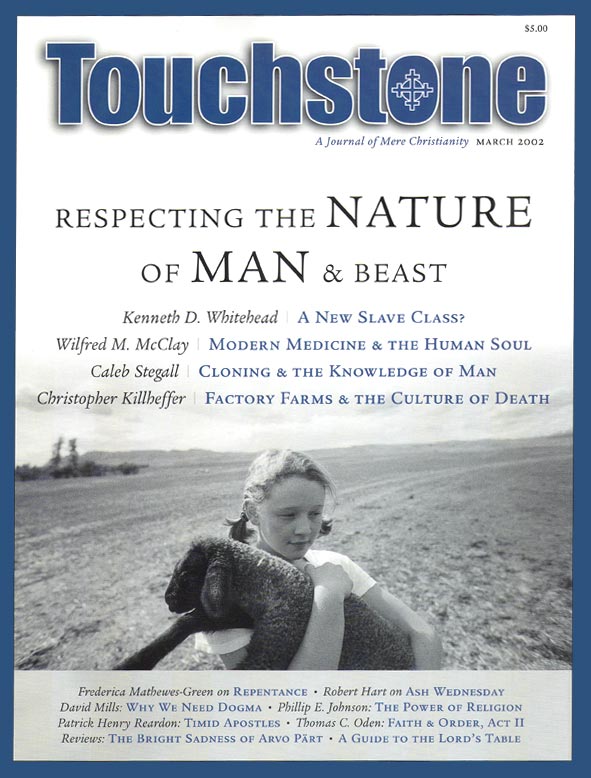
Factory Farms & the Culture of Death

by Christopher Killheffer

Now what is it moves our very hearts and sickens us so much at cruelty to poor brutes? . . . There is something so very dreadful, so satanic in tormenting those who have never harmed us, and who cannot defend themselves, who are utterly in our power, who have neither weapons of offence nor defence, that none but very hardened persons can endure the thought of it. . . . Think then, my brethren, of your feelings at cruelty practised on brute animals, and you will gain one sort of feeling which the history of Christ’s Cross and Passion ought to excite within you.1

Cardinal Newman, here in a Good Friday sermon, draws on a common and natural moral sense as a means of contemplating the mystery of our Savior’s Passion. Yet today many Christians—even those who think of themselves as serious or “orthodox” Christians—take the stance, more or less without thought, that the particular natural sensibility which “sickens us so much at cruelty to poor brutes” is one which ought to be mortified. The idea, or at least the implication, is that this sense is somehow illusory or false, that it is merely sentimental and therefore to be put aside. We assume that this natural sensitivity towards animal suffering must give way to an industrial progress that benefits mankind.

In practice, this attitude, whether it be justified or not, is the device by which Christians avoid the unpleasant thought of animal suffering—suffering which today exists in forms and on a scale unimaginable in Newman’s time. As a result many Christians, committed to indifference, remain ignorant of the suffering that is inflicted by the current system of agriculture and animal husbandry. This is a morally dangerous situation because the current agricultural system is one in which we all play a vital role. The industry responsible for inflicting the suffering exists only because of consumer support for it. The industry acts on our behalf; Christians will find no neutral ground. One must decide to support the system or to resist it.

The natural abhorrence of animal suffering, as a sentiment, is not sufficient, of course, to settle the matter. But then the notion that indifference must be maintained in support of industrial progress is no less a sentiment, and one which does not even have the advantage of being a natural one. We cannot rely on either of these sentiments alone to answer our question: Is there a justification for the current system based on Christian morality?

Factory Farms

The ignorance of what happens on modern factory farms is widespread. The majority of the billions of animals raised and slaughtered in the United States are raised according to the new methods of “agribusiness,” methods developed and applied only during the last 50 or 60 years. The goal has been to increase productivity and profits by minimizing the need for the two things which had defined agriculture and animal husbandry for millennia: land and labor.

To this end, the raising of livestock—primarily pigs, chickens, and veal calves—was shifted from outdoor fields and pens to the darkened, mechanized interior of massive hangars. In these hangars, overcrowding and forced inactivity are the rule. Meat chickens are packed into these hangars to the standard of one 3.5-pound bird per square foot. Pigs are kept in small, stacked cages designed to severely restrict movement. Complete immobility is imposed on sows for long periods; for veal calves and egg-laying hens the forced immobility is for life. There is nothing in these hangars of the traditional associations of the barn: no hay, no bedding, no open space. Food and water are distributed mechanically. These conditions provoke behavior in animals that is unnatural; cannibalism, for example, is common among both chickens and pigs. In order to reduce the instances of cannibalism, producers remove teeth from pigs and burn all or part of the beaks off chickens.

This situation is very different from that of a man beating a dog in anger or out of a perverse desire to inflict suffering. Few Christians would hesitate to condemn such malicious behavior. The suffering caused on factory farms does not result directly from malice, but rather from depriving animals of the things that normal (either domesticated or wild) animal life requires.

The industrial system operates according to a notion that equates animals with machines or commodities, factory products which have needs only insofar as we would like to maximize efficiency in one aspect of their life for our benefit. It is acknowledged, for instance, that they have a need for food only because we wish them to put on weight. This notion is the premise behind the system and the root of all the suffering that it inflicts. Does this notion have a Christian basis?


Christopher Killheffer works at Yale University Library and on a farm near New Haven, Connecticut, where he is a parishioner of St. Mary's Church.

A Journal of Mere Christianity—Delivered to Your Door

  • Essays on theology, culture, and the Church
  • Contributors from across the Christian traditions

Subscribe (Print + Online)

Six print issues (one year) of Touchstone, plus full online access and PDF downloads for only $39.95.

Subscribe (Online Only)

Get a one-year full-access subscription to the Touchstone online archives for only $19.95.


bulk subscriptions

Order Touchstone subscriptions in bulk and save $10 per sub! Each subscription includes 6 issues of Touchstone plus full online access to touchstonemag.com—including archives, videos, and pdf downloads of recent issues for only $29.95 each! Great for churches or study groups.

Transactions will be processed on a secure server.


more on culture from the online archives
20.7—September 2007

Retaking Mars Hill

Paul Didn’t Build Bridges to Popular Culture by Russell D. Moore

31.2—March/April 2018

Millennial Mission

The Transmission of Christianity Is Not a New Task by Nathanael Devlin

29.3—May/June 2016

The Master's Voice

Our Choice Is Obedience or Jesus as Anti-Christ by Anthony Esolen


more from the online archives

32.6—November/December 2019

Listening Up

Historical Truth, Beguiling Stories & Three Kinds of Hearers by Anthony Esolen

31.6—November/December 2018

Of Single Importance

on the Church's Response to the Anti-marriage Tide by Diane Woerner

30.3—May/June 2017

Known Trespassing

on the Misuse of Property Rights to Justify Slavery & Abortion by Robert Hart

calling all readers

Please Donate

"There are magazines worth reading but few worth saving . . . Touchstone is just such a magazine."
—Alice von Hildebrand

"Here we do not concede one square millimeter of territory to falsehood, folly, contemporary sentimentality, or fashion. We speak the truth, and let God be our judge. . . . Touchstone is the one committedly Christian conservative journal."
—Anthony Esolen, Touchstone senior editor

Support Touchstone

00