




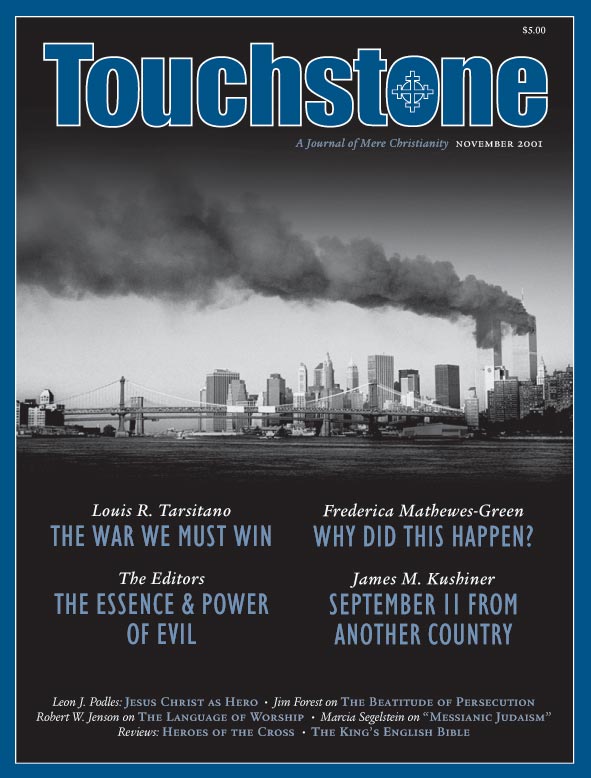
The King’s English Bible
Wide as the Waters: The Story of the English Bible and the Revolution It
Inspired
by Benson Bobrick
New York: Simon and Schuster, 2001
(379 pages; $26.00, cloth)
In the Beginning: The Story of the King James Bible and How It Changed
a Nation, a Language, and a Culture
by Alister McGrath
New York: Doubleday, 2001
(340 pages; $24.95, cloth)
reviewed by Preston Jones
Have you, from time to time, seen a man fall flat on his face and lick the dust? I don’t mean to put words in your mouth, but, here in the land of the living, have you ever expected a man to go from strength to strength only to see him end up, perhaps because pride goes before a fall, succeeding only by the skin of his teeth? Or have you ever considered a person to be a mere thorn in the flesh, only to discover, once the scales fell from your eyes, that he was in fact the salt of the earth?
Whether or not you have had experiences such as these, you have almost surely heard or said the italicized phrases, and that’s because they are found in the King James Version (KJV) of the Bible, the Scripture translation that reigned among English-speakers from the mid-seventeenth through the late-twentieth century, when the New International Version overtook it at the sales counter. To this day, politicians say that they are “fighting the good fight,” mothers tell their children to “turn the other cheek,” and vacationers refer to their respective paradises as lands of “milk and honey.”
As Alister McGrath points out in In the Beginning, only Shakespeare has had an influence on modern English approaching that of the King James Bible. So there is some justice in the complaint, often heard (in this instance by Richard John Neuhaus), that “English-speaking Christians have largely lost a common biblical vocabulary as a consequence of the proliferation of translations.”
The point is well taken and is obviously right, but there is another way of looking at it. For example, when I was a child, I read from the Living Bible (a paraphrase) at home and learned from the KJV in Sunday school. As a young teen I went to a church that used the New American Standard, though I read, initially, from the New International Version and later from the King James. In the Navy I read the Bible mostly in a modern French translation, and in later years I used the Amplified and Phillips versions. Nowadays I mostly use contemporary French and Welsh versions, along with the Gospels in the Vulgate, though when I do read in English, I opt for the old KJV, with Moffatt’s New Testament occasionally tossed in. My Anglican parish in Canada employed the New King James Version, while my parishes in northern California and Texas promote the Revised Standard Version.
The upshot is that, for me (and for many like me), differences between responsible translations have come to seem insignificant. It’s true that, since no standard phrases are held in common among the various translations, a common biblical vocabulary is impossible save among members of particular churches or denominations. But perhaps the content of a passage, being rehearsed in different ways, sticks more readily in the mind. It is, after all, a common experience for a reader to gain insight into a passage after reading it in a translation with which he’s unaccustomed. In any event, when a person is exposed to several translations, he comes to rely less on a particular translation’s figures of speech. This in itself may be a good thing. By the mid-nineteenth century, numerous phrases taken from the King James Version were in regular play in the public sphere, though, emptied of their original content, they became mere catchphrases. (Of course, today’s common language comes chiefly from television.)
But in the first instance, was it a good idea for the Bible to be made widely available? McGrath, more than popular historian Benson Bobrick, maintains that corruption and ignorance among the clergy in pre-Reformation England were fairly widespread and that the common folk were thus deprived of authentic Christianity. He frequently points out that the vast majority of Christians in the late Middle Ages and early modern period couldn’t read Latin, the language of international politics, academic discourse, and the Bible. Most of God’s people, that is, were shut out from God’s Word in written form. But in early modern England, the printing press, a growing sense of English identity, and the winds of reform combined to get the Bible into the hands of ordinary men and women. The Bible was a liberator.
There were political ramifications as well. In Wide as the Waters Bobrick writes that the inspiration for the American Revolution must be traced to the Protestant idea that every man should have access to the Bible in his own language. The “light” of the Revolution and the glorious human rights it wrought, Bobrick suggests, “was a biblical light, which the English Bible had given them: the idea of the equality of man. . . . It was the idea of the sacred and equal importance of every man, as made in the image of God.”
On the other hand, consider the myriad Protestant denominations listed in your telephone book and the fact that, to this day, many believers who agree on the fundamentals of the faith act and speak—clinging to proof texts—as if they do not. The fact that mid-nineteenth-century northern and southern Americans read from the same Bible did not stop them from blowing each other’s heads off in the American Civil War. The Bible was a source of liberty, but thanks to the human condition, it was also used as a weapon. Confederates and Yankees ransacked their Bibles to justify their respective causes and likely made a tidy contribution thereby to the secularization process. So in political terms at least, the answer to the question—was it a good idea for the Bible to be made widely available?—seems to be both yes and no.
Preston Jones teaches history at John Brown University.
A Journal of Mere Christianity—Delivered to Your Door
- Essays on theology, culture, and the Church
- Contributors from across the Christian traditions

Six print issues (one year) of Touchstone, plus full online access and PDF downloads for only $39.95.

Get a one-year full-access subscription to the Touchstone online archives for only $19.95.
bulk subscriptions
Order Touchstone subscriptions in bulk and save $10 per sub! Each subscription includes 6 issues of Touchstone plus full online access to touchstonemag.com—including archives, videos, and pdf downloads of recent issues for only $29.95 each! Great for churches or study groups.
Transactions will be processed on a secure server.
more from the online archives

28.2—March/April 2015
Man, Woman & the Mystery of Christ
An Evangelical Protestant Perspective by Russell D. Moore
21.6—July/August 2008
Benedict XVI on the Crisis of Faith & Reason by Samuel Gregg
19.8—October 2006
on the Good Father’s Quiet Desperation by Russell D. Moore
calling all readers
Please Donate
"There are magazines worth reading but few worth saving . . . Touchstone is just such a magazine."
—Alice von Hildebrand
"Here we do not concede one square millimeter of territory to falsehood, folly, contemporary sentimentality, or fashion. We speak the truth, and let God be our judge. . . . Touchstone is the one committedly Christian conservative journal."
—Anthony Esolen, Touchstone senior editor
