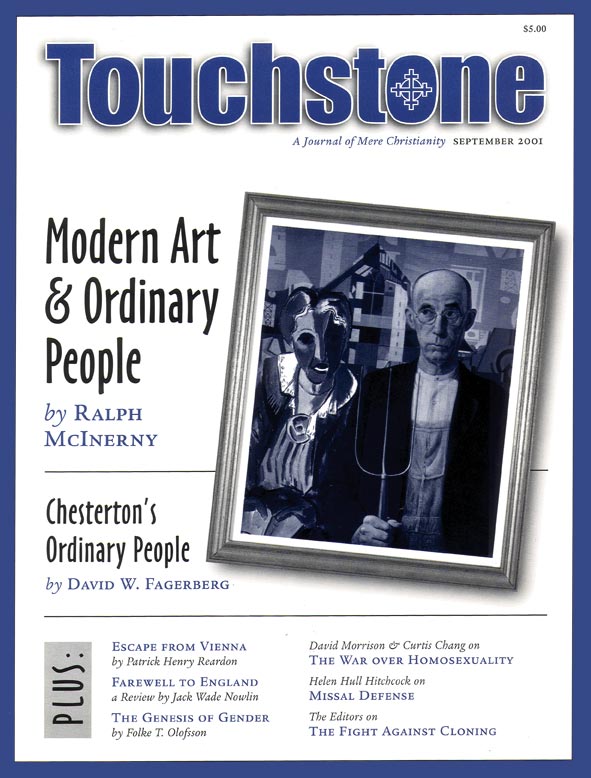
Art for the Masses
The Death of Culture & the Culture of Death
by Ralph McInerny
Delmore Schwartz has a memorable line: “In dreams begin responsibilities.” What is true of the individual is true of the culture as well. Imagination is a prelude to action. In this paper I examine the role literature has played in bringing about the Culture of Death. That culture denies that every human life has value and is willing to sacrifice some human lives for the alleged benefit of others. Literature both effects and reflects the transition.
The works of what is called the Western canon were produced in the cultural ambience of Christendom and thus shared an outlook on human agents and what they were destined for. Thus C. S. Lewis gave it as a bonus of his conversion that he now shared the faith of the authors he studied. Dante, in his dedicatory letter to Can Grande della Scala, advises that his great poem can be read in the way the Bible is. There is a literal meaning, and there is an allegorical meaning as well. The literal meaning is the state of souls after death. The allegorical meaning is that human beings, by what they freely do, determine their eternal condition, whether of happiness or damnation. In some sense Dante’s work was inspired as the Bible was—there is Beatrice behind it all, and Virgil of course, a gathering up of the gospel and what preceded it. The writers of the Bible were inspired by the Holy Ghost. George Bernard Shaw said he believed that the Bible was inspired by the Holy Ghost, but then he believed that all other books were as well. This quip separates him from, rather than links him to, Dante. The secularization of culture is accompanied by the secularization of the arts. The latter was a long process, but it reaches a culmination in what is called modernity.
My thoughts on modern art were stimulated by reading John Carey’s The Intellectuals and the Masses and pursuing various leads he gives. The thesis is this: Those who sought to kill culture for the common man display a disturbing disposition to want to get rid of the common man—whom they regard as already dead.
Dead Letters
When I first read Ortega y Gassett it was with keen delight, but now when I go back to him I am appalled at what he has to say and repentant of my earlier enthusiasm. In a 1948 essay called “The Dehumanization of Art,” Ortega makes explicit the aesthetic implications of his contempt for ordinary folk that was already palpable in The Revolt of the Masses.
Ortega, in The Revolt of the Masses, sounds like an advance man for Planned Parenthood or Zero Population Growth. There are just too many people, and he regards them with undisguised loathing. I still have the little 35-cent reprint of the book I bought half a century ago. On its cover one finds this: “With Western populations tripled in the last 100 years, a powerful new phenomenon has arisen—the mass-man. Can Western culture survive his encroachments? Will democracy crumble into mediocrity and chaos?” The book was published in 1930. It opens with a scary scenario.
Towns are full of people, houses full of tenants, hotels full of guests, trains full of travelers, cafés full of customers, parks full of promenaders, consulting-rooms of famous doctors full of patients, theaters full of spectators, and beaches full of bathers. What previously was, in general, no problem, now begins to be an everyday one, namely, to find room.1
That all these people should presume to crowd into the sacred precincts of art is something that must be prevented, and Ortega thinks this is just what modern art has done. On the back cover of my old edition of this book there is an ironic legend: “Good Reading for the Millions.” The Revolt of the Masses was one of the first mass-market paperbacks.
The mark of the modern in any art, Ortega argues, is that it thwarts the expectations of the ordinary man. His point is not that modern art attracts only a few, as if this were merely a contingent fact. Modern art, as he sees it, deliberately repels the many, and that is why reactions to it divide men into “two different varieties of the human species,” into “two orders or ranks: the illustrious and the vulgar.” The majority does not like modern art because it cannot understand it. One can, of course, dislike art that one understands, but something much deeper is involved here. “Modern art will always have the masses against it. It is essentially unpopular; moreover, it is anti-popular.” Such art challenges the assumption that men are equal.
A Journal of Mere Christianity—Delivered to Your Door
- Essays on theology, culture, and the Church
- Contributors from across the Christian traditions

Six print issues (one year) of Touchstone, plus full online access and PDF downloads for only $39.95.

Get a one-year full-access subscription to the Touchstone online archives for only $19.95.
bulk subscriptions
Order Touchstone subscriptions in bulk and save $10 per sub! Each subscription includes 6 issues of Touchstone plus full online access to touchstonemag.com—including archives, videos, and pdf downloads of recent issues for only $29.95 each! Great for churches or study groups.
Transactions will be processed on a secure server.
more on culture from the online archives

more from the online archives
calling all readers
Please Donate
"There are magazines worth reading but few worth saving . . . Touchstone is just such a magazine."
—Alice von Hildebrand
"Here we do not concede one square millimeter of territory to falsehood, folly, contemporary sentimentality, or fashion. We speak the truth, and let God be our judge. . . . Touchstone is the one committedly Christian conservative journal."
—Anthony Esolen, Touchstone senior editor